Coding agents succumb to context decay soon after exceeding a few hours.
Coding agents lose effectiveness after just a few hours of use.
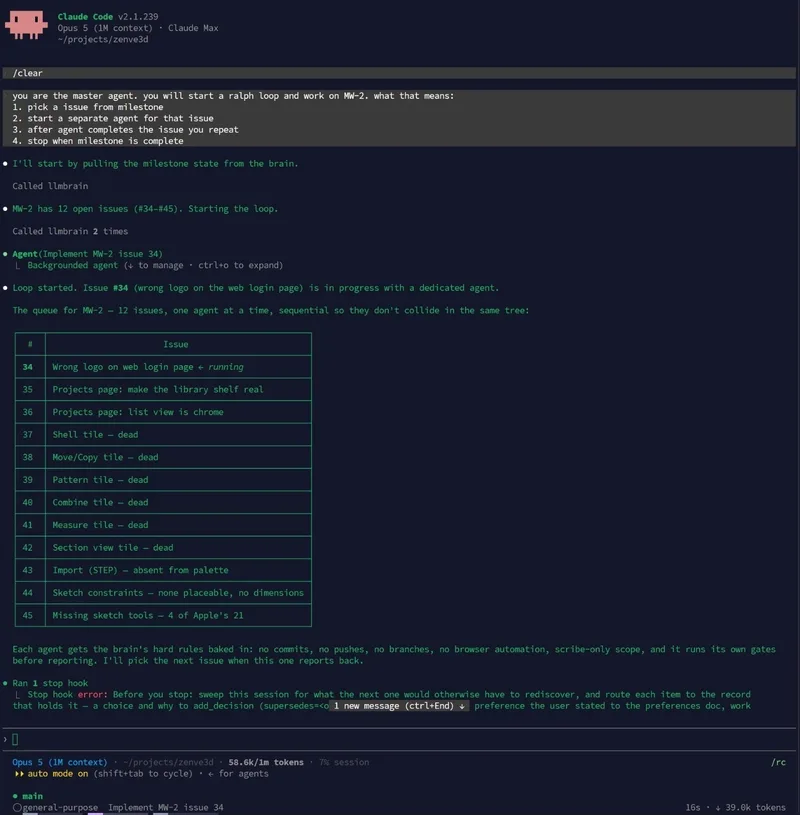
Performance drops sharply within the first three hours. They begin repeating code written earlier in the same session, abandoning their own design decisions, and enter cycles of fixing problems they created moments before. The issue isn’t the model’s limitations—it’s how sessions degrade over time.
Context decay erodes an agent’s reliability long before its window fills. The problem stems from accumulated noise: outdated files, abandoned reasoning chains, and repetitive chatter overwhelm the model’s ability to focus. Even with large context windows, an agent’s judgment deteriorates before the window is fully utilized. Retrieval accuracy declines, instructions weaken, and earlier mistakes are treated as unquestionable truth. No prompt adjustment can reverse this—only strict session discipline works.
The solution requires a different approach than longer prompts. A Ralph loop—named after Ralph Wiggum’s simplicity in The Simpsons—avoids extended sessions entirely. It uses a minimal bash script:
while :; do
  cat PROMPT.md | claude -p
done
This method runs the agent in repeated, isolated sessions. Each iteration starts fresh, reads a task plan, handles one unfinished step, logs progress to disk, then exits. The loop restarts immediately, ensuring no single session grows unwieldy. The approach treats each context window as a finite, precious resource rather than a growing repository of information. While individual iterations may introduce noise, the overall direction remains consistent because each starts with a clean slate.
For real-world use, external memory is essential. A local PROMPT.md file alone will eventually misalign with project reality, forcing the agent to re-examine past decisions. A hosted solution like LLMBrain, an MCP server, provides persistent project state across sessions. This ensures the agent retains high-level understanding between loops.
Deploying a coding agent this way means abandoning the idea of a single "smarter" long-running agent. Instead, focus on building a resilient loop where only external side effects—committed files, git pushes, or TODO.md updates—persist. The model itself remains stateless, with each task handled in isolation.
All Replies (3)
Want a live back-and-forth? Join the global AI chat room — login to talk.
This is a nightmare. Does gating the output actually stop duplicate side effects? Try isolating each attempt in a fresh session with while :; do cat PROMPT.md | claude -p; done, so stale context doesn’t compound the problem.
It's infuriating when they start hallucinating imports. Has anyone found a way to lock the file paths?
One concrete step that helps is to wrap the agent in a bare-bones bash loop that restarts a fresh session every iteration: while :; do cat PROMPT.md | claude -p; done. This way, each run starts with a clean context window instead of accumulating stale files and contradictions from earlier in the session.
Maintaining plan files can quickly turn into a mess, especially when debugging drags on for hours. The real challenge isn’t just the handoff logic—it’s how easily agents lose focus after prolonged sessions. Like Ralph Wiggum’s charm, the solution might lie in simplicity: just restart the session with a fresh context window every time you need to pick up where you left off, ensuring no stale files or contradictory reasoning clutter the current task. The key isn’t making one session smarter—it’s treating each iteration as a clean slate.