Capability Card Stone 1.0 keeps multi-agent chaos under control
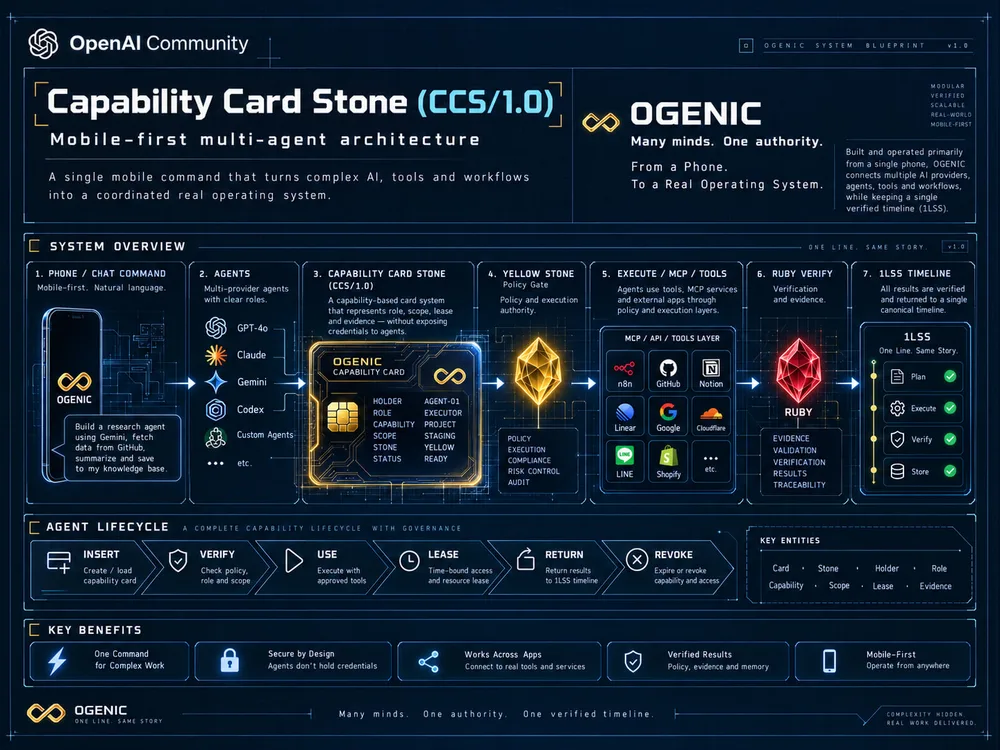
Most multi-agent setups are a nightmare of overlapping permissions where every agent basically has a key to the house and hopes for the best. Capability Card Stone (CCS/1.0) tries to fix this by treating authority like a physical token rather than a vague permission string. The goal is a "mobile-first" architecture where a user sends one command from a phone and a swarm of agents handles the rest, but only one "canonical line" actually records what happened and what is verified.
How does the "Card and Stone" logic actually work?
Instead of giving an agent a full API key or a broad role, CCS uses a scoped capability language. Think of the "Card" as a specific ticket and the "Stone" as the turnstile. The agent doesn't need to understand the underlying infrastructure; it just presents the Card to the Stone to get through.
The system operates on a very strict lifecycle:INSERT → VERIFY → USE → LEASE → RETURN → REVOKE
If an agent needs to do something, it doesn't just "have" the power. It must move through this sequence. The most interesting bit here is the "Lease" phase. If a specific execution source hits a limit or goes offline, an agent can request a compatible Card lease. This means it can get a temporary, bounded extension of authority with a specific lifetime and audit trail, rather than the developer just cranking up the permissions for the whole agent to stop it from crashing.
Why bother with a verified timeline?
In most agentic workflows, you have a "planning" agent, a "coding" agent, and an "execution" agent. The problem is that they often hallucinate success or silently fail, and the state becomes a mess of contradictory logs. CCS implements a verification layer that sits between the execution and the final record.
The logic is simple: an agent can do whatever it wants in the sandbox, but nothing gets written to the canonical session unless the verification layer signs off on the evidence. This prevents the "telephone game" effect where Agent A tells Agent B it finished a task, and Agent B tells the user it's done, while the actual code is still broken.
Where do MCP and n8n fit in?
A lot of people try to make the Model Context Protocol (MCP) or workflow engines like n8n the "brain" of the operation. CCS treats them as "execution fabrics." They are the muscles, not the nervous system. By pushing the control plane above the workflow engine, the architecture ensures that the human remains the only authority, and the agents are just temporary lease-holders of specific capabilities.
What happens when this fails?
The risk here is the "Stone" becoming a bottleneck. If the policy boundary is too rigid, agents will constantly trigger "Revoke" or fail at the "Verify" stage, leaving the user with a "Task Failed" message and no explanation. If the verification layer is too lenient, you're back to square one with uncontrolled agents.
To make this actually work on a mobile device, the "canonical timeline" has to be incredibly lean. You can't have a 50-page log of every thought the agent had; you only get the verified outcome and the minimum evidence required to maintain state. If the evidence is missing, the chain breaks, and the agent can't "Lease" further capabilities because it can't prove what it did previously.
Treating authority as a physical token solves the overlap issue. Just link the GitHub repo so we can test that mobile-first workflow.