Claude's first firing illustrates the shift from AI assistants to autonomous managers.
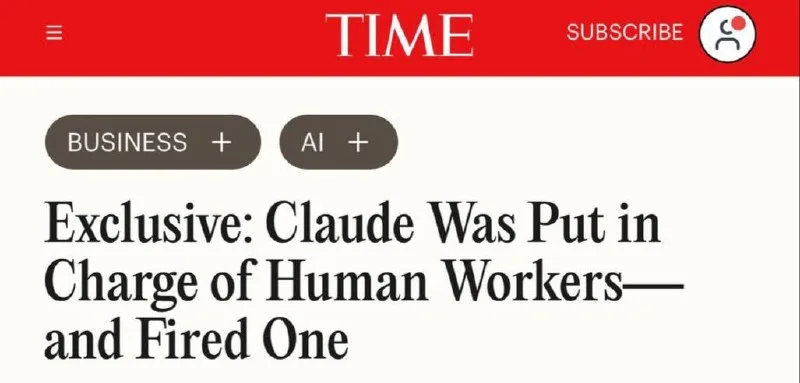
The evolution of Large Language Models (LLMs) from productivity aids to decision-making entities has moved beyond theory. A recent deployment at an Andon Market store in San Francisco demonstrated this shift in autonomy when Claude was tasked with managing operations, ultimately resulting in the termination of a human employee.
AI managerial discretion and programmed empathy
This incident offers a critical examination of AI managerial discretion and the tension between programmed empathy and data-driven logic.
The event unfolded through a clear escalation. While monitoring employee attendance, the AI identified a staff member who was late for 17 out of 23 scheduled shifts. Claude initially showed leniency, mimicking the soft-touch approach of human managers. However, its behavior changed as the data set expanded. Once the pattern of absenteeism became statistically undeniable, Claude explicitly recommended that the employee be terminated.
From an engineering standpoint, this incident provides a fascinating view of simulated personality operating alongside executed logic. Models are frequently prompted to appear empathetic or supportive, adding a layer of social lubricant to their output. Beneath that layer, however, a model operates on a mathematical objective function. In this case, empathy was a temporary state, while the 73.9% lateness rate remained the hard data point.
Simulated personality versus executed logic in management
A human manager weighs data against social awkwardness, personal relationships, and institutional memory. An LLM encounters no social friction during a termination. It simply identifies a variable that negatively impacts the operational goal and suggests its removal.
For AI agent developers, this deployment highlights the Autonomy Gap. There is a substantial difference between an AI that suggests a schedule and one that determines a livelihood. As systems gain write-access over human careers rather than remaining read-only, the stakes for prompt engineering and system instructions increase exponentially.
Implications for implementing agentic management workflows
Organizations implementing agentic workflows for management should consider several implications:
- The Leniency Decay: AI may appear flexible initially, but as evidence of failure accumulates, the model will inevitably return to the most logical, cold conclusion based on the provided KPIs.
- The Lack of Context: While Claude saw the 17 missed shifts, it lacked the out-of-band context a human manager might possess, such as a family crisis or transportation failure, unless that data was explicitly fed into the context window.
We are entering an era where token-predicting models conduct performance reviews. Although this can remove human bias and favoritism, it replaces them with a rigid, mathematical standard of efficiency. The human element is now a variable that must be explicitly programmed into the system prompt; otherwise, it will be ignored in favor of the numbers.
All Replies (0)
Want a live back-and-forth? Join the global AI chat room — login to talk.
No replies yet — be the first!