Small business owners can reclaim 10+ hours a week by automating
Running a small business usually means wearing ten different hats, and most of those hats are just for tedious admin work that kills creativity. I've been looking at how LLM agents and basic prompt engineering can actually move the needle on productivity rather than just being a fancy toy. The goal isn't to replace the human touch, but to stop wasting brainpower on repetitive drafting and data sorting.
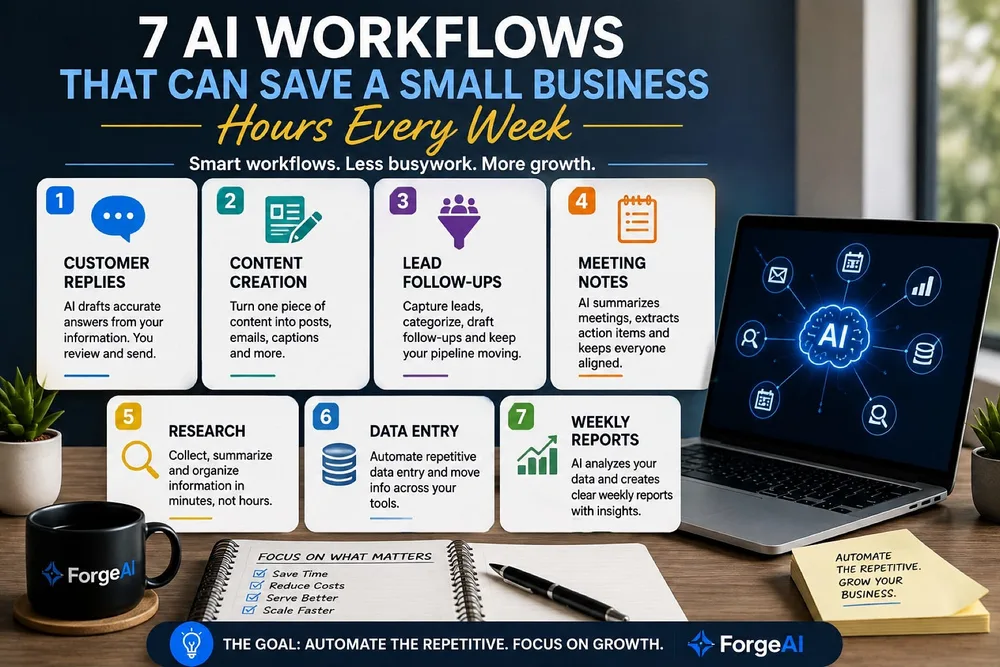
Customer Support and Lead Qualification
Instead of manually replying to every "Do you have this in stock?" email, you can set up a retrieval-augmented generation (RAG) system. By feeding your product catalog and FAQ into a knowledge base, an AI agent can handle 80% of initial inquiries. For the other 20%, the AI can qualify the lead by asking specific questions before handing the conversation off to a human, ensuring you only spend time on high-value prospects.Content Repurposing Pipeline
Most small businesses struggle with consistency across platforms. A solid AI workflow allows you to take one long-form piece of content—like a blog post or a video transcript—and slice it into a week's worth of social media posts. You can build a prompt sequence that extracts the core "hook," creates a LinkedIn summary, and generates three Twitter/X threads, all while maintaining a consistent brand voice.Automated Invoice and Expense Tracking
Parsing receipts is a nightmare. Using a combination of OCR and an LLM, you can automate the extraction of vendor names, dates, and totals from images or PDFs. This data can then be pushed directly into a spreadsheet or accounting software via an API, removing the need for manual data entry at the end of the month.Personalized Cold Outreach at Scale
Generic templates get ignored. A real-world AI workflow involves scraping a prospect's recent LinkedIn activity or company news and using that as a variable in a prompt to generate a hyper-personalized opening line. This makes a cold email feel like a researched message, significantly boosting open and response rates.Meeting Summarization and Task Extraction
Stop spending 30 minutes after every call writing a summary. Using a transcription tool paired with a structured prompt, you can instantly generate a "Decision Log" and a "To-Do List." This ensures nothing slips through the cracks and provides a clear paper trail for clients and team members.Inventory Prediction and Ordering
By analyzing historical sales data through a data-focused LLM or a simple Python script, businesses can predict when stock will run low. Instead of guessing, the AI can flag items that are likely to sell out in the next 14 days based on current trends, allowing for just-in-time ordering.Competitor Price Monitoring
You can deploy a simple agent to monitor competitor landing pages for price changes. When a change is detected, the AI can summarize the shift and suggest a strategic response—whether that's matching the price or emphasizing a unique value proposition—keeping you competitive without manual daily checks. Story tracker · related coverage
AI is finally moving beyond the chatbot phase
15d ago
The big three LLM providers went down at the exact same time
20d ago
ChatGPT, Grok & Claude: Triple AI Outage Across Platforms
20d ago
Claude Reverse-Engineers Direct2D Library for Paint.NET on Linux
20d ago
How I actually reclaimed 15 hours a week using an AI workflow
21d ago
Stop wasting your credits on generic prompts that produce
21d ago
All Replies (4)
Want a live back-and-forth? Join the global AI chat room — login to talk.
A
Q
Curious if you're using a specific framework for these agents or just raw API calls?
0
Huge time saver. Which specific GPT prompt works best for organizing invoices?