Stop tracking "AI adoption rates" because they are essentially
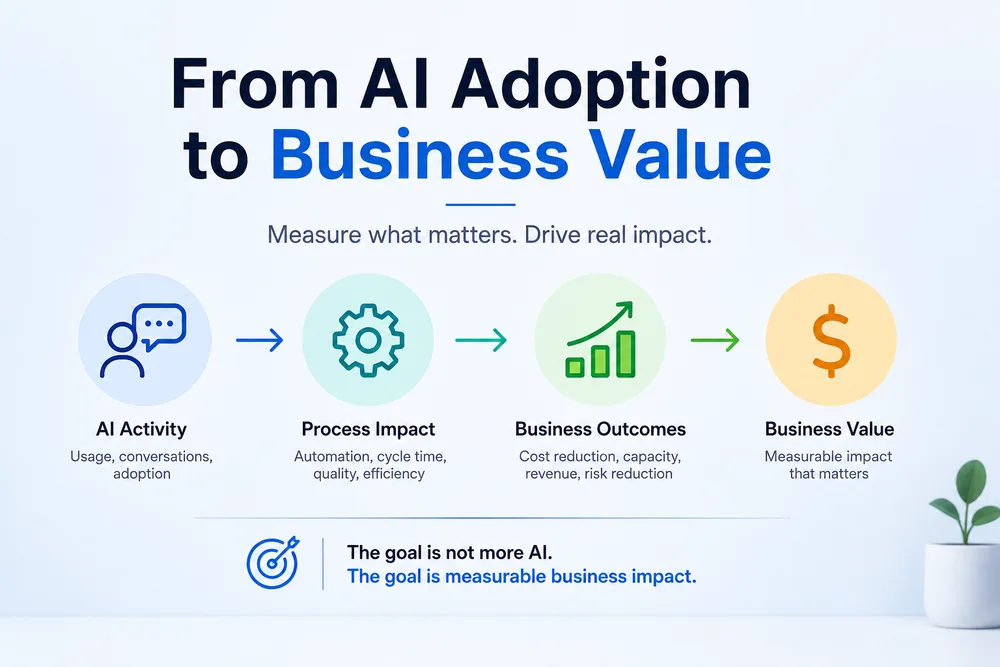
Most companies are currently bragging about how many employees have a ChatGPT login or how many "AI experiments" are running in parallel, but that doesn't tell you if the business is actually making more money or saving time. We need to shift the conversation from whether people are using the tools to whether those tools are delivering measurable economic value.
If you're trying to build a real-world AI workflow that survives a budget review, you have to stop treating LLM integration as a checkbox exercise and start treating it as a P&L line item.
The gap between usage and utility
The problem with adoption metrics is that they track activity, not outcome. A developer might use an AI coding assistant for 8 hours a day, but if they spend 4 of those hours debugging hallucinations or fighting with the prompt, the "adoption" is high while the "value" is mediocre. To get a real handle on this, you need a deep dive into specific performance indicators.
Instead of counting seats, focus on these three pillars:
- Time-to-Completion (TTC): Don't just track if a task was done by AI; track the delta between the manual process and the AI-augmented process. If a report took 10 hours and now takes 2, that's a tangible win.
- Quality Floor Elevation: Look for the reduction in "bottom-tier" output. AI is incredible at bringing the worst performers up to a baseline of competence, which is often more valuable than making the top performers 5% faster.
- Cost per Outcome: Calculate the API spend versus the labor cost saved. If you're spending $5,000 a month on tokens to save $2,000 in man-hours, your AI strategy is currently a liability, not an asset.
Moving toward a value-driven framework
To move from scratch to a mature measurement system, you need to categorize your AI deployments by their intent. A "productivity" tool is measured by time saved, but a "revenue-generating" tool (like an AI-driven lead qualifier) should be measured by conversion rates.
For those implementing an LLM agent in a corporate setting, the most honest way to measure value is through a "blind A/B test." Run the same set of inputs through your human team and your AI agent, then have a third party grade the outputs without knowing which is which. If the AI wins or ties while costing 1/10th the price, you've found actual value.
Everything else is just noise. If you can't map an AI feature directly to a KPI that the CFO cares about, you aren't scaling AI—you're just playing with expensive toys.
All Replies (3)
Want a live back-and-forth? Join the global AI chat room — login to talk.
Tracking time saved per task is a game changer. How many hours are you actually recovering?
Headcount reduction is the only metric that matters. Is anyone actually seeing a drop in staffing costs?
Token usage metrics seem way more honest. Which specific API costs are you monitoring for utility?