Stop Trusting AI Call Scoring Until You Measure Agreement Rates
The industry is currently obsessed with the "100% coverage" metric. Every sales manager is bragging about how their AI now audits every single customer interaction, whereas human QA managers used to sample maybe 2% of calls. On paper, this looks like a massive win for data integrity. In reality, if your LLM is hallucinating its grading or applying a rigid, context-blind rubric, you aren't getting 100% visibility—you're getting 100% confident misinformation.
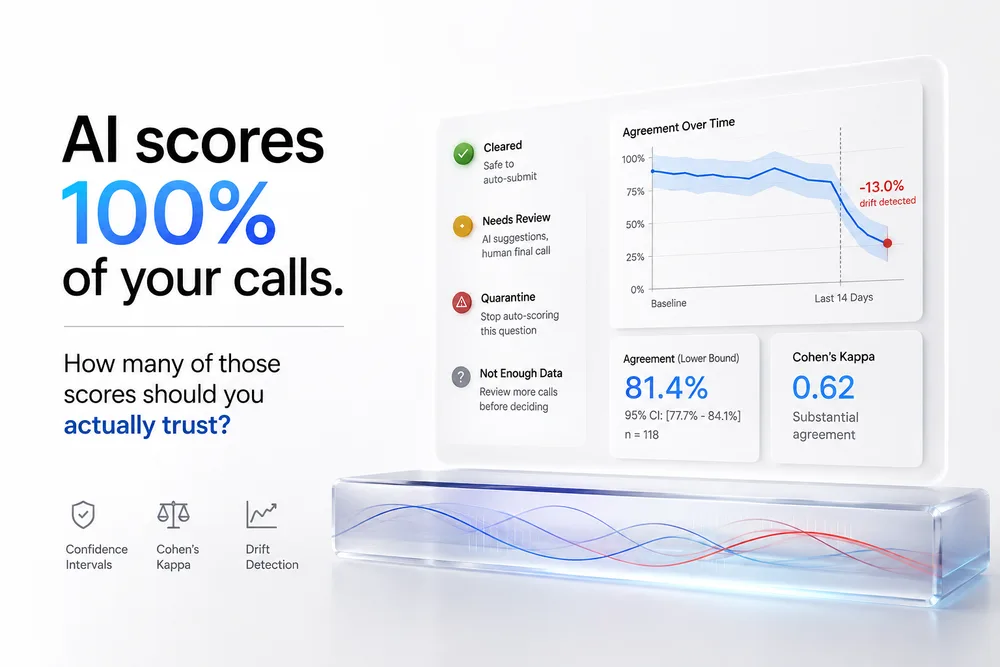
I decided to stop guessing about the accuracy of these automated scores, so I built an open-source tool specifically to measure the agreement rate between AI and human graders across every single QA question. The goal wasn't just to see if the AI was "mostly right," but to pinpoint exactly which parts of the rubric the LLM fails at.
The Gap Between Coverage and Accuracy
When you move from human sampling to AI scoring, you encounter a hidden danger: the "Consistency Trap." An LLM will give you a score for every call, and it will do so consistently. But consistency is not accuracy. If the prompt is slightly off, the AI might penalize a rep for not saying a specific phrase, even if the rep handled the objection perfectly in a natural way.
To solve this, I focused on a deep dive into the agreement delta. Here is how the logic works for anyone wanting to build a similar validation layer:
1. Parallel Scoring: You take a subset of calls (e.g., 100 calls) and have them scored by both the AI and a senior human QA lead.
2. Agreement Mapping: Instead of a general accuracy percentage, you map the agreement per question. You'll often find the AI is 95% accurate on "Did the rep introduce themselves?" but only 40% accurate on "Did the rep handle the pricing objection effectively?"
3. Weighting the Trust: Once you have the agreement rate per question, you can apply a "trust coefficient" to your dashboard. If a question has low human-AI agreement, that metric is flagged as "unreliable" and ignored for performance reviews.
Implementing a Validation Workflow
If you're managing an AI workflow for call auditing, you can't just set it and forget it. You need a continuous loop of human-in-the-loop (HITL) validation. I recommend setting up a random sampling trigger where 5% of "high-confidence" AI scores are audited by humans to ensure the model hasn't drifted.
For those looking to implement this from scratch, focus on the prompt engineering of your rubric. The more subjective the question, the lower the agreement will be. Turning "Was the rep empathetic?" into "Did the rep acknowledge the customer's frustration using specific keywords?" usually bumps the agreement rate significantly.
The real value of AI in QA isn't the ability to score everything—it's the ability to tell you exactly where the human and the machine disagree, because that's where the actual coaching opportunities live.
All Replies (4)
Want a live back-and-forth? Join the global AI chat room — login to talk.
Terrifying. How many calls did you have to audit manually to find that?
Sampling 5% of perfect scores revealed so many hallucinations. Who else is auditing their AI results?
Struggling with accuracy. Are you seeing a high variance between AI scores and manual spot checks?
Sarcasm is ruining my sentiment scores. How are you guys handling those tricky tone shifts?