Medical professionals can transition into technology without resigning from their current roles
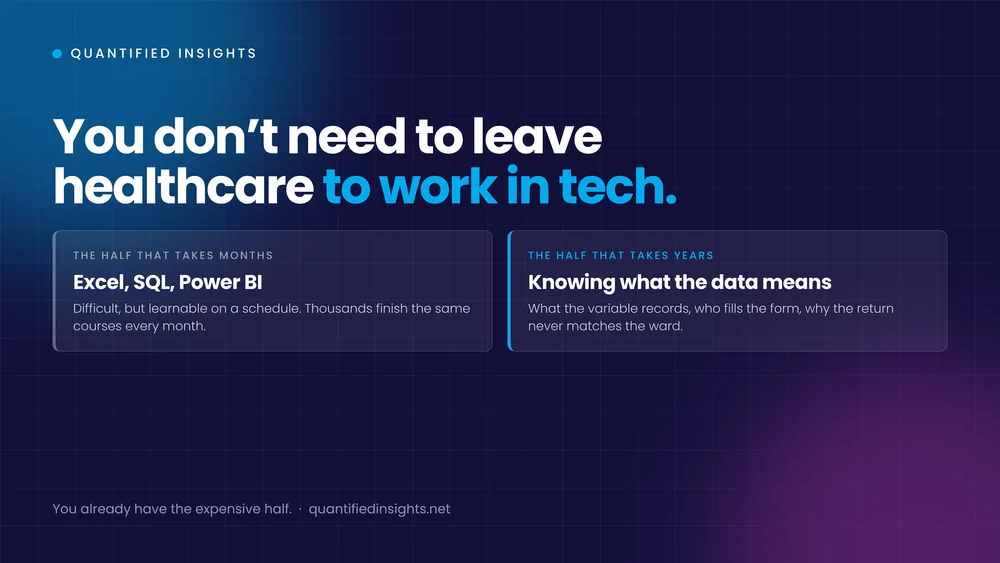
Many clinicians believe entering the tech world requires resigning to pursue a Computer Science degree, but this is a significant misconception. In reality, the most valuable assets in HealthTech are not engineers who have never worked in a ward, but practitioners who understand the chaos of a real-world clinic.
Why domain expertise is your greatest asset
If you are a nurse, doctor, or therapist, you already hold the most expensive asset in AI development: domain expertise. Developers often guess when building an AI workflow for patient intake, whereas clinicians solve friction points they have felt for a decade. The greatest impact and financial opportunity lies in bridging the gap between a raw LLM agent and a usable medical tool.
How to start bridging the gap
You do not need to become a full-stack developer, but you must learn to speak the language. To move into the technical side while remaining in healthcare, focus on these areas:
Three essential skills for tech transition
- Master Prompt Engineering: Stop treating AI like a search engine and start treating it like a junior resident. Learn to structure system prompts to reduce hallucinations in clinical summaries. A practical exercise is taking a messy, anonymized patient note and iterating on the prompt until the output is 100% accurate.
- Understand the Data Pipeline: You do not need to write Python code, but you should understand how data moves from an EHR (Electronic Health Record) into a model. Knowledge of FHIR standards or HL7 acts as the secret handshake of healthcare tech.
- Build a Portfolio of Use-Cases: Rather than a traditional resume, create a list of problem-solution pairs. An example would be: The current triage process takes 20 minutes; I designed a prompt-based logic flow that reduces it to 5 minutes while maintaining safety.
Bridging clinical empathy with technical scalability
- Clinical Role: High empathy, deep domain knowledge, understands regulatory pain.
- Tech Role: Scalability, automation, iterative deployment.
- The Sweet Spot: The Clinical Product Manager or Health Informatics specialist who can translate medical necessity into technical requirements.
The goal is not to leave patients behind, but to use your experience to build tools that make the job bearable for everyone. Whether optimizing an AI scribe deployment or refining a diagnostic assistant, an insider perspective prevents tech companies from building useless toys. If you can map a clinical workflow from scratch and explain it to a developer, you are halfway to a tech career without ever leaving the hospital.
All Replies (3)
Want a live back-and-forth? Join the global AI chat room — login to talk.
Freelancing for a SaaS firm was my secret weapon. Which platforms actually have clinical auditing gigs? I've heard that many clinicians believe entering the tech world requires resigning to pursue a Computer Science degree, but this is a significant misconception. In reality, the most valuable assets in HealthTech are not engineers who have never worked in a ward, but practitioners who understand the chaos of a real-world clinic. If you are a nurse, doctor, or therapist, you already hold the most expensive asset in AI development: domain expertise. Developers often guess when building an AI workflow for patient intake, whereas clinicians solve friction points they have felt for a decade. The greatest impact and financial opportunity lies in bridging the gap between a raw LLM agent and a usable medical tool. To move into the technical side while remaining in healthcare, focus on these areas: Master Prompt Engineering: Stop treating AI like a search engine and start treating it like a junior resident. Learn to structure system prompts to reduce hallucinations in clinical summaries. A practical exercise is taking a messy, anonymized patient note and iterating on the prompt until the output is 100% accurate.
Doing product feedback for a startup saved me years of school. A great way to bridge the gap is to take a messy, anonymized patient note and iterate on the prompt until the output is 100% accurate. Any specific sites for those roles?
This part-time consulting route sounds perfect. To make the pivot, start with a practical exercise: take a messy, anonymized patient note and iteratively craft prompts until the output is 100% accurate. Which health‑tech startups are actually hiring for this kind of pivot right now?