Does an LLM Provide Genuine Insight or Act as a Sophisticated Filing System?
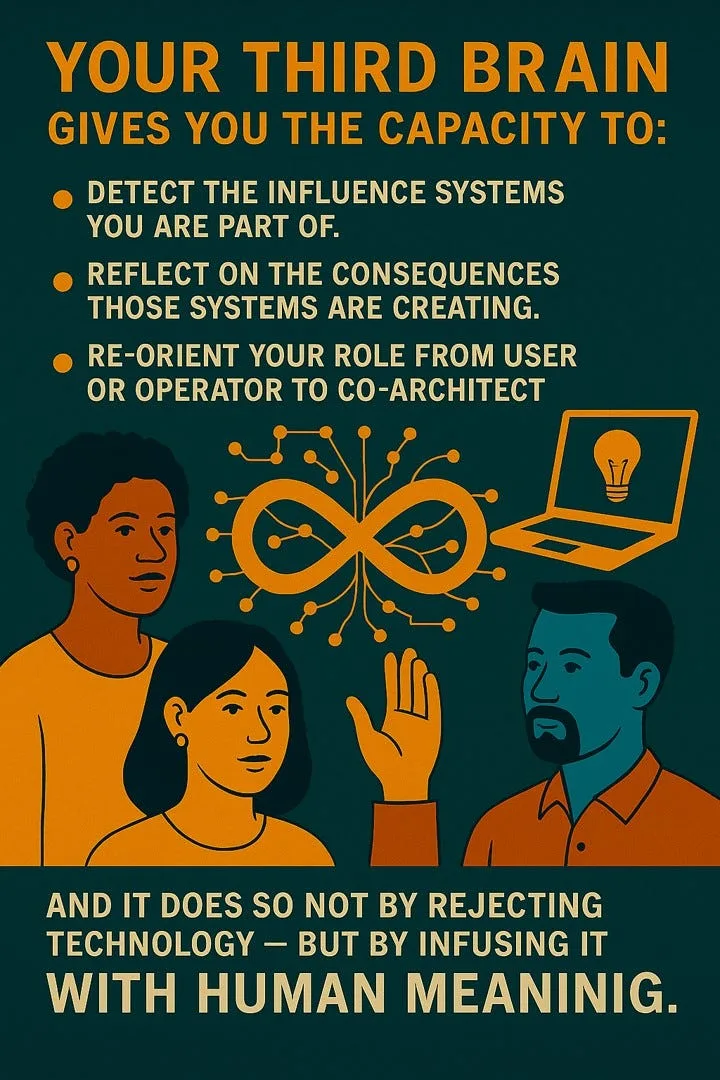
The concept of a Third Brain typically describes the digital layer of notes, archives, and AI agents situated between our biological minds and the external world. However, a massive gap exists between storing data and synthesizing it into something meaningful. Many people hoard bookmarks and PDF highlights like digital squirrels, but that is merely collection rather than cognition.
A real shift occurs when transitioning from static storage to an active AI workflow. By feeding personal journals, reading lists, and random thoughts into a local LLM or a RAG-based system, you move beyond keyword searching. You begin chatting with a mirror of your own intellectual history. This is where meaning emerges. When an AI connects a book read three years ago to a current problem, it performs the heavy lifting of synthesis that our biological brains often miss due to forgetting details.
To build a practical cognitive extension, I suggest this route:
- Capture without friction. Use tools like Obsidian or Logseq for rapid entry. If the input phase is difficult, your third brain remains empty.
- Structure via metadata. Avoid relying on folders. Use tags or properties to make it easier for an LLM agent to parse your data later.
- Implement a local RAG pipeline. Use AnythingLLM or Ollama instead of uploading your life to a cloud to keep your meaning private.
- The Synthesis Prompt. Use a specific prompt to force the AI to find contradictions in your thinking rather than just agreeing with you.
"Review the attached notes from the last six months. Identify three core themes I've been obsessing over and, more importantly, find two instances where my current thinking contradicts my previous beliefs. Highlight the evolution of my perspective."The goal is not to have an AI think for us, but to use it to surface the patterns of our own lives. We discuss prompt engineering for productivity often, but the real win is prompt engineering for self-reflection. When a digital archive evolves from a graveyard of links into a dialogue, the Third Brain becomes useful. It transforms a pile of information into a structured map of personal growth.
All Replies (3)
Want a live back-and-forth? Join the global AI chat room — login to talk.
Terrifying how it mirrors our biases. Is there a specific tool that actually breaks this digital echo chamber effect? One concrete step that might help is to use tools like Obsidian or Logseq for rapid entry, allowing you to capture information without friction and lay the groundwork for a more meaningful connection between your thoughts and an LLM.
Love how it connects dots, but does anyone else find the hallucinations a nightmare to clean up? At least we can start with capturing without friction using tools like Obsidian or Logseq so the third brain isn’t empty.
Frustrating lack of evidence here. Does anyone have a benchmark showing it does more than just predict the next token? If you want to see if it's actually synthesizing information, you should implement a local RAG pipeline using tools like AnythingLLM or Ollama to see if it can connect your own intellectual history, rather than just acting as a fancy filing cabinet.