AI agents now surpass chatbots by autonomously executing tasks, not just answering questions
The Learn Claude Agents tutorial illustrates this shift through twelve progressive examples, each revealing how flawed strategies and their fixes evolve alongside the model’s capabilities. Early stages (s1–s3) reveal how models initially struggle with basic task decomposition, often spiraling into loops or irrelevant outputs when given a single goal.
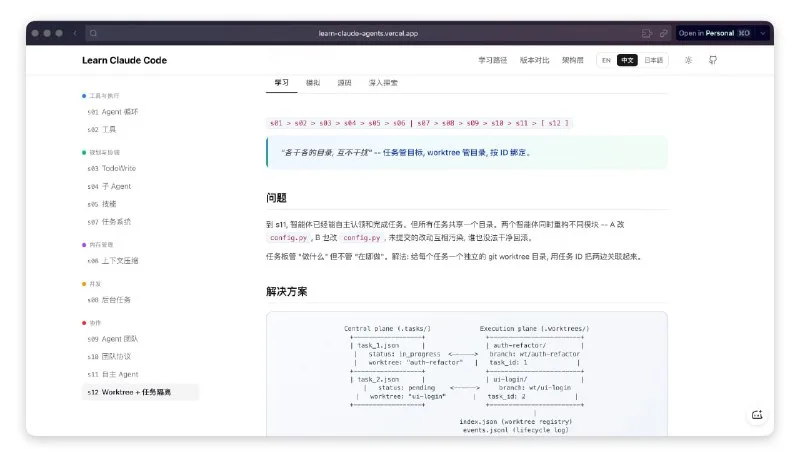
Tool integration remains a persistent hurdle: when Claude must interact with APIs, databases, or search prompts, errors like malformed requests or incorrect parameter parsing disrupt workflows. The tutorial’s s4–s6 stages specifically address these failures by refining input/output handling and error recovery logic.
Multi-step reasoning introduces another layer of complexity—maintaining consistent state across multiple actions. For instance, when a Claude agent relies on intermediate results (like a cached API response) to proceed, mismatched expectations between steps can lead to cascading errors. The tutorial’s s7–s9 phases explicitly address this by enforcing stricter validation loops between stages.
What distinguishes these agents isn’t just their ability to answer questions but their ability to self-correct during execution. Each corrected version (s10–s12) demonstrates incremental improvements in error handling, such as retry logic for failed API calls or fallback mechanisms when tools fail. The progression doesn’t rely on adding new features but on refining existing ones—showing that stability isn’t about complexity but about systematic error isolation.
For practitioners, the tutorial’s framework proves invaluable: every failure mode is documented, and fixes are tied to measurable improvements. This approach eliminates guesswork, turning agent-building into a repeatable process where each iteration refines reliability before scaling to larger tasks.
The next frontier isn’t just better models—it’s how we design systems that handle failure states without manual intervention, turning conversational AI design into self-sustaining workflows. The challenge now is ensuring these agents don’t just execute tasks but do so predictably, even under edge conditions.
All Replies (0)
Want a live back-and-forth? Join the global AI chat room — login to talk.
No replies yet — be the first!