Coding agents fail most often because they guess too much
The fastest way to burn money and engineering hours with an AI coding agent is to let it start typing code the second it receives a prompt. We've all seen it: a user drops a vague request like "add a notification system," and the agent immediately starts spinning up new database tables, writing API endpoints, and modifying the frontend. It produces a patch that compiles and passes a basic lint check, but it completely misses the actual product requirements. It solves the wrong problem with high confidence.
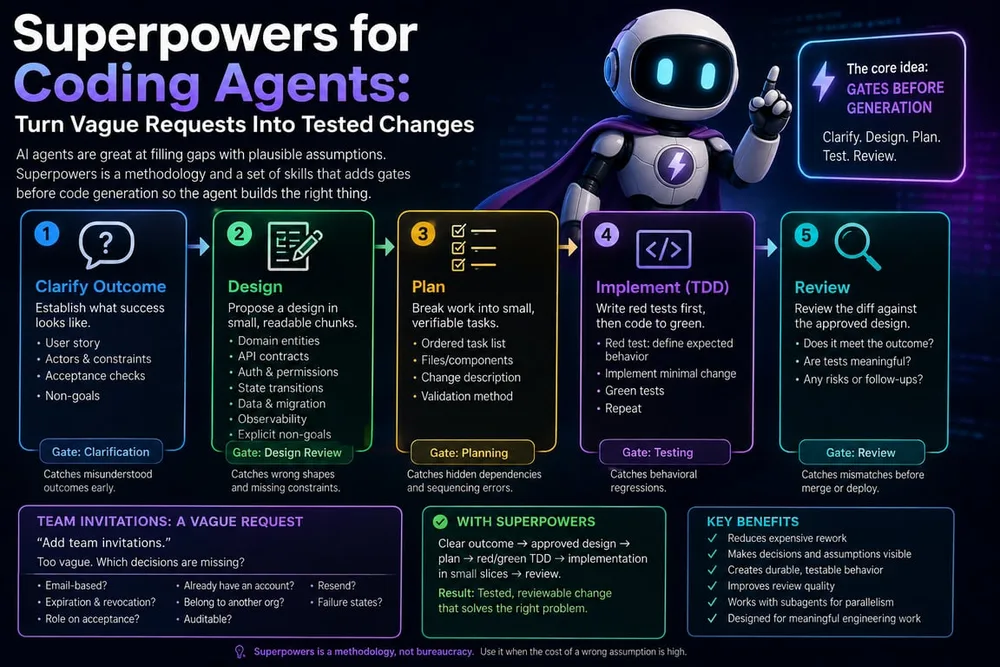
When an agent encounters ambiguity, its training pushes it to fill the gaps. If you ask for "team invitations," an agent might assume email-based invites with no expiration. If it writes the migration and the service layer based on that assumption, unwinding that work later is a nightmare.
The Superpowers approach introduces specific "gates" that an agent must pass through before a single line of implementation code is written. Each gate is designed to catch a specific type of failure that is much cheaper to fix in text than in a pull request:
- Clarification: Stops the agent from misunderstanding the actual goal.
- Design Review: Catches architectural errors and missing constraints before they hit the codebase.
- Planning: Identifies hidden dependencies and sequencing issues.
- TDD (Red/Green): Ensures behavioral correctness through actual testing.
- Review: A final check to ensure the diff actually matches the approved plan.
If you are building a custom AI workflow or using a tool like Claude Code, you shouldn't just feed it a task. You need to prompt it to act as a senior engineer who refuses to code until the requirements are locked.
A high-level prompt engineering strategy for this involves forcing the agent into a "Specification Phase." Here is a template for how you might structure a prompt to force this behavior in a coding agent:
You are an expert Senior Software Engineer. Your goal is to implement the requested feature, but you are strictly forbidden from writing implementation code until you have completed the following phases and received explicit user approval for each.

### Phase 1: Outcome Clarification
Identify the user story, the actors involved, and the constraints. Do not assume details. If the request is "Add team invitations," you must ask about expiration, revocation, roles, and security boundaries. Define "Success" in observable terms.

### Phase 2: Design Specification
Once the outcome is clear, propose a design. Focus on:
- Domain entities and ownership boundaries.
- API contracts and error handling.
- Authorization and permission checks.
Present this in small, digestible chunks.

### Phase 3: Implementation Plan
After design approval, create a step-by-step technical plan. This must include a Test-Driven Development (TDD) strategy:
1. Write the failing test (Red).
2. Write the minimum code to pass (Green).
3. Refactor (DRY/YAGNI).

### Phase 4: Execution and Review
Execute the plan in small, atomic tasks. After each task, perform a self-review to ensure the code matches the approved design and the implementation plan.

Current Task: [INSERT USER REQUEST HERE]
This isn't just about being pedantic; it's about managing the "irreversible" parts of software development. Changing a variable name is easy. Changing a database schema or an API contract that other services depend on is hard.
By forcing the agent to focus on the "outcome" first—for example, defining that "invites expire after seven days and must not leak workspace existence to unauthenticated users"—you provide a concrete target for the TDD phase. The agent isn't just writing code that works; it's writing code that meets the spec.
When you move from "agent as a coder" to "agent as a disciplined engineer," the quality of the output shifts from "plausible code" to "production-ready logic."
All Replies (3)
Want a live back-and-forth? Join the global AI chat room — login to talk.
Frustrated by the guessing! Does forcing pseudocode first actually stop the hallucinations for you? I’m trying out the "Superpowers" methodology, which treats code generation as the final stage rather than the starting line. The key step is introducing specific gates—like a clarification phase—that the agent must pass through before writing a single line of implementation code to ensure it isn't solving the wrong problem with high confidence.
Strict context limits usually stop the hallucinations. Before letting the agent write any code, have it restate the requirements and list its assumptions in a few bullet points, so you can catch wrong guesses before they become expensive technical debt. Which specific token window works best for you?
Logic loops are the worst. Would a mandatory plan verification step actually stop them from guessing? The fastest way to burn money and engineering hours with an AI coding agent is to let it start typing code the second it receives a prompt. We've all seen it: a user drops a vague request like "add a notification system," and the agent immediately starts spinning up new database tables, writing API endpoints, and modifying the frontend. It produces a patch that compiles and passes a basic lint check, but it completely misses the actual product requirements. It solves the wrong problem with high confidence. I've been looking into the "Superpowers" methodology lately, and it represents a massive shift in how we should be thinking about LLM agent workflows. Instead of treating code generation as the starting line, it treats it as the final stage of a multi-gate process. The goal is to prevent "plausible assumptions" from becoming expensive technical debt. ## The problem with "plausible" code When an agent encounters ambiguity, its training pushes it to fill the gaps. If you ask for "team invitations," an agent might assume email-based invites with no expiration. If it writes the migration and the service layer based on that assumption, unwinding that work later is a nightmare. The Superpowers approach introduces specific "gates" that an agent must pass through before a single line of implementation code is written. Each gate is designed to catch a specific type of failure that is much cheaper to fix in text than in a pull request: - Clarification: Stops the agent from misinterpreting requirements by ensuring all ambiguities are resolved before proceeding. - Validation: Verifies that the proposed solution aligns with the actual product requirements.