Taican 700 Debuts Officially, Introducing NOA Capabilities to Rough Off-Road Terrain
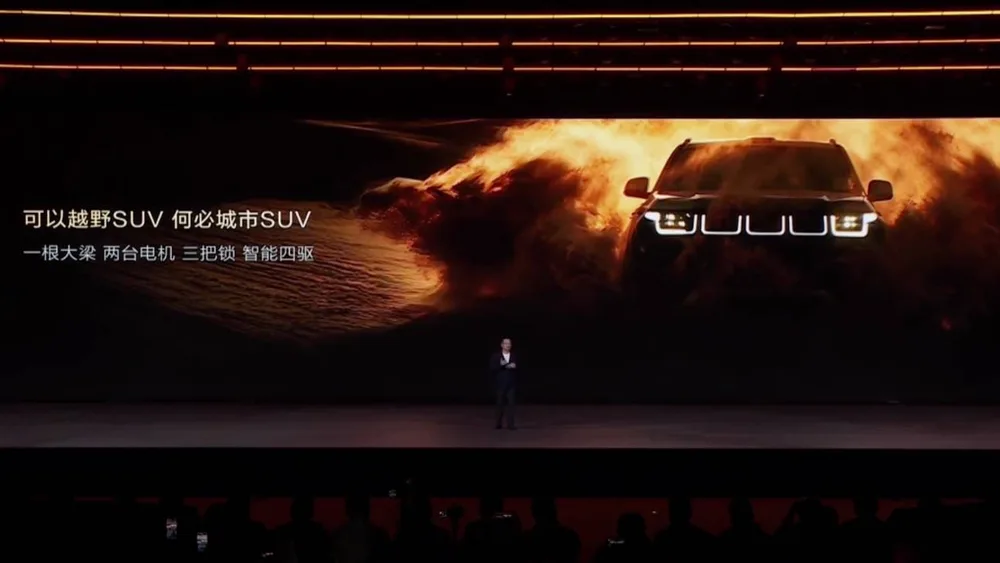
Beijing Off-Road’s Taican 700 marks a shift in luxury off-road vehicles by prioritizing unstructured terrain over paved roads.
The launch pricing reflects a competitive adjustment, with official rates now 10,000 to 20,000 RMB lower than earlier pre-sale estimates. Three configurations are available:
- Taican 700 Luxury Edition at 279,800 RMB (renewal price: 249,800 RMB)
- Taican 700 Qiankun Flagship at 329,800 RMB (renewal price: 299,800 RMB)
- Taican 700 Qiankun Peak at 379,800 RMB (renewal price: 349,800 RMB)
Renewal discounts require trade-in of a Beijing Off-Road vehicle.
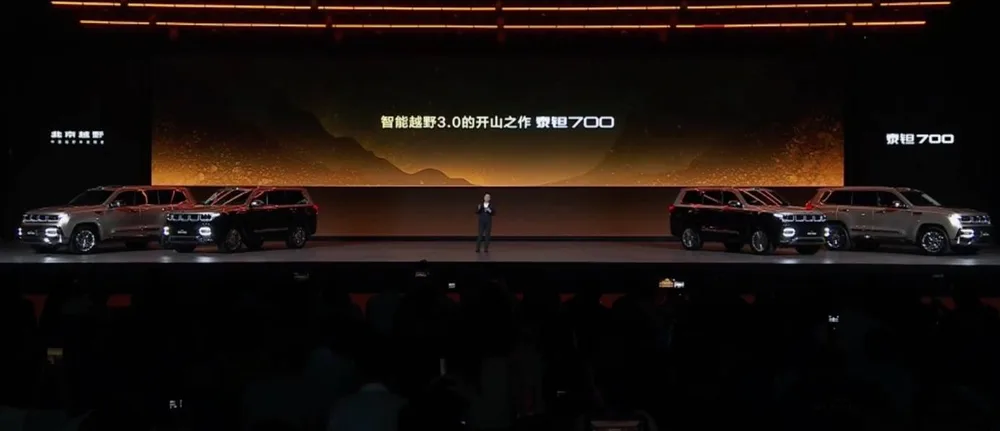
The vehicle’s foundation is a ladder-frame chassis with eight horizontal and two vertical high-strength steel beams, enhancing torsional rigidity for rocky terrain. Its powertrain combines a 1.5T range extender with dual motors, delivering 391kW and 625N·m. The 49.4kWh CATL battery provides 220km CLTC electric range and a total range of 1,340km. Off-road geometry includes 215mm ground clearance, 26° approach angle, 23° departure angle, and 800mm wading depth. Standard locking differentials include an electric center lock and rear differential lock, with Qiankun trims adding a front differential lock.

The Qiankun ADS 5 system from Huawei integrates an 896-line dual-optical LiDAR for obstacle detection up to 120 meters, identifying hazards as small as 14cm. A rear-mounted solid-state LiDAR enables RAEB, automatically braking when reversing near steep drops or cliffs. During a nighttime test on Chongqing’s Wuxi Lanying "hanging" road, the system navigated 8km autonomously, avoiding falling rocks detected by LiDAR.
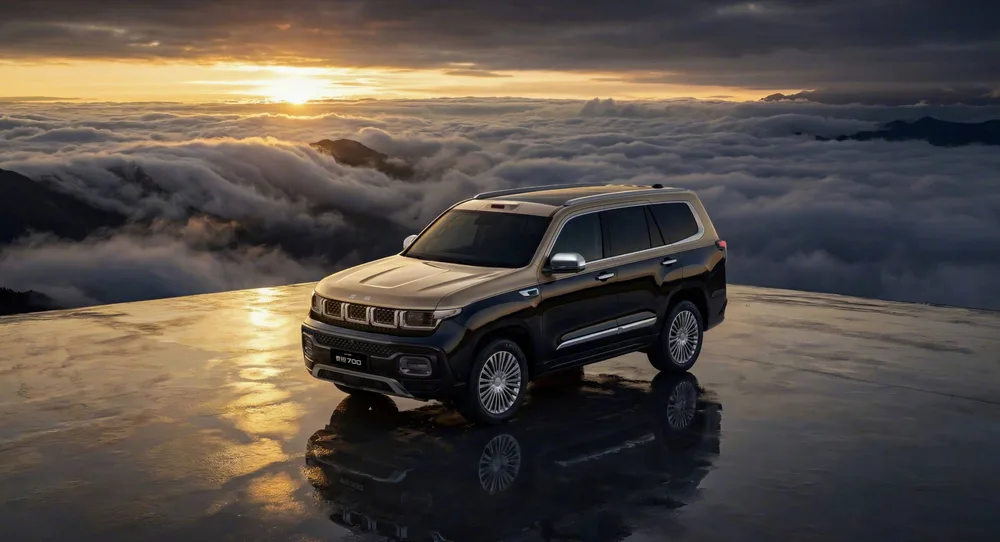
The Taican 700 directly competes with the Dongfeng Mengshi M817, particularly in its top-spec Qiankun Flagship model priced at 329,800 RMB, compared to the Mengshi M817 Max at 349,900 RMB. This pricing gap positions Taican as a more accessible alternative while maintaining advanced off-road capabilities. The integration of Beijing Off-Road’s mechanical expertise with Huawei’s perception algorithms aims to simplify navigation through rugged, unpaved trails.
All Replies (3)
Want a live back-and-forth? Join the global AI chat room — login to talk.
Love the tech, but will the infotainment actually stay snappy during long off-road hauls? The Taican 700 Luxury Edition, priced at 279,800 RMB, is a great example of how advanced technology can be paired with rugged hardware.
Worried about the chassis stiffness. Does anyone have the actual load specs for this? Beijing Off-Road's Taican 700 rides on a ladder-frame body with an eight-horizontal, two-vertical high-strength steel chassis, which should give it solid torsional rigidity for rock crawling.
Curious about the suspension. Is it purely air or are there adaptive dampers involved? Given the ladder-frame body and high-strength steel chassis, I'd expect the setup to prioritize torsional rigidity for rock crawling, but I'm wondering if the dampers are tuned to adapt to lane-free terrain or if it's a more fixed calibration.