Follow-up Suggestions Bug
What Broke and When
Starting the afternoon of September 10, 2026, ChatGPT on Plus accounts began appending a two-item clickable bullet list labeled "suggested follow-up prompts" to the bottom of nearly every response, even with "Suggested prompts" disabled in Settings under Personalization. These aren't just UI decorations—they're being injected into the actual response text, copied along with the response when using the copy button, and visible to the model itself within the conversation context.
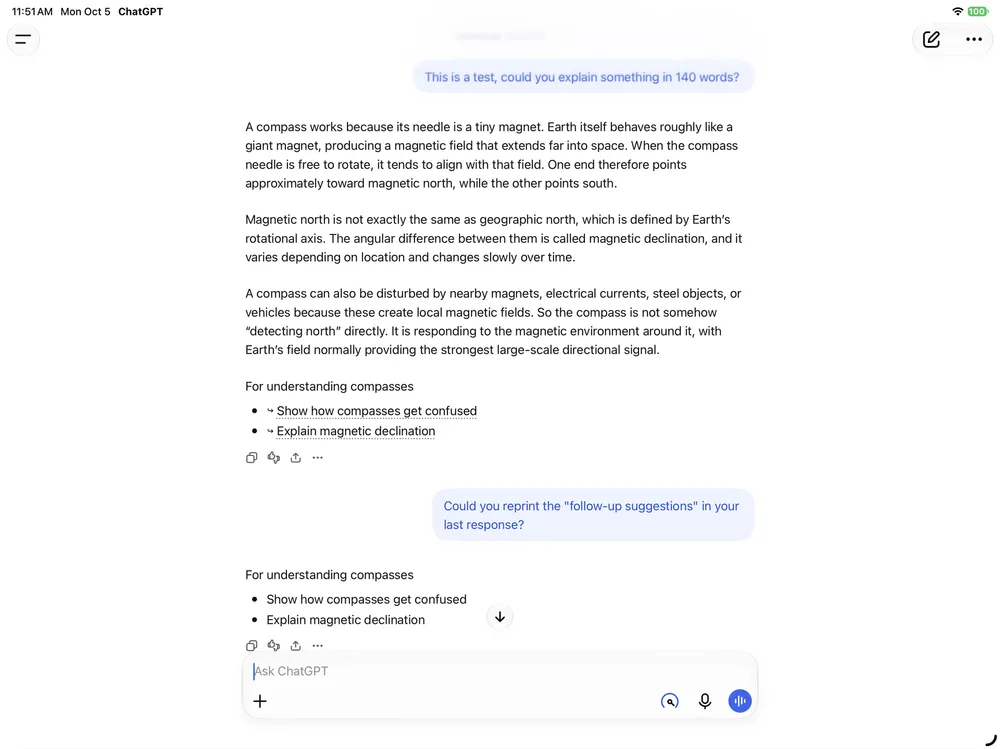
The Core Problem Isn't UI, It's Injection
The suggested follow-up prompts are being written directly into the response text stream, not rendered as a separate UI component below it. When the copy icon is clicked, the clipboard captures the full response plus the suggestion bullets, forcing manual cleanup before pasting into another document or chat. Worse, since ChatGPT can see these prompts in its own output, they consume context window space and may subtly influence the direction of the ongoing conversation. The suggestions themselves are also poorly matched—they reference only the most recent response rather than the broader conversation thread, making them feel irrelevant and noise-inducing.
Why Toggle Settings Won't Help
Turning off "Suggested prompts" in Personalization under Settings should disable these, but it doesn't. The setting was already confirmed as off by the reporter, yet the prompts persist. Custom Instructions were also attempted as a workaround—explicitly instructing the model not to append follow-up suggestions—and direct requests to the model to stop producing them were also ignored. Neither approach works because the behavior appears to be server-side and hardwired into the response generation pipeline, not controlled by client-side preferences or model-level instructions. This suggests the feature bypass local configuration entirely, rendering user controls ineffective.
Reproduction Is Disturbingly Consistent
Almost every prompt triggers the behavior. The reporter tested with simple queries like "Could you explain something (your choice)?" and the suggestions appeared regardless of topic, length, or complexity. This isn't an edge case triggered by specific phrasing—it's pervasive. The issue spans all environments: the latest ChatGPT app on iPhone and iPad, plus Safari and Chrome browsers on the web. It occurs in regular "Chat" mode on the Plus model, across surface types including Web, iOS, and iPadOS. The consistency across platforms and devices indicates a backend change, not a client bug.
Context Pollution and Relevance Decay
Because the suggested prompts are embedded in the response text and visible to the model, each one adds tokens to the conversation history. Over a long chat session, these accumulate unnecessarily, reducing available context for actual user input and model output. The relevance problem compounds this: instead of offering thoughtful continuations that align with the user's intent or the conversation's trajectory, the prompts latch onto the literal content of the last response. A user discussing debugging strategies might see suggestions like "How do I fix a null pointer exception?" or "What are common API errors?"—technically related but strategically unhelpful, since the user never asked for those directions.
Workarounds Are Clunky and Incomplete
Until OpenAI pushes a server-side fix, users have a few imperfect options. Manual cleanup is the most reliable—copying the response, pasting it, and deleting the suggestion bullets before saving or sharing. Some have tried selecting only the desired text (excluding the bullets) before copying, but this requires careful selection and isn't always practical on mobile. Disabling JavaScript in the browser prevents the UI from rendering the copy button, but it also breaks other interactive features. Asking the model to summarize or restate its previous answer without the appended prompts can yield a clean version, though it costs extra turns and tokens. None of these are satisfactory long-term solutions, especially for users who rely on copying responses into code editors, documentation, or other tools where trailing junk text causes real friction.
The Bigger Picture: Feature Overreach
This bug reflects a broader pattern where convenience features are inserted into core output streams without sufficient user control. Whether it's auto-suggestions, inline citations, or formatting hints, embedding these as text rather than as separate metadata creates downstream problems for anyone using the output programmatically. A simple toggle to strip appended suggestions before copying—or better, a server-side switch to disable them entirely for paying users—would resolve this immediately. Until then, every response needs a manual trim.
I noticed that clicking a follow-up prompt in the headers makes the entire response disappear from the screen but not from the conversation history. This bug is micro-stuttering-inducing and makes the UI feel unintuitive. Did the devs intentionally design it this way to encourage