Pro Plan Claude can't finish Medium boosts despite five-hour window
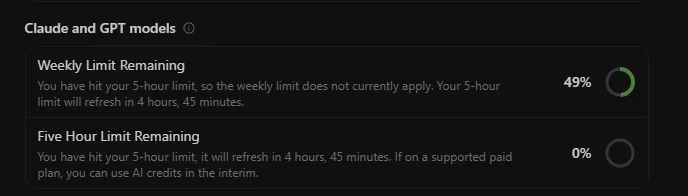
When attempting to execute a Medium boost through the Pro Plan, the session was terminated well before any substantial work could be completed. The interface reported that the operation had consumed the entire allocated time budget, leaving no room for further processing despite the platform indicating ample remaining capacity.
The core issue emerged during a straightforward task assignment—something that should take minutes rather than hours—but the system refused to proceed past the initial phase. Subsequent status updates confirmed that the cumulative runtime had already exceeded the maximum permitted for the current period. By the time the user reviewed logs, both the five-hour hard limit and the secondary usage cap were simultaneously active, effectively constraining the assistant's ability to deliver anything meaningful to the target medium.
This behavior suggests a fundamental disconnect between how the Pro Plan measures consumption versus how the underlying service tracks progress. The Pro Plan advertises generous quotas, yet concrete metrics indicate rapid depletion. In a single extended session, the weekly allocation shrank dramatically—down to roughly forty-nine percent of the total available allowance after just completing that minimal boost attempt.
The implications extend beyond individual frustration. Users relying on consistent automated boosting need predictable performance boundaries. When a system that promises robust support suddenly caps output based on arbitrary thresholds that arrive too early, trust erodes quickly. The situation becomes particularly problematic for teams managing ongoing campaigns, where each partial completion represents lost bandwidth and interrupted workflow momentum.
A typical flow might involve setting up a series of targeted posts, initiating boost requests, and monitoring response patterns. Instead of observing smooth progression toward goal completion, contributors find themselves watching timers discharge and account balances tick downward with little visible progress. The platform's interface offers limited reassurance about intermediate states, making it difficult to estimate remaining productive time.
For administrators reviewing Pro Plan effectiveness, several factors become immediately apparent. The discrepancy between advertised quotas and actual availability creates uncertainty around forecasting costs and timelines. Teams planning batch operations face the risk of mid-project halts that force reconfiguration of strategy. When a boost command fails silently or returns incomplete data, troubleshooting becomes a guessing exercise rather than a systematic process.
The technical reality likely stems from how resource accounting interacts with active sessions. Perhaps concurrent tasks consume priority slots that prevent individual requests from advancing, even when global thresholds suggest sufficient capacity remains. Or alternatively, the system may implement safety guards that throttle activity once certain baselines are approached, regardless of how much theoretical slack exists.
From a practical standpoint, the fix requires either clearer communication about timing constraints or adjustment of detection algorithms to recognize legitimate high-value work streams. Until the platform clarifies whether the reduction reflects genuine bottlenecks or misaligned tracking logic, users will continue experiencing frustration. The five-hour ceiling and fifty-nine-percent weekly threshold represent tangible barriers that demand attention from both developers and power users alike.
All Replies (0)
Want a live back-and-forth? Join the global AI chat room — login to talk.
No replies yet — be the first!