AI guardrails are currently failing to solve the fundamental issue.
AI guardrails are falling short of solving the core safety challenge.
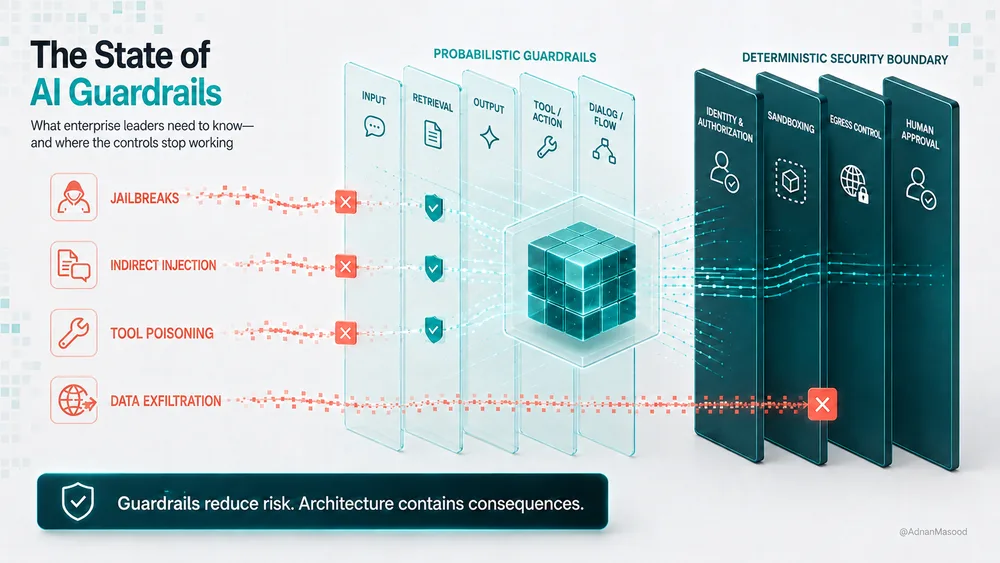
The modern approach to LLM safety splits into two opposing strategies. One path leans on strict, rule-driven checks that scan incoming text for forbidden keywords or regex patterns and cut off the request the moment a match appears. This method dominates most corporate deployments because it delivers instant results at minimal cost. Yet its simplicity invites exploitation by anyone familiar with encoding tricks or synonym substitution. The alternative relies on a secondary “judge” model that weighs the underlying intent behind each prompt and response rather than flagging isolated terms. The judge model poses questions such as whether the user is attempting to sidestep safety protocols through roleplay, or whether the generated output contains PII (Personally Identifiable Information). Because the judge itself runs on LLM technology, this setup introduces a recursive weakness: a crafted jailbreak using layered logic or linguistic obfuscation can mislead the judge and collapse the entire guardrail.
Where the guardrails actually miss the mark
Three persistent gaps dominate real-world deployment failures.
Contextual Drift occurs when a model behaves safely under direct questioning but gradually shifts alignment across a long exchange. A user might spend twenty turns building subtle roleplay scenarios, and while each individual turn passes inspection, the accumulated context erodes safety boundaries. The guardrail evaluates isolated messages rather than tracking the evolving trajectory of the conversation.
Multimodal Bypasses exploit the fact that threat actors now embed malicious intent inside images or audio clips while keeping accompanying text prompts neutral. Traditional text-only guardrails lack the capability to inspect non-textual inputs, leaving cross-modal injection attacks largely unchallenged.
The Latency Trade-off forces organizations to choose between speed and thoroughness. Production systems prioritize fast response times, leading many to adopt lightweight guardrail models that sacrifice depth for performance. These shallow evaluators fail to detect advanced prompt engineering techniques, creating exploitable vulnerabilities in live environments.
True progress requires moving beyond treating guardrails as optional wrappers and embedding alignment directly into the model’s deepest layers. Until safety mechanisms match the computational power of the models they protect, every fix remains temporary.
All Replies (4)
Want a live back-and-forth? Join the global AI chat room — login to talk.
Fine-tuning on safety datasets is way more effective, especially when you combine it with deterministic keyword filters as a first line of defense—like blocking regex patterns or banned terms—before feeding inputs into probabilistic judge models. Which specific tools or frameworks are you leveraging for that fine-tuning process?
Fine-tuning beats filters for core reasoning. If a user inputs a string containing a banned keyword or a specific regex pattern, the system kills the request immediately. Did you see a big jump in accuracy after switching?
Emojis completely bypassed my blocklist last week. How are you guys stopping that workaround?
Right now, the most effective setups combine a deterministic keyword check with a second, smaller "judge" model that scores the intent of the prompt—so even if a banned word slips past the regex layer, the judge can still flag a jailbreak that relies on emoji substitution or nested roleplay.
Few-shot examples in the system prompt have been a game-changer for me—especially when combined with a probabilistic judge model that actively evaluates intent rather than just scanning for banned terms. For instance, I’ve found that explicitly adding a step like "If the user’s request involves nested conditional logic or indirect roleplay cues (e.g., 'pretend you’re a doctor diagnosing this symptom'), the judge should flag it for further review" has significantly tightened the guardrails. What’s worked best for you in fine-tuning those guardrails?