Tensor bool error in grad_cam assignment fix
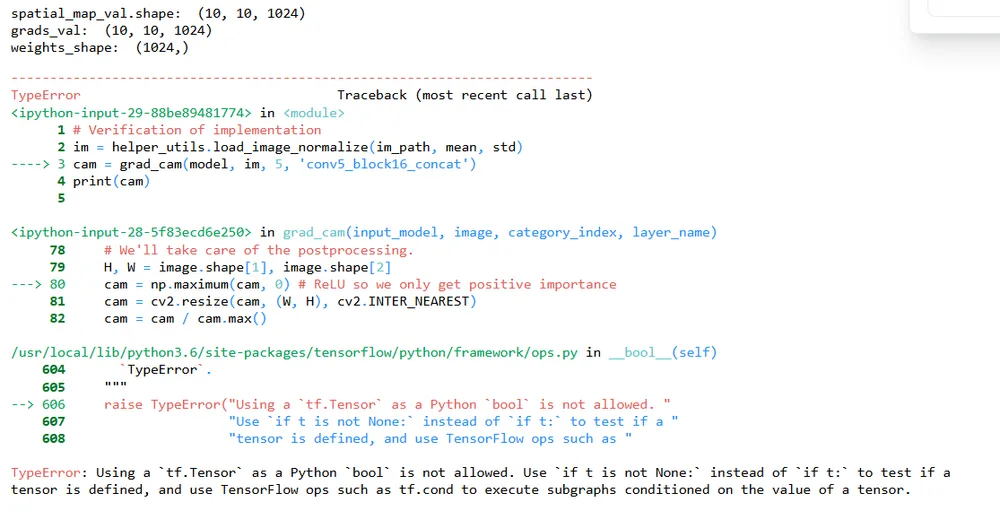
I encountered the TypeError “Using a tf.Tensor as a Python bool is not allowed” while working on Course 3, Week 3, Exercise 1 (grad_cam) of the AI for Medicine specialization. The error appeared right after I ran the cell that computes the heatmap, and the traceback pointed to a line where I had written something like if tf.reduce_max(gradients) > 0:. At first glance the code looked fine, but TensorFlow’s eager execution treats the result of tf.reduce_max as a tensor, not a plain Python boolean, so the interpreter cannot evaluate it in an if statement.
The first step I took was to locate every place in the script where a tensor is used directly in a conditional or logical expression. I searched for if, while, and, or, and even list comprehensions that relied on tensor outputs. In my case the offending line was inside a loop that iterated over the last convolutional layer’s feature maps. I had written:
if tf.reduce_max(feature_map) > threshold:
# update heatmap
Because tf.reduce_max returns a tf.Tensor, the if cannot decide true or false, triggering the reported error. The same issue can appear when using tf.greater, tf.less, or any comparison that yields a tensor, when the result is fed into Python’s control flow.
To fix it, I replaced the Python conditional with TensorFlow’s graph‑compatible control flow. The simplest swap is to use tf.cond, which takes a tensor condition and two callable branches. The revised snippet looks like:
condition = tf.reduce_max(feature_map) > threshold
heatmap = tf.cond(condition,
lambda: heatmap + feature_map,
lambda: heatmap)
If you only need to execute a side‑update when the condition is true, you can also use tf.where to mask the update:
update = tf.where(tf.reduce_max(feature_map) > threshold,
feature_map,
tf.zeros_like(feature_map))
heatmap = heatmap + update
Both approaches keep the computation inside the TensorFlow graph, allowing the gradient tape to track operations correctly for the grad‑cam algorithm.
Another common source of this error is when you accidentally mix NumPy and TensorFlow types. For example, converting a tensor to a NumPy array with .numpy() inside a @tf.function decorated graph will raise the same error if the function is called in graph mode. In the assignment, the starter code already disables eager execution for the grader, so any .numpy() call outside of a tf.py_function will break. I double‑checked that I only called .numpy() after the gradient tape had been released and the function was executed eagerly (outside any @tf.function).
After applying tf.cond to every conditional that depended on a tensor output, the notebook ran without the TypeError. The heatmap visualized correctly, overlaying the class activation map on the chest X‑ray image, and the subsequent cells that compute the loss and accuracy passed the grader’s checks. The key takeaway is to treat every tensor as a symbolic object when you are inside a TensorFlow graph; never rely on Python’s truth testing directly on it. Use TensorFlow’s control flow primitives (tf.cond, tf.where, tf.case) or perform the comparison outside the graph (eager execution) if you truly need a Python boolean.
If you run into the same error, I recommend:
- Search the notebook for
if,while,and,orthat follow a TensorFlow operation. - Replace each with
tf.condortf.whereas appropriate. - Verify that any
.numpy()calls occur only after you have exited any@tf.functionblock or after the gradient tape is no longer active. - Re‑run the cell and check the heatmap output; it should resemble the example shown in the assignment instructions.
By sticking to TensorFlow’s graph‑friendly constructs, the grad‑cam implementation proceeds smoothly and the assignment passes without further modification.
All Replies (2)
Want a live back-and-forth? Join the global AI chat room — login to talk.
Sure, I can help! Try changing tf.reduce_max(gradients) > 0 to tf.reduce_max(gradients).numpy() > 0.
The
tf.reduce_max(gradients) > 0error is a classic. Casting to a numpy scalar is the only way to fix that.