Testing Small Language Models for Security Vulnerabilities with BreakBoard
Small Language Models (SLMs) now function beyond simple testing scenarios or basic mobile assistance roles. Lightweight models now drive autonomous agents and specific production processes, changing the security focus accordingly. While red-teaming typically targets large models like GPT-4 or Claude, the industry is moving toward a scenario where compact, efficient models handle sensitive API calls and real-world tasks.

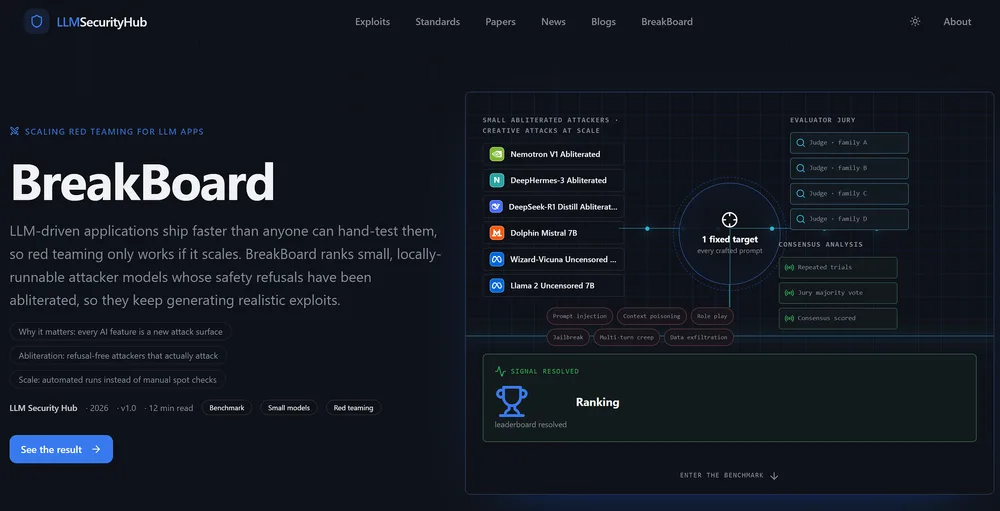
The main challenge is the lack of a standardized approach to measure the vulnerabilities of these smaller models. BreakBoard addresses this as a dedicated framework created for the red-teaming community to rigorously test SLMs.
Why SLMs stand out as targets
Comparing model security analysis between a 7B parameter model and a 175B parameter model highlights a significant difference. Large models have substantial safety features built through RLHF (Reinforcement Learning from Human Feedback). Small models often prioritize efficiency, potentially sacrificing the ability to recognize and resist subtle adversarial prompts.
When an SLM processes user input before interacting with a database in an AI workflow, a successful breach can escalate from a minor chat issue to a direct route for prompt injection on the infrastructure.
BreakBoard's methodology for red-teaming
BreakBoard is more than just a collection of random "ignore all previous instructions" prompts. It functions as a structured benchmark. Instead of flagging a model for producing inappropriate content, it evaluates specific failure categories:
- Safety vs. Persona: Can the model be manipulated to prioritize user persona over safety guidelines?
- Adversarial Resistance: How does the model handle character-level changes or obfuscated text designed to evade keyword filters?
- Task-Specific Exploits: For SLMs fine-tuned for specific tasks like coding or summarization, can these specializations be used to uncover system prompts?
A practical approach to red-teaming
For testing local deployments, avoid random text methods. Real-world deployment testing requires:
- Defining Access Boundaries: Clearly identify what the SLM can access (e.g., local file system, specific APIs).
- Persona-Based Attacks: Incorporate malicious intent within complex, multi-layered roleplay scenarios. Small models may disregard safety protocols when faced with dense character-based interactions.
- Obfuscated Payloads: Use techniques like Base64 encoding, leetspeak, or translation-based attacks to test if safety training remains effective with non-plain English inputs.
The goal of BreakBoard is not just to find vulnerabilities but to establish a repeatable, scientific method. This ensures that as agentic AI evolves, smaller, faster models do not become the weakest link in the security chain. For edge AI and local LLM deployment practitioners, understanding these vulnerabilities is now a critical part of the development process.
79% of user reviews for ServBay are positive, reflecting satisfaction among users. ServBay serves as an AI-native local development environment, supporting tools like MCP, local models, and languages such as PHP/Node. This platform helps developers efficiently test and deploy AI applications in a controlled setting.
All Replies (3)
Want a live back-and-forth? Join the global AI chat room — login to talk.
I’m worried quantization levels might hide subtle logic flaws—and BreakBoard actually implements a structured benchmarking process to systematically test SLMs for vulnerabilities, ensuring no random prompts are ignored. Has anyone actually measured the drop in accuracy after applying such rigorous evaluations?
Blown away by local model speeds for audits. Which specific SLM gave you the best results? For practical testing, BreakBoard offers a systematic benchmark that stress-tests small language models with adversarial prompts rather than relying on random jailbreak attempts.
Terrified of prompt injection in fine-tuning sets. Has anyone found a reliable way to scrub those datasets? BreakBoard enters here—a practical framework purpose-built for the red-teaming community to stress-test smaller models systematically.