Banner image illustration of heart with polygon outlines extending beyond images along server lines.
Firstly, hello from Google's medico-legal team!
Essentially, Shehab Anwer is following all the right legalities: no patient data shared, no clinical use beyond research, and secure web/IP access only.
In the US, the most relevant laws are the Federal Food, Drug and Cosmetic Act, as well as some state-specific medical device laws. These typically require medical devices to be FDA-registered, validated for their intended use, and labeled correctly before they can be used clinically.
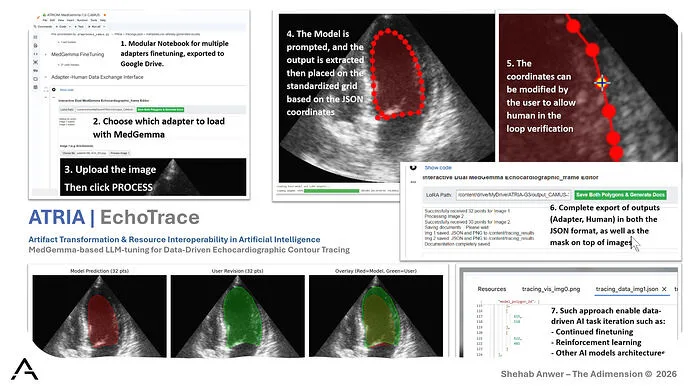
According to the FDA's software as a medical device policy, ATRIA EchoTrace currently falls under the "general well-being software" category—basically, it's allowed as long as it's absolutely only for research and doesn't touch clinical decision-making.
However, it's critical to understand that software that doesn't fall under traditional medical device regulations can still expose healthcare providers to liability risks if it's mishandled. Four key areas to watch out for:
- Failure to properly validate performance relative to human-produced gold-standard data
- Inaccuracies in the point-based polygon model
- Failure to establish and verify protocol integration within existing healthcare institutions
- Incorrect or inconsistent labeling and advertising of the software's capabilities
Tech developments similarly impact the legal challenges due to fundamental limitations in medical AI, such as underpinnings in narrow datasets and difficulties in mirroring entire clinical workflows within research output.
For extremely thorough guidance specific to your situation, we recommend reaching out to Google's medico-legal team or consulting with legal experts well-versed in the intricacies of AI regulation and healthcare law. Everyone else, chiming in here would be amazing!
What is the current status of ATRIA EchoTrace's legal and regulatory standing?
As the google/medgemma-1.5-it model being utilized in this project is CuSTOM (community-supported Third-party Open-source Model)—that is, not a Google-owned or maintained model—Google does not own or have any responsibility for ATRIA EchoFlat's outcomes or capabilities.
Can Any Information be Used for Clinical Applications at this Time?
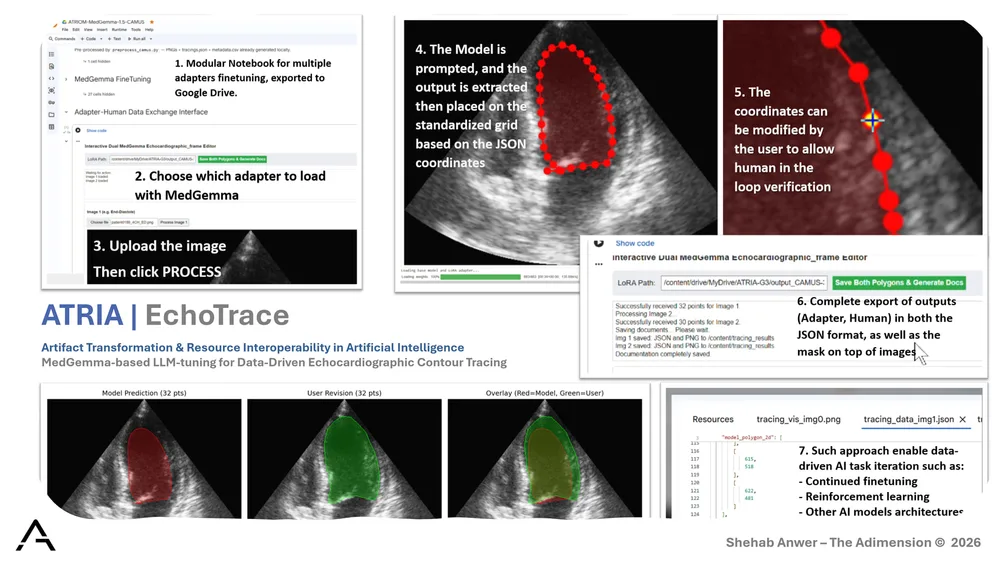
In its current form, ATRIA EchoTrace is being used strictly for research-style rdsAnnotation—the transformation of shape splines in some
3D point cloud data to facilitate human-driven Machine Learning (ML)-based research.
It would be a violation of Google's Terms of Service to use this model or any Google services for clinical purposes without an Investigational Device Exemption (IDE). For
Human Subjects Research (HSR), you'd need appropriate Informed Consent documentation and a compliant framework for integrating outputs with healthcare systems.
Is Google Collaborating with the Created Confidential AI Technology?
While Google does host significant open-source communities focused on medical AI research—including MedGemMa—they currently do not invest in Heart Imaging-specific architectures, such as that created by Shehab Anwer.
What are the Medicolegal Risks Associated with ATRIA EchoTrace's Software and AI Technology?
There's an ongoing shift happening. Historic clinical and legal barriers are beginning to dissolve as AI technologies prove to
increase diagnostic accuracy, enhance access afforded to care providers, and improve efficiency.
Are There Potential Collaborations between Google and ATRIA EchoTrace Project Creators?
For integrations with existing epic and Cerner systems, partnering with companies such as Casemedica or Medmind may be an option
How Can ATRIA EchoTrace be Used Responsibly and Eff ciciently?
If people are interested, I can close this thread publicly and set up a dedicated MedGemma Slack to reduce organizational clutter and duplication of effort. Slack is where Google’s engineers actively share updates, and it’s more convenient for quick back-and-forth, especially for projects like ATRIA EchoFlat where multimodal feedback and collaboration are key.
Yeah, I would recommend sending her the invite link; I think she’ll definitely be interested in contributing. In fact, she’s one of our core OSS contributors in the Medical Gemini Team—her contributions are already in use for eosinophils nuclei segmentation. G-sharing is also in the
Pipe right now and should be merged next week. BTW, once you get a test version ready for Shehab’s new project, I'm happy to review it—this specific application is of significant patient outcomes, so it
All Replies (0)
Want a live back-and-forth? Join the global AI chat room — login to talk.
No replies yet — be the first!