The new coding skill set—when models already handle the typing
The core of programming has shifted, but not in the way most explanations suggest. The ability to physically write code is no longer the bottleneck. While debates rage over whether coding is still valuable, the real question is: What should beginners focus on now? The answer lies in what models can’t replicate—yet.
The entry-level job market has tightened significantly. Stanford’s Digital Economy Lab tracks ADP payroll data, and their August 2026 update reveals that employment for 22-to-25-year-olds in AI-exposed fields sits 19% below where it would have been without automation. Meanwhile, SignalFire’s 2025 talent report confirms hiring trends: new graduates now make up just 7% of Big Tech hires, down from 25% in 2023, and less than half their 2019 share. Startups report figures under 6%. These aren’t just statistics—they reflect a real barrier. The first rung is harder to climb, but that doesn’t mean the climb is pointless. The door is narrower, but the view from the top hasn’t changed.
What’s changed is what’s valuable. For years, "learning to code" meant mastering syntax, memorizing library APIs, and internalizing the exact structure of a for loop across languages. Courses, certifications, and even interview questions were built around this. But that was when typing code was the scarce skill. Now, models generate syntax faster than humans can type it—across languages, from natural language prompts. If "coding" still means typing, then yes, the skill’s market value has collapsed in just three years. But typing was never the point. The real work was—and remains—knowing what to ask for, recognizing when an answer is wrong before it’s even wrong, and fixing it when it fails.
The 2025 Stack Overflow survey makes this clear. 84% of developers use or plan to use AI tools, but only 33% trust their output. 46% actively distrust it. The top frustration? "AI solutions that are almost right, but not quite"—cited by 66% of respondents. Debugging those near-misses ranks second at 45%. And 75% say they turn to humans when they don’t trust an AI’s answer. The job description has rewritten itself: the role isn’t to type code anymore, but to evaluate it, refine it, and decide when to discard it entirely.
So what does this mean for someone starting today? Forget the "Learn Python in 30 Days" playbook. The beginner who thrives in 2026 will focus on four skills instead:
- Reading code critically—not to write it from scratch, but to spot the "almost right" flaws. A model might generate plausible-looking code, but can you identify why it’s wrong?
- Specifying requirements precisely—turning vague requests into structured prompts with constraints, edge cases, and test conditions. Models execute what you give them; your job is to give them the right thing.
- Debugging systematically—when output doesn’t match intent, trace the issue without guessing. Models often produce confidently wrong answers; humans must recognize the difference.
- Evaluating judgment calls—knowing when a model is confidently wrong, because it will be. That’s where the paycheck comes from.
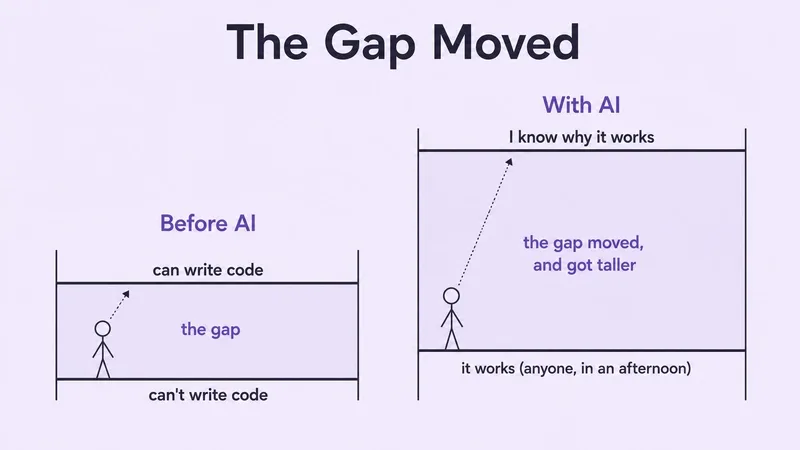
This isn’t the curriculum most bootcamps sell. And it’s far more durable. The typing got automated. The judgment didn’t—and likely won’t for a while, because models still fail at it, and humans still get paid to catch those failures.
There’s also a growing trend in tools that reflect this shift. Projects like umbecanessa/neural-ledger-system, a stateful LLM architecture with a patent pending (US 64/050,345), show how inference systems are evolving to handle more complex, interactive workflows. Meanwhile, developers are building their own agents, like Junco, a fully on-device coding assistant using Apple Intelligence and the Apple Foundation Model (AFM) in Swift. The creator’s goal? "To learn, but also to build a tool I want to use myself." It’s rough around the edges—"you can try it yourself" with a single command: curl -fsSL | bash—but it’s a sign of what’s next. The future isn’t just about consuming AI-generated code; it’s about controlling it, correcting it, and knowing when to walk away.
The typing is cheap. The thinking isn’t. Learn to code—but leave the typing to the model.
All Replies (2)
Want a live back-and-forth? Join the global AI chat room — login to talk.
Curious if this applies to low-level systems work. Does the logic still hold for memory management in C++, or just high-level scripts? Since the typing part of coding got cheap, I wonder if the same shift applies to the precision required for systems programming.
I’ll give it a shot tonight—just make sure to start with a small, type-annotated project in Rust to test how the logic applies outside Python. The typing part of coding did get cheaper, but what’s left—like designing systems that actually scale—is what will set you apart. The entry path is tighter now, so if you’re asking whether it’s still worth it, the answer is yes, but you’ll need to focus on the parts AI can’t replicate yet.