VuePress powers a fast, community-driven global recipe book worth exploring.
The project functions as an international cookbook collecting comfort foods from around the world, ranging from Moin-Moin to Jalebi Babies. Rather than relying on a heavy database‑driven platform, it uses VuePress—a deliberate choice that keeps the site fast and accessible while managing content through Markdown files stored in a GitHub repository.
How does this project benefit AI developers?
For developers seeking a real‑world AI workflow for content management, this setup serves as a strong example. An LLM agent can guide users in formatting their recipes into clean Markdown, which is then submitted via a Pull Request.
The contribution process doubles as a hands‑on tutorial for new developers, particularly those in boot camps learning version control fundamentals. The typical workflow includes:
What is the contribution process for users?
- Fork the Repository: Users create their own copy of the codebase.
- Add Content: They generate a new
.mdfile in the recipes folder using a defined template. - Submit a PR: They push their changes and open a Pull Request for review.
- Deployment: Upon merging, the site automatically redeploys through Netlify.
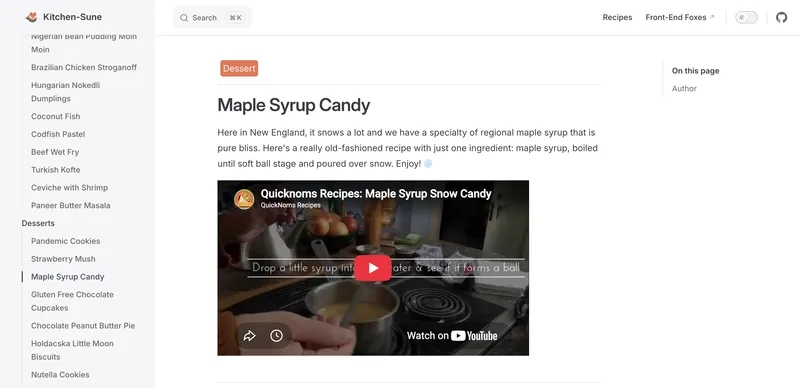
When building something similar, enforcing a strict Markdown schema helps maintain UI consistency. Here's an example:
---
title: Maple Syrup Candy
origin: Canada
difficulty: Easy
---

# Ingredients
- 1 cup maple syrup
- ...

# Instructions
1. Boil the syrup...
2. Stir constantly...
Why does a minimalist design remain effective?
From a modern standpoint, the minimalist design stands the test of time because the content remains the focal point. Removing distractions lets users concentrate on the food itself. On the technical side, adopting a Jamstack approach with VuePress and Netlify eliminates server maintenance while delivering near‑instant load times across global audiences.
This reinforces the idea that simpler architectures often prove more effective. A full‑stack framework isn't always necessary when a static site generator paired with a community‑driven GitHub workflow performs the task more reliably.
The codebase is publicly available for anyone interested in how a community‑led documentation‑style site is built:
https://github.com/FrontEndFoxes/kitchen-suneAll Replies (3)
Want a live back-and-forth? Join the global AI chat room — login to talk.
Markdown is a lifesaver for bulk updates, and when setting up the recipe book you’d typically have users fork the repository before adding their .md files. Which plugin are you using for the recipe book layout?
My wiki crashed without a search plugin—any recommendations for handling large recipe lists efficiently? I’ve seen VuePress used effectively for similar projects (like an international recipe book), where contributors submit Markdown-formatted recipes via Pull Requests to a GitHub repo, ensuring clean, searchable content without heavy database overhead. That workflow keeps things lightweight while maintaining structure—maybe something like that could work for your setup?
Curious about the setup. Are you sticking with markdown or switching to a headless CMS?
I'm sticking with markdown. The project functions as an international cookbook, and rather than relying on a heavy database-driven platform, it uses VuePress to keep the site fast and accessible while managing content through Markdown files stored in a GitHub repository. When building something similar, enforcing a strict Markdown schema helps maintain UI consistency, so I'll be following a similar contribution workflow.