AI Agents in the Software Factory
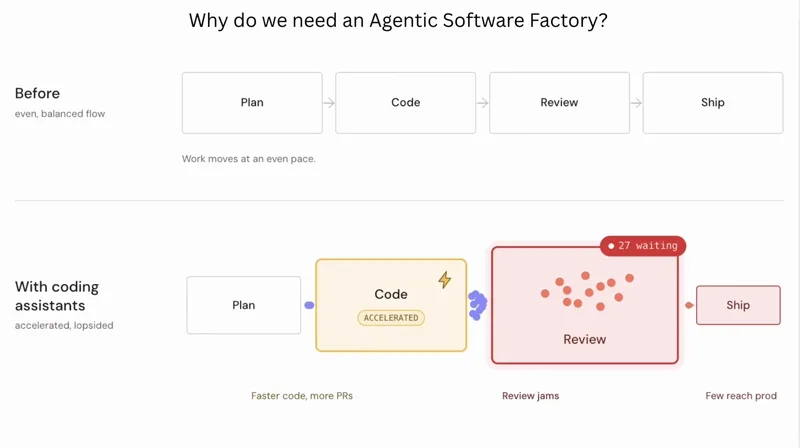
If accelerating code generation creates a surge in feature output, the real bottleneck shifts to review and quality assurance stages. This pressure transfer explains why the agentic software factory model is gaining traction as a necessary evolution.
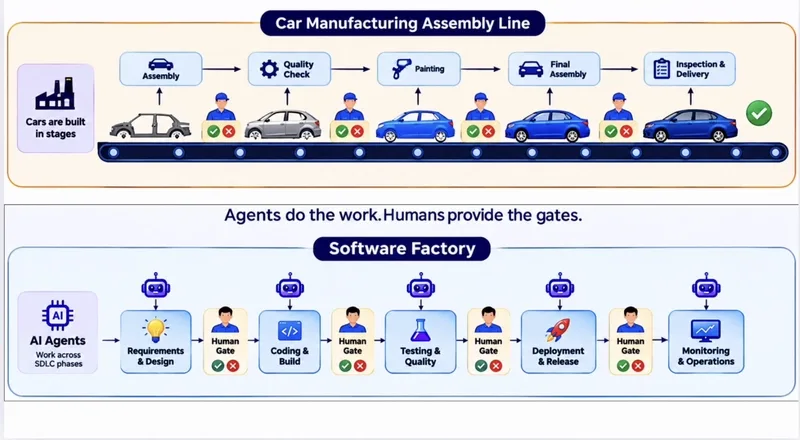
The objective is to move beyond viewing AI as an advanced autocomplete and instead treat the entire software development life cycle as a connected production line. In traditional manufacturing, a component progresses through defined stations such as assembly, finishing, and quality control. An agentic workflow applies this same sequential logic to coding. Rather than relying on a single comprehensive prompt, the process uses specialized agents for distinct phases including planning, coding, testing, and deployment, with human operators serving as final quality checkpoints.
Structuring the Agentic Workflow
Transitioning to this model requires shifting the mindset from conversational interaction with AI to process orchestration. A practical AI workflow for a software factory typically follows these stages:
1. Context and Requirements: An agent reviews existing documentation and service context to establish precise objectives.
2. Implementation Strategy: Before code generation begins, an agent creates a technical blueprint. This stage often involves human intervention to prevent the AI from suggesting nonexistent dependencies.
3. Development: The agent executes the established plan, handling the primary coding tasks.
4. Automated Testing: The code enters a continuous integration pipeline where agents, or established test suites, verify the modifications.
5. Human Review: A developer examines the changeset. The reviewer focuses on strategic validation rather than routine checks, providing approval based on security protocols and architectural consistency.
6. Release and Monitoring: Deployed code is monitored by agents for performance indicators. Anomalies, such as error rate spikes, can trigger automated reversal procedures or team alerts.
Progression in Software Delivery
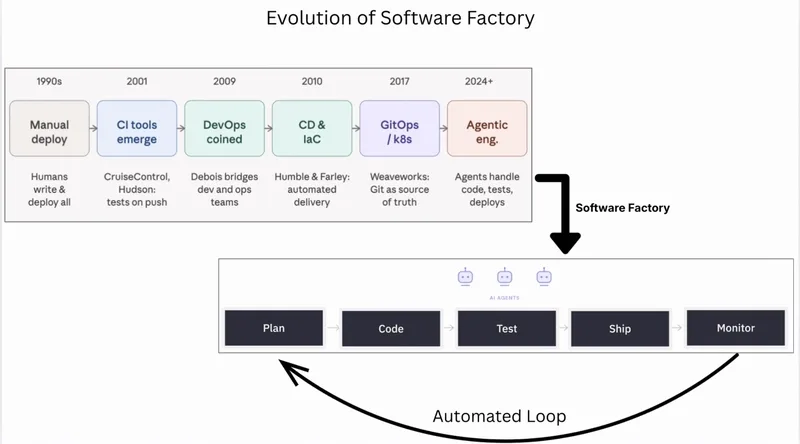
The industry has transitioned from manual server configuration in earlier decades to DevOps automation, and now to this agentic layer. The key distinction is that previous automation focused on streamlining the workflow, whereas agentic systems automate the decision-making processes embedded within that workflow.
For those implementing this structure, a phased approach is recommended. Beginning with a dedicated test case generation agent provides a safety net, enabling greater reliance on coding assistants like Claude Code or Cursor without proportional risk to production stability.
The intent is not to eliminate the developer role but to redefine it. Developers transition from executing repetitive tasks to overseeing system design and constraint definition, while agents manage the execution layer.
All Replies (3)
Want a live back-and-forth? Join the global AI chat room — login to talk.
Architectural drift is a nightmare. How are you stopping the agent from hallucinating dependencies?
Rushing AI output ruined my last project. How do you verify the code before deploying?
I'm seeing so much junk code. Does a strict automated testing layer actually stop the hallucinations?