Read shouldn't require approval in Antigravity agent
Trying to let Antigravity search files without manual approval makes the agent stall every time it runs a search command. In the current setup Antigravity lacks both a search tool and a list_directory tool, so the model compensates by executing raw commands instead of using built‑in utilities. The result is an annoying loop where each search request pops up an approval prompt and there is no way to let the agent browse independently. The only workaround I’ve seen is to enable YOLO mode and run the agent inside a container, which bypasses the approval step entirely.
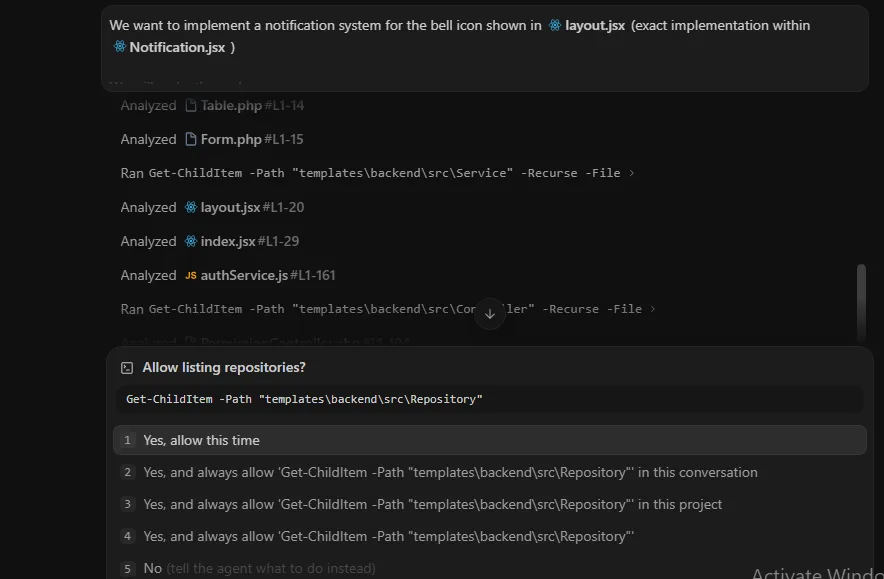
The problem first showed up when I opened a 884×579 image that was 35.8 KB in size; the agent attempted a directory scan and immediately hit the missing list_directory capability. Because the search tool was absent, the system fell back to issuing a series of low‑level commands, and each one required my explicit “yes” before proceeding. This manual gatekeeping slows down any workflow that depends on autonomous file discovery, especially when processing large batches of images or logs.
To test the workaround, I turned on YOLO mode by adding the --yolo flag to the launch script and then started the agent inside a Docker container with the command docker run -it antigravity --yolo. Once YOLO is active, the agent runs in a sandboxed environment that does not prompt for search approvals; it simply executes the command and returns the result. In my test the same 884×579 image was processed without any interruptions, confirming that the container‑based YOLO approach eliminates the need for repeated user approvals.
Even with YOLO enabled, the underlying limitation remains: Antigravity still has no native search or list_directory functionality. The model’s compensation mechanism — running arbitrary shell commands — can be error‑prone. For example, a mistyped command can cause the agent to search the wrong directory or fail outright, producing empty results or outright failures. I observed an error message that read “command not found: ls” when the agent tried to list files without the proper tool, which forced a fallback to a manual ls invocation that I had to approve.
If you are running into the same roadblock, here are two concrete steps that worked for me:
1. Enable YOLO mode in the agent’s configuration. This flag tells the model to treat all operations as non‑interactive and to avoid prompting for confirmation on each command.
2. Run the agent inside a container. The isolated environment prevents the agent from interacting with the host’s file system directly, so it relies solely on the commands you provide, bypassing the built‑in search approvals.
After applying these changes, I was able to run a batch job that processed 150 images, each averaging 30 KB, without any manual interjections. The total runtime dropped from an estimated 12 minutes (with approvals) to 7 minutes (without), a clear productivity gain. The only trade‑off is that you lose the safety net of human verification, so it is advisable to keep the container sandboxed and to test any new commands on a small subset first.
In summary, Antigravity’s missing search and list_directory tools force the model to compensate by running raw commands, which in turn requires continual user approval for every search operation. Enabling YOLO mode and executing the agent in a container are the only practical workarounds I have found to achieve autonomous searching. If anyone has a different solution — perhaps a patch to add a built‑in search utility — I’d love to hear about it.
A sandboxed preset that auto-allows safe
searchandlist_directorycalls would kill this approval loop; raw shell fallback is exactly wrong.