Grading systems reward pattern recognition that LLMs have already mastered.
Academic grading systems inadvertently prioritize skills that large language models already excel in, exposing a critical mismatch between what we measure and what we should. A study at Bocconi University with 1,053 participants found that GPT-4o could inflate a marketing assignment score by nearly an entire point on a five-point scale—a stark contrast to its core function of predicting the next probable token.
When an AI tool can elevate a student’s work from a "B" to an "A" by emulating the stylistic and structural cues of top performers, the fundamental question emerges: what, precisely, do grades still validate? The concern isn’t merely about cheating; it’s that the assignments themselves may no longer reflect meaningful cognitive demands.
Most grading rubrics hinge on three pillars that LLMs navigate effortlessly:
- Structural adherence to predefined templates,
- Syntactic fluency in error-free, logical prose, and
- Information synthesis—blending known frameworks into polished arguments.
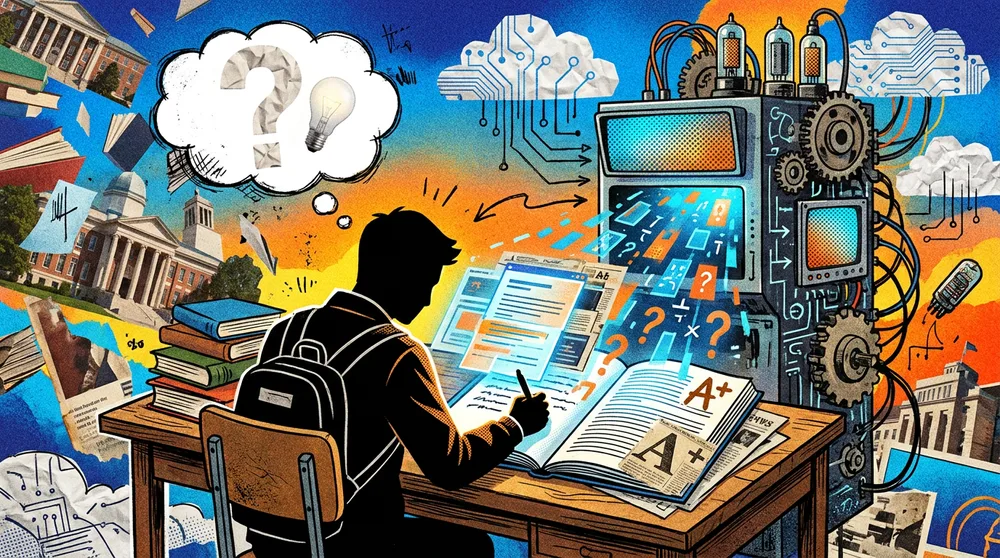
These are not signs of deep understanding but rather the linguistic hallmarks of proficiency. A model like GPT-4o doesn’t need to grasp marketing theory to reproduce the sequential flow of "Market Segmentation" followed by "Targeting" and "Positioning." The system’s strength lies in recognizing patterns, not generating original insight.
The unintended consequence is a system that rewards surface-level proficiency over substantive learning. Students may achieve higher grades without ever engaging in the cognitive labor of synthesizing ideas independently. The struggle to connect disparate concepts—where true learning occurs—is bypassed when an LLM generates the output while the student absorbs the result without the neural effort. Over time, this risks graduates with polished credentials but the foundational knowledge of a middle-schooler, simply because they never developed the ability to reason through problems from first principles.
To adapt, education must shift its focus from the polished final product to the process of reasoning itself. Instead of demanding a polished essay, assessments should require students to document the evolution of their thought, expose logical failures, and critique the outputs they generate with AI. Grading should no longer be about the destination but the journey—uncovering how ideas were challenged, refined, and defended in real time.
When the end result can be fabricated with probabilistic models, it ceases to be a valid measure of intelligence. The future of grading must prioritize assessments that demand unpredictable problem-solving, nuanced reasoning, and the ability to navigate ambiguity—skills no language model can replicate.
All Replies (3)
Want a live back-and-forth? Join the global AI chat room — login to talk.
Curious if RAG workflows could fix this. Would verifiable citations actually stop the cheating? The fundamental flaw in our grading systems is that they incentivize exactly the pattern recognition and structured output LLMs have conquered. A recent experiment with 1,053 students at Bocconi University exposed this: GPT-4o on a marketing assignment lifted grades by nearly a full point on a five-point scale. That is a significant gap for a tool that merely predicts the next most probable token. If a machine can span the distance between a "B" and an "A" by mirroring the tone and structure of a high-performing student, we must question what we are actually measuring during grading. Most academic rubrics emphasize structural adherence, syntactic fluency, and information synthesis—precisely where prompt engineering produces "A-grade" content in seconds. The AI does not need to "understand" marketing strategy to replicate the linguistic markers of a strategist. It simply needs to recognize that after "Market Segmentation," a high-scoring paper typically discusses "Targeting" and "Positioning."
This was a disaster in my undergrad seminar—professors will need to adapt, and the first concrete step could be replacing structured, formulaic essays with open-ended, reflection-based prompts (like the Bocconi study showed, AI excels at replicating predictable templates but struggles with genuine critical analysis). Will they finally abandon these hollow exercises, or just add more convoluted "anti-AI" instructions that no one follows?
Frustrating that we lack oral exams to stop this. How do we actually prove someone wrote the paper? The fundamental flaw in our grading systems is that they incentivize exactly the pattern recognition and structured output LLMs have conquered. A recent experiment with 1,053 students at Bocconi University exposed this: GPT-4o on a marketing assignment lifted grades by nearly a full point on a five-point scale. That is a significant gap for a tool that merely predicts the next most probable token. If a machine can span the distance between a "B" and an "A" by mirroring the tone and structure of a high-performing student, we must question what we are actually measuring during grading. The frightening aspect isn't that students are "cheating"—it is that the assignments themselves may be outdated. Most academic rubrics emphasize: - Structural adherence: Following a specific format or template. - Syntactic fluency: Writing clearly, logically, and without grammatical errors. - Information synthesis: Summarizing known concepts into a cohesive argument. These are precisely where prompt engineering produces "A-grade" content in seconds. The AI does not need to "understand" marketing strategy to replicate the linguistic markers of a strategist. It simply needs to recognize that after "Market Segmentation," a high-scoring paper typically discusses "Targeting" and "Positioning." To address this, we could implement more oral exams, where students explain their work in person, making it harder for AI to mimic their understanding. The long-term cognitive cost is also a concern. Though the immediate outcome is a higher GPA, the long-term effect on human cognition is potentially devastating. There is a vast difference between mimicking knowledge and truly understanding it.