Organizational knowledge is the only real moat left in the AI era
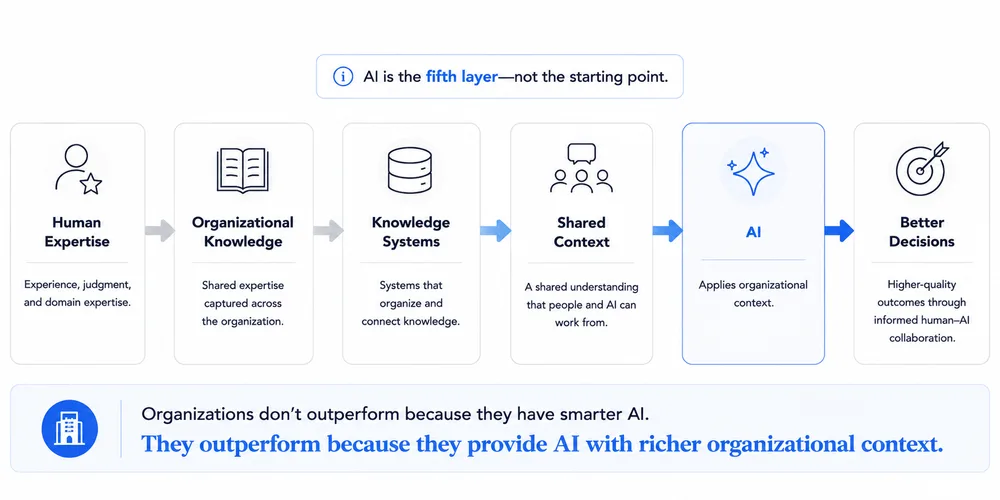
Most companies are treating LLMs like a magic pill, plugging in a generic model and wondering why the output feels like a corporate brochure. The reality is that the model isn't the advantage—everyone has access to the same frontier models. The actual competitive edge is the proprietary, messy, undocumented knowledge trapped in your company's Slack channels, old PDFs, and the heads of senior engineers. If you aren't figuring out how to bridge this knowledge gap, you're just paying for a very expensive autocomplete.
Why generic LLMs fail in production
When you deploy a standard AI workflow, you hit a wall the moment the task requires context that isn't in the public training set. A generic model knows how to write Python, but it doesn't know why your specific legacy API handles authentication in a weird, non-standard way. This is where the "Knowledge Gap" happens. You end up spending more time correcting the AI's hallucinations about your internal processes than you would have spent just doing the work manually.
To actually move from a demo to a real-world deployment, you have to stop focusing on the model and start focusing on the data pipeline. This usually means moving toward a RAG (Retrieval-Augmented Generation) architecture, but even then, most people do it wrong by just dumping raw folders into a vector database.
Closing the gap with a better AI workflow
If you want to turn organizational knowledge into a functional LLM agent, you need a more surgical approach to prompt engineering and data retrieval. Here is a practical way to structure this:
1. Knowledge Auditing: Identify the "golden sources" of truth. Stop indexing everything; index the documentation that is actually correct.
2. Contextual Chunking: Instead of splitting text by character count, split by semantic meaning. Use metadata tags to tell the AI whether a piece of information is a "hard rule" or a "suggested guideline."
3. Iterative Refinement: Build a feedback loop where subject matter experts (SMEs) flag wrong answers. Use these corrections to update the knowledge base, not just the prompt.
The goal is to create a system where the AI acts as a high-speed interface for your company's collective intelligence. When you successfully map your internal logic to the LLM's reasoning capabilities, you stop worrying about which model is "smarter" and start benefiting from a system that actually understands your business. The win isn't in the AI itself, but in how effectively you can feed it the specific, private context that your competitors don't have.
All Replies (3)
Want a live back-and-forth? Join the global AI chat room — login to talk.
This is a goldmine. Are you getting better results from RAG or fine-tuning for this?