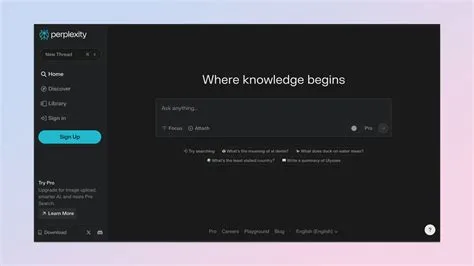
Is Nvidia's $30 billion investment in Perplexity actually worth the excitement?

PromptCube Expert 2h ago 189 views 1 likes 4 min read

Nvidia has become the AI industry's biggest investment fund, splashing billions across chips, models, and compute companies in recent months. Now they're placing a massive bet on an AI application company — Perplexity.
Is Nvidia's $30 billion investment in Perplexity actually worth the excitement?

The rumor: Nvidia is in talks to invest in the AI search startup, which would push its valuation past $30 billion — a 50% jump from just a year ago. If it closes, this becomes one of Nvidia's most strategically important ecosystem plays.

Perplexity isn't just growing in valuation — its revenue is accelerating hard. Annual recurring revenue reportedly hit $750 million recently, up from under $250 million at the start of the year. The growth is driven by AI search subscriptions and its new Pro Agent product, Perplexity Computer, which handles full desktop workflows autonomously.

For Nvidia, though, Perplexity's value runs deeper than being another search entry point. Over the past few years, Nvidia rode the generative AI wave thanks to its dominance in GPUs and CUDA. But as competition shifts from raw compute toward models and applications, Nvidia needs new leverage — and Perplexity sits right at that intersection of user-facing AI and developer tooling.

Is Nvidia's $30 billion investment in Perplexity actually worth the excitement?

From AI Search Star to Ecosystem Puzzle Piece

Founded in 2022, Perplexity emerged as one of the earliest pure-play AI application companies, built around a simple but powerful idea: rebuild search using large language models.

When ChatGPT first exploded, traditional search was still stuck on keyword matching and listing web results. Perplexity flipped the script — ask a question, get synthesized answers pulled from across the web, with source citations. It became the de facto face of AI-powered search.
Is Nvidia's $30 billion investment in Perplexity actually worth the excitement?

But that advantage is eroding fast. With OpenAI, Google, and Anthropic baking in browsing and agentic capabilities, Perplexity’s core differentiator is getting watered down. So they pivoted — transforming from a single-purpose search tool into a broader AI assistant platform.

Enter Perplexity Computer: less about answering questions, more about doing tasks. Think data aggregation, software automation, end-to-end workflow execution — exactly the kind of agentic behavior OpenAI and Anthropic have been signaling too. The battlefield has moved from “who answers better” to “who actually gets stuff done.”

So why did Nvidia pick this company among so many AI agent plays?

Is Nvidia's $30 billion investment in Perplexity actually worth the excitement?

Enter Nemotron: Nvidia’s Play for AI Infrastructure Control

Make no mistake, Nvidia dominates today’s AI stack as the go-to supplier of compute power. Both OpenAI and Anthropic rely heavily on their chips. Yet despite controlling the foundation of the AI boom, Nvidia lacks direct access to billions of end users — something it desperately wants to change.

That’s where Nemotron comes in.

Unlike closed models like GPT or Claude, Nemotron isn’t designed to compete directly. Instead, it aims to be Nvidia’s version of AI infrastructure — offering models, datasets, training methods, and inference tools so businesses and developers can build apps natively on top of Nvidia hardware.

Open-source momentum — led by players like DeepSeek — has made it clear that proprietary models aren’t the only path forward. By doubling down on open ecosystems, Nvidia hopes to drive demand for its own silicon further up the stack.

Which brings us back to Perplexity. As AI becomes more agentic, whoever owns the top-layer application interface gains serious influence over how people interact with foundational models. That makes Perplexity a strategic bridge between Nvidia’s lower-level dominance and the consumer-facing future they want to shape.

And unlike most startups chasing unicorn status alone, Perplexity comes pre-loaded with real usage, proven monetization, and star power — all without requiring billions upfront.

Tying Up Loose Ends

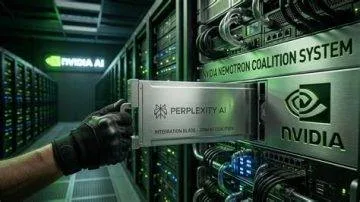
Looking closer, the relationship seems inevitable. Back in March, Perplexity joined Nvidia’s Nemotron Coalition, collaborating across model development, hardware optimization, and software engineering. Reports also suggest Nvidia considered investing tens of millions via tech licensing and talent acquisition — mirroring its approach with AI coding firm Poolside, where investment, tech sharing, and team integration happened simultaneously.

These aren’t just financial bets — they’re ecosystem plays aimed at building out a complete AI software stack under the Nvidia umbrella.

Still, skepticism remains. Sure, Perplexity was ahead of the curve in AI search, but can it justify a $30 billion tag?

The harsh truth? In the old internet era, companies could lock in loyalty through design, experience, and ecosystem stickiness. But in the age of AI, the line between application and base model keeps blurring.

Perplexity succeeded because LLMs elevated search beyond text retrieval. But once OpenAI, Google, and Anthropic replicate those features internally, differentiation fades fast. Suddenly, app builders depend entirely on whatever foundational model wins — and risk being rewritten by the next upgrade cycle.

Two years ago, Jensen Huang himself said he used Perplexity daily. At the time, it felt like prophecy — AI search was the future, and he knew it.

Today? He might say the same thing. Except now, I’ve stopped using it altogether.

Not because it got worse — because everything else caught up so quickly that nothing feels irreplaceable anymore.

If Perplexity really is worth $30 billion, then proving that value will take more than nostalgia or hype. It’ll need to own whatever comes after search — and make sure nobody else defines that future for them.

NvidiaPerplexityNemotron
Detailed breakdowns of putting AI to work are in a guide to making money with AI, with plenty of directly applicable cases.

All Replies (3)

N
NeonPanda Intermediate 2h ago
Makes sense. I've been using Perplexity daily for research and it's a total game changer.
0 Reply
L
LeoMaker Expert 2h ago
Do you think this move is more about securing their software moat or just hardware distribution?
0 Reply
A
AlexTinkerer Advanced 2h ago
Don't forget they're also trying to control the data pipeline, which is just as vital as the chips.
0 Reply

Write a Reply

Markdown supported