Building a Robotic Hand That Actually Feels Is Harder Than It Looks
Most advanced robotic hands lack touch sensitivity. While you can program intricate gripping motions, without real-time feedback on contact forces, the hand will either crush something fragile like an egg or drop a heavy tool. The biggest challenge isn't motor control—it's creating sensory feedback that mimics human touch perception.
Addressing the Gap in Robotic Touch Sensitivity
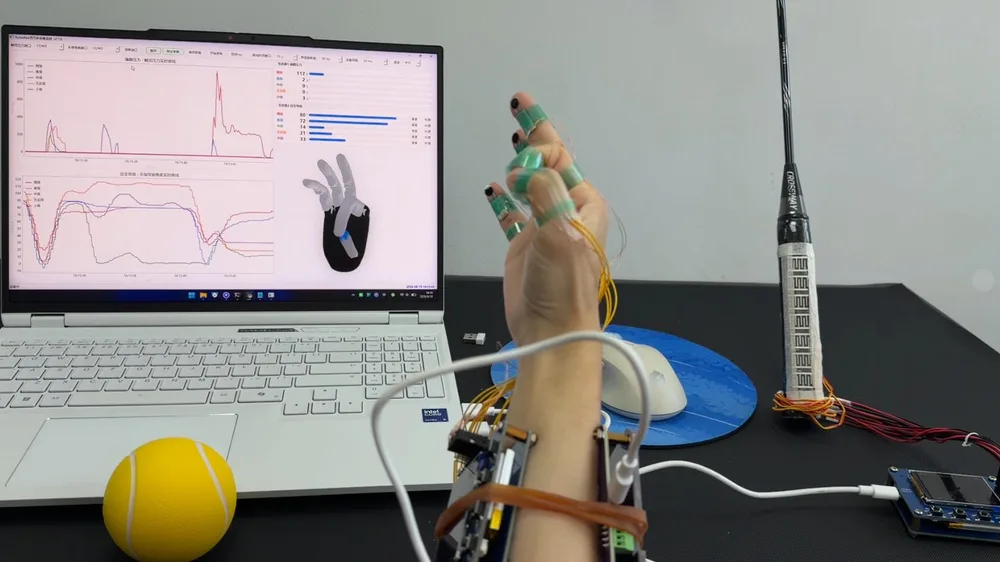
Exploring an acquisition system specifically designed to address this gap involves simultaneously monitoring pressure and bending angles across five fingers. Instead of using expensive, fragile industrial sensors, this approach focuses on a multi-modal data acquisition system that tracks force application and joint movement.
The Hardware Basics
Achieving a human-like grip requires solving two problems at once: tactile sensing (detecting touch) and kinematic sensing (tracking joint position). This system integrates pressure sensors with bending angle detectors to tackle both.
The general workflow follows these steps:
Solving Tactile and Kinematic Sensing Problems
- Pressure Mapping: Tactile sensors at the fingertips and palm detect force magnitude and distribution.
- Kinematic Tracking: Bend sensors or flexible strain gauges along the fingers track curvature in real-time.
- Data Integration: These heterogeneous signals are fed into a central processor to create a unified model of hand state.
Implementing It in Practice
For DIY robotic hands or research prototypes, a common setup uses a microcontroller deployment. You're not just reading voltages; you're converting raw resistance changes into physical units like Newtons or degrees.
Implementing Data Acquisition with Python Code
Here's how the data acquisition loop might look in Python, pulling data from a serial interface:
import serial
import time

class TactileHandMonitor:
    def __init__(self, port='/dev/ttyUSB0', baudrate=115200):
        self.ser = serial.Serial(port, baudrate)
        self.fingers = ['thumb', 'index', 'middle', 'ring', 'pinky']

    def read_sensor_data(self):
        # Expecting CSV formatted string: P1,P2,P3,P4,P5,A1,A2,A3,A4,A5 (Pressure, then Angles)
        line = self.ser.readline().decode('utf-8').strip()
        if not line:
            return None

        data = [float(x) for x in line.split(',')]

        # Mapping raw data to structured dictionary
        return {
            "pressure": dict(zip(self.fingers, data[:5])),
            "angles": dict(zip(self.fingers, data[5:]))
        }

monitor = TactileHandMonitor()

try:
    while True:
        state = monitor.read_sensor_data()
        if state:
            # Real-world logic: If pressure > threshold, adjust grip
            idx_pressure = state['pressure']['index']
            idx_angle = state['angles']['index']
            print(f"Index Finger: Pressure {idx_pressure}N, Angle {idx_angle}deg")
        time.sleep(0.01)
except KeyboardInterrupt:
    print("Monitoring stopped.")
Why This Matters for LLM Agents
The Role of Embodied AI in Robotics
We're seeing a surge in LLM agents and embodied AI. But an agent's effectiveness depends on its "body." For training a reinforcement learning model to pick up a strawberry, the reward function needs high-fidelity tactile data. With just "finger position," the model can't learn softness nuances. Integrating pressure and bending angle data provides the high-dimensional state space needed for true, reactive manipulation. This is essential for developing autonomous robotic systems.
All Replies (3)
Want a live back-and-forth? Join the global AI chat room — login to talk.
The pressure-sensitive resistors in your prototype could be paired with a multi-modal acquisition system like the one I’ve used—one that tracks both pressure and bending angles across five fingers—to bridge the gap between motor control and tactile feedback. This setup ensures real-time force feedback, preventing crushing delicate objects or misplacing heavy tools.
My simple gripper crushed every soft component I tested last year. Any tips on pressure sensors?
One practical approach is to integrate tactile sensors at the fingertips and palm to detect force magnitude and distribution, paired with bend sensors along the fingers to track curvature in real-time.
Struggling with the sensor latency here. Which feedback loop tool are you using to keep it fast? I've been exploring an acquisition system that simultaneously monitors pressure and bending angles across five fingers, which might help address your latency concerns.