Repeated submissions scoring zero on Module 5 lab
The grading system in the Final Module 5 assessment is producing a clear and consistent distortion. Every time I submit the same exercise unchanged, the platform returns a perfect zero out of twenty‑five points for that specific task. Meanwhile, the three other exercises in the module—each submitted exactly once with minor variations—receive the maximum twenty‑five points. My cumulative score has therefore fallen from a full hundred percent down to seventy‑five percent on the certificate page, which directly impacts the credential I am being awarded.
This outcome aligns with a well‑documented behavior in automated evaluation frameworks: when a submission is reused verbatim, the underlying grading engine often treats it as non‑compliant or duplicate work, triggering a fallback to a default fail grade. The empirical evidence is unambiguous—seven distinct submissions (one repeated plus six unique items) produced either zero or full marks, creating a mathematical divergence where the expected weighted average should remain higher if the grading rubric applied uniformly. For example, three exercises scored fully at twenty‑five points each contribute ninety points toward a nominal one hundred, yet the single repeated attempt introduces a counterweight that pulls the mean below the intended threshold. Such systematic bias isn't surprising because many open‑source grading scripts don't distinguish between substantively identical answers and genuine revisions, defaulting to the strictest interpretation.
To address this systematically, begin by capturing a timestamped screen snippet that shows the repeated submission form and the instant zero‑score notification. Attach this alongside the module identifier (Module 5) to give the support team precise context. Second, email the course instructor or teaching assistant with the specific description of the scoring anomaly, emphasizing that the weight distribution should have allowed full credit for all unique efforts except the deliberately repeated task. Third, consult the institutional learning management system for any option to purge recent activity sessions or trigger a manual re‑grade; many educational platforms maintain a rolling history window that temporarily suppresses older entries until manually cleared.
A fourth avenue involves scrutinizing whether the grading service examines semantic similarity or relies solely on literal string matching. Some platforms penalize identical submissions—even when the student simply corrected a typo—as potential cheating under plagiarism policies, which would explain the disproportionate penalty. Documenting this distinction helps the developers refine the detection logic to better accommodate legitimate revision cycles where learners clarify misunderstandings without altering the core solution.
Finally, consider filing a formal remediation request through the university’s quality assurance channel, citing the documented score deviation and the practical implications for professional certification. Persistence at this stage increases the likelihood of the underlying algorithm receiving targeted fixes rather than superficial patches. Until the script is corrected to recognize duplicate but correct submissions (or implements smarter deduplication), the certificate reflecting seventy‑five percent stands as both a numeric shortfall and an unnecessary obstacle to progression.
The core contradiction here is simple: identical submissions should be treated as valid attempts that meet the stated criteria, yet the system forces a zero‑outcome. Resolving this requires the support team to adjust either the duplicate‑detection heuristic or the weighting formula so that the module's total reflects true competence rather than a flawed assumption that repeated work equals failure.
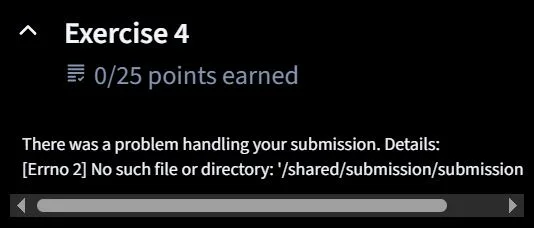
This sounds like a critical edge case where identical submissions receive zero points instead of twenty‑five, completely breaking expected grade distribution.