Chinese open-weight models now outpace US models by 1.6B downloads on Hugging Face
Chinese teams are increasingly adopting open-weight models in their tech stacks due to their performance parity with closed APIs. The perception of open models as merely cost-effective alternatives to GPT-4 is outdated. Chinese models currently demonstrate superior adoption rates and performance, particularly in agentic capabilities that were previously exclusive to closed systems like Claude Code in December 2025.
Defining "open" in 2026
The distinction between open-weight and true open-source models is critical for deployment decisions. Llama, Qwen, Gemma, and DeepSeek represent open-weight models, offering weights and inference code (via VLLM, SGLANG, or Transformers) but not the full training recipe. True open-source models, which are less common, provide weights, licenses, inference code, and complete training data for full reconstruction. The U.S. has nonprofit projects like Olmo from the Allen Institute for AI, OpenAthena’s Marin, and EleutherAI’s Pythia as examples. Nvidia’s Nemotron models release extensive training data under permissive licenses, making them more open than standard open-weight models, though they remain not fully open-source since all data isn’t public. 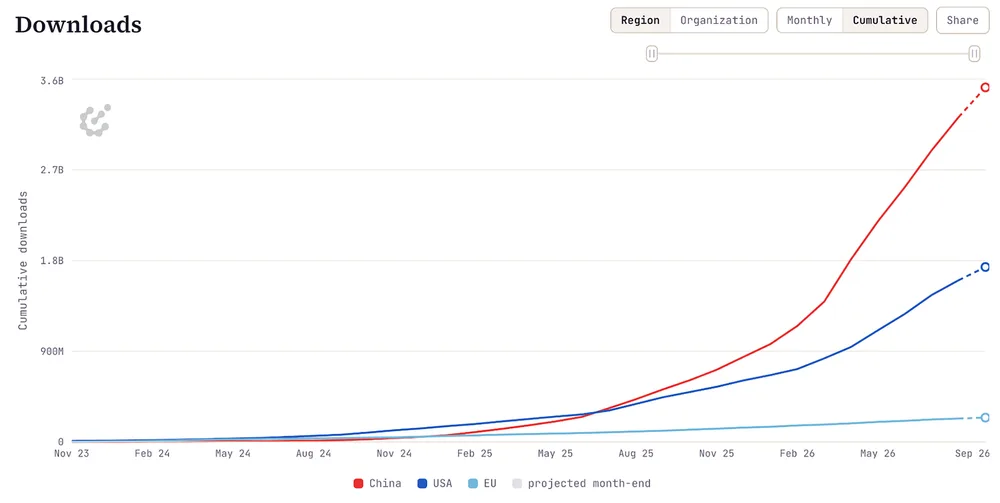
Performance and adoption trends
The shift in momentum began approximately 18 months ago. Hugging Face download data shows China took the lead around July 2025, largely due to Alibaba’s Qwen series. By August 2025, Chinese model downloads reached 3.2 B, double the U.S. total. Benchmarks like the Artificial Analysis Intelligence Index (AAII) highlight this technical lead. As of September 14, 2026, top-tier Chinese models outperform U.S. counterparts:
- Z.ai GLM-5.3: 45
- Moonshot AI Kimi K3: 44
- Z.ai GLM-5.3-Flash: 42
- Thinking Machines Inkling / Inkling Small: 26
A leader scoring 45 while the closest U.S. competitor is at 26 underscores a significant change. Models like GLM-5.2 and Kimi K3 have crossed the agentic-capability threshold previously seen in Claude Code, enabling complex, multi-step tasks once requiring top-tier closed APIs.
Recent studies highlight these advancements. A 45-point DeepSeek V4 Flash censorship gap was observed on China-sensitive prompts versus matched controls across 76 pairs evaluated by four judges. A model using 61% CTGT GPT-OSS-120B outperformed Kimi K3 on FinanceReasoning at an 8k budget. Performance reached 93% for Inkling at 65. These findings were rigorously examined under controlled scenarios to understand broader implications. While enabling AI accessibility, concerns have grown over models influenced by foreign actors, such as those tied to the Chinese Communist Party. Domain-specific applications often see meaningful gains without larger teacher models, as a self-distilled model matches scores taught by advanced Chinese counterparts. Methods and results are detailed in a released study, with models, data, and evaluations publicly available. 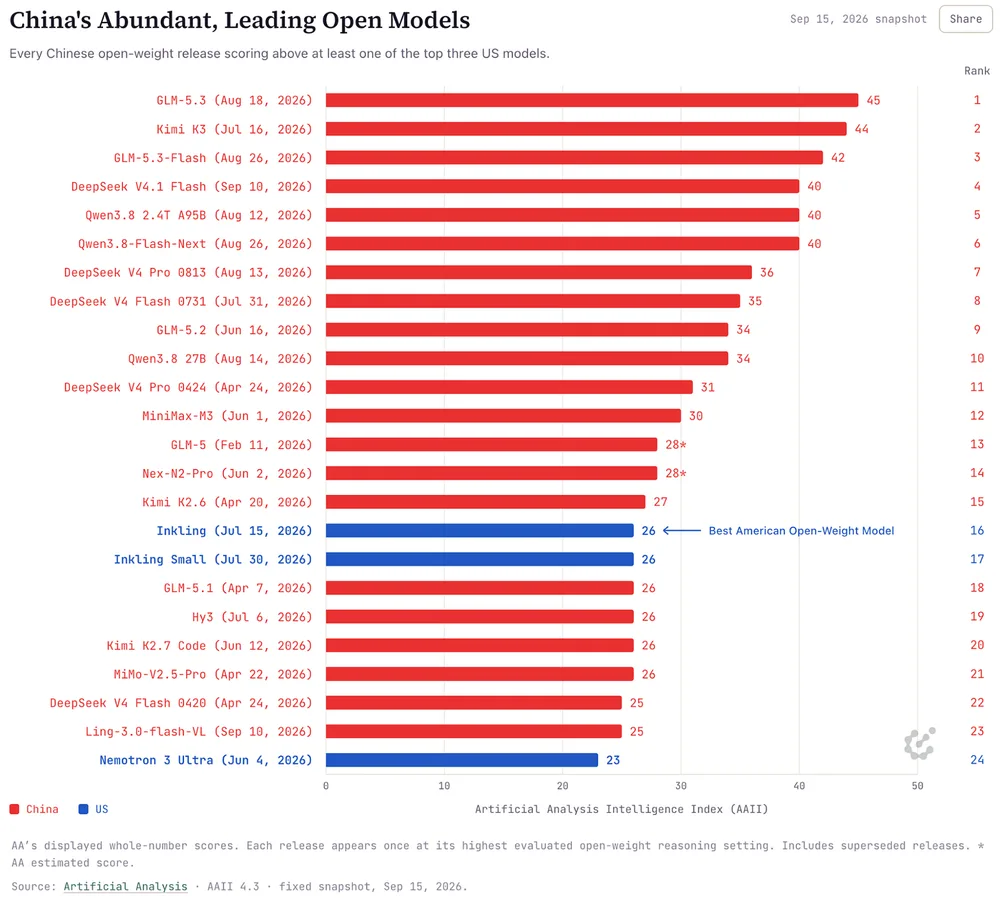
The 1.6B download gap for localized models is fascinating—especially when you consider how much localized tokenization alone can shave off inference time. Right now, the shift toward open-weight models is accelerating, with Chinese models not just catching up but leading in both adoption and capabilities like agentic reasoning, which were once exclusive to closed systems. The performance gap with APIs has narrowed so much that "open" is no longer just about cost—it’s about flexibility and scalability in production. For example, teams I work with are now deploying models like Qwen or DeepSeek with VLLM for optimized inference, proving that open-weight models can outperform many proprietary alternatives in real-world workflows.