Should you build an in-house AI team before or after developing an AI strategy?
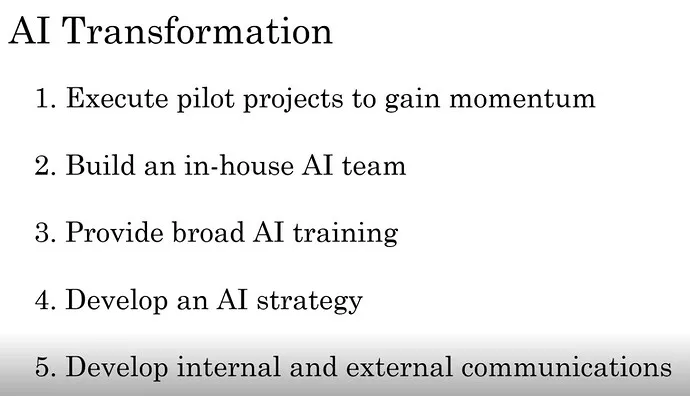
The standard framework for AI Transformation lists five specific steps, but the sequence of Step 2 (Build an in-house AI team) and Step 4 (Develop an AI Strategy) feels counterintuitive. On paper, it suggests hiring the talent first and figuring out the strategic direction later. In a real-world execution environment, that order is often flipped because you cannot accurately define the necessary skill sets or headcount without a concrete strategy to guide the hiring process.
Does the sequence of hiring and strategizing actually matter?
If you follow the provided order—building the team in Step 2 and drafting the strategy in Step 4—you risk hiring generalists who might not fit the specific technical needs of your eventual goals. For example, if your strategy eventually pivots toward fine-tuning small language models (SLMs) for on-device deployment, but you hired a team focused purely on prompt engineering and API integration in Step 2, you have a resource mismatch.
Logically, the workflow should look like this:
1. Define the AI Strategy (Identify the "where" and "why").
2. Determine the resource requirements (Identify the "who" and "how").
3. Build the in-house team based on those specific requirements.
The risk of the "Team First" approach
When you build a team before a strategy, you are essentially betting on the talent to define the strategy for you. While this can work if you hire high-level AI architects who can steer the company, it often leads to "tool-seeking problems" where the team implements technology because it is trendy, rather than because it solves a core business pain point.
If you are executing this in a corporate environment, the cost of a wrong hire in the AI space is high. Senior AI engineers and researchers command premium salaries; hiring them without a roadmap leads to inefficiency and frustration for the talent, who generally prefer clear objectives over vague mandates to "do AI."
A more practical execution flow
For those actually implementing these steps, I'd argue for a tighter loop. You don't need a 50-page strategy document, but you do need a strategic direction before you sign a single offer letter.
- Phase A: Identify the high-impact use cases and the technical moat you want to build.
- Phase B: Map those use cases to specific roles (e.g., do you need an NLP specialist, a data engineer, or a product manager with AI experience?).
- Phase C: Recruit and onboard the team to execute that specific roadmap.
Hiring before Step 4 is a recipe for disaster. I once hired three data scientists without a plan and they spent months idling.