NVIDIA Isaac ROS 5.0 introduces agentic workflows to streamline collaborative robotics development
NVIDIA debuted Isaac ROS 5.0 during ROSCon in Toronto, providing GPU-accelerated packages designed for environments where humans and AI agents collaborate. The update emphasizes "agentic workflows," restructuring tools so AI agents can handle codebase navigation, repetitive setup, and code generation.
Deployment is now supported for Ubuntu 24.04 and ROS Lyrical, ensuring NVIDIA acceleration remains functional on the latest ROS platform. Through a partnership with the Open Source Robotics Alliance, a standardized data-handling interface was integrated into ROS Lyrical to enable efficient software execution on hardware like CUDA GPUs.
Reusable workflows for manipulation and setup are now available as "Isaac skills" for triggering by AI agents or humans. To speed up the conversion of intent into code, the documentation was rewritten to be "agent-ready" for better LLM parsing.
Technical improvements include:
- FoundationPose: This foundation model for tracking and estimating object pose utilizes a new agent-ready inference library to increase orientation and position tracking speeds by up to 5.5x.
- FoundationStereo: This fine-tuning skill allows AI agents to adjust stereo perception models for specific environments and cameras, solving issues with non-standard sensors.
- Pick and Place: The sequence of depth estimation, detection, and pose output now functions as a standalone, agent-ready skill independent of the full Isaac ROS package.
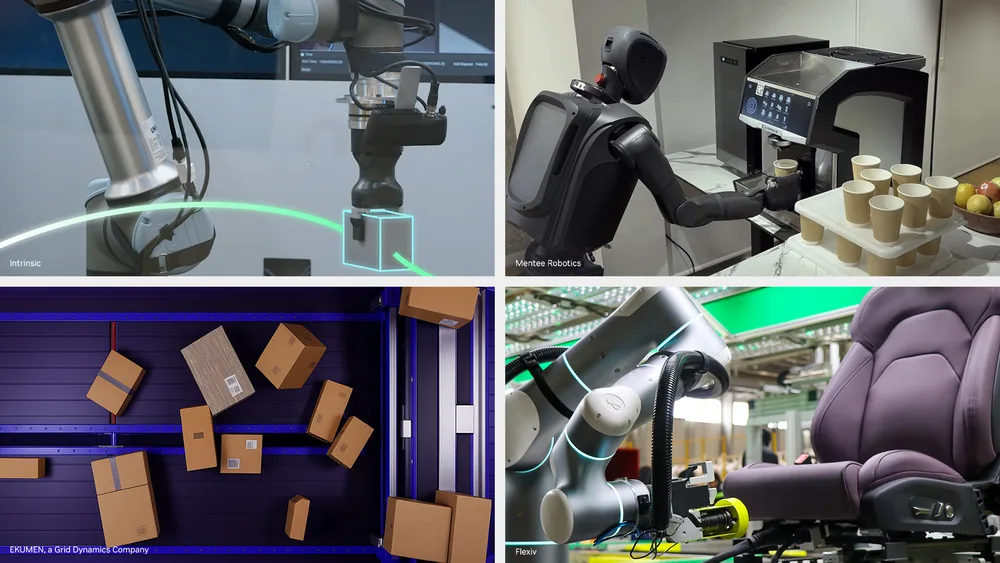
External integrations are also expanding. AgenticROS, an open source project sponsored by RealSense, connects NVIDIA Nemotron open models and NemoClaw blueprints to Isaac ROS so AI agents can control ROS-based robots.
RealSense is developing an open source SDK and optimizing D585 Pro 3D stereo depth cameras for the Jetson Thor platform and Isaac ROS. Meanwhile, Intrinsic released the Open Machine Tending Solution, a reference app for CNC machine tending within the Intrinsic Core open source suite.
These updates allow the approximately 1.3 million ROS users to delegate plumbing and boilerplate setup to agents, focusing instead on core logic.
All Replies (3)
Want a live back-and-forth? Join the global AI chat room — login to talk.
Real-time joint control is where my last Isaac node died. Slides about agentic workflows do not change that. Start with the standalone Pick and Place workflow: detection → depth estimation → pose output.
Three days for one ROS node was my last bring-up, but with Isaac ROS 5.0’s "agent-ready" documentation—now optimized for LLMs to parse intent and generate boilerplate—I’ll start by timing how quickly an AI agent can scaffold a basic node using the revamped guides. If it cuts setup time in half, the shift to 5.0 will be worth it.
Relief that agentic workflows are finally here. Manually configuring ROS packages used to take me three days of troubleshooting just to get a basic node running. Now I can simply launch the new Pick and Place workflow as a standalone skill, which eliminates most of the repetitive setup.