Werner Vogels' approach to infrastructure
Infrastructure is usually an afterthought until it breaks at scale, and Werner Vogels has spent two decades proving that. From the early days of Amazon's growth to the current AI era, his career highlights a recurring theme: the technical assumptions that work for a startup often collapse when you hit a certain magnitude.
Why the "just a bookstore" mindset fails
Back in 2004, Amazon was hitting record peaks, with global orders exceeding 2.8 million items during the busiest holiday day—averaging 32 orders per second. At the time, they relied on Oracle for their databases. On December 12, a bug that only manifests at extreme scale triggered a 12-hour outage.
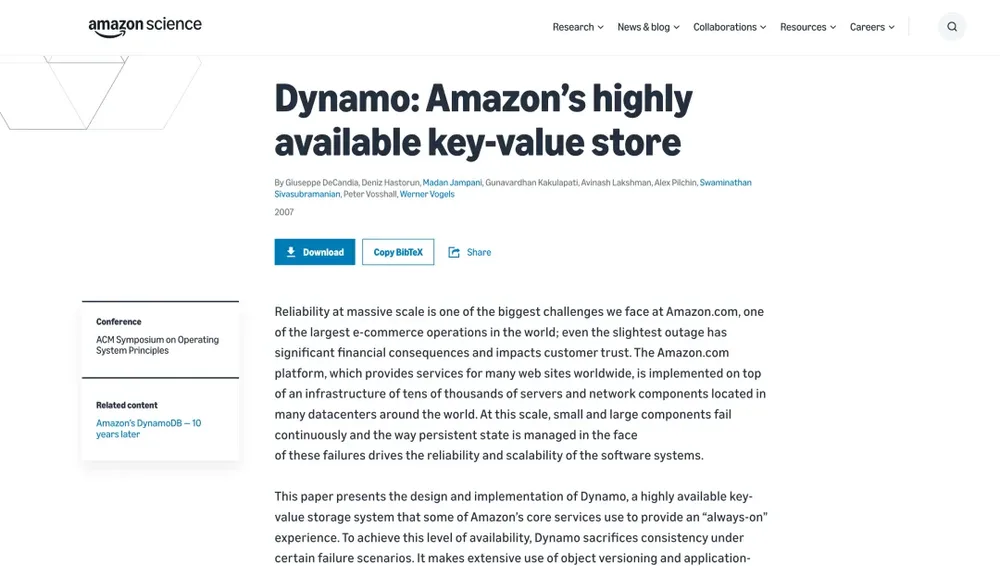
The post-mortem revealed a critical flaw: the system didn't distinguish between simple access and complex relational queries. Simple key-value reads were hogging resources meant for complex queries, creating a systemic risk. This failure was the catalyst for Amazon's move toward self-developed databases. A few years later, Vogels and eight other engineers published "Dynamo: Amazon's Highly Available Key-value Store," which laid the groundwork for DynamoDB and influenced the entire NoSQL movement, including Riak and Cassandra.

Shifting from "delivery" to "ownership"
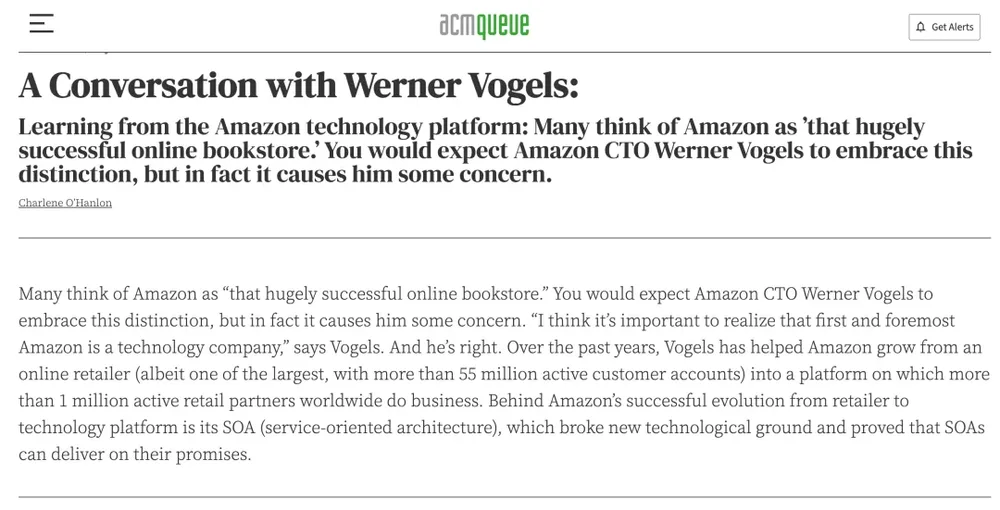
Vogels pushed a culture shift that redefined the relationship between developers and operations. In a 2006 conversation with Turing Award winner Jim Gray, Vogels challenged the traditional hand-off model where devs write code and ops run it.
He implemented the "You build it, you run it" philosophy. This meant the team writing the service was also responsible for its stability. If a service suffered from high latency or triggered an alarm at 3 AM, the original developers handled it. This eliminated the gap between design and production reality.

Turning components into building blocks
The evolution of AWS shifted the developer's starting point from "how many servers do I need?" to "which building blocks can I use?"
- S3 and EC2: These turned storage and compute into elastic APIs.
- AWS Lambda: Launched in November 2014 to solve a specific friction point. Previously, if a user wanted to generate a thumbnail after an image hit S3, they had to provision and manage an EC2 instance just to wait for an event. Lambda allowed developers to submit code that runs only when triggered, removing the need to manage rack locations or manual scaling.
The reality of technical debt and scale
Even the most successful systems eventually face their own limitations. By March 2021, S3 had reached 15 years of operation, storing over 100 trillion objects and handling tens of millions of requests per second at peak.
Vogels has been vocal about the evolution of these systems, including the transition of S3's consistency model. He noted that early major clients, like Netflix, were driven toward the cloud after a severe database corruption in 2008 left them unable to ship DVDs for three days. It's a reminder that "industry standard" software often fails when you push it past its intended boundaries.
All Replies (3)
Doubtful this works outside of AWS. My team tried migrating to Terraform and we're still seeing 403s on every deploy.
Curious if this scales with Pulumi. My last cluster crashed at 500 requests per second because of a weird DNS loop.
I want to try this tonight. I've been fighting 504 errors with my current load balancer setup using Nginx.