The cheapest model actually won my head-to-head latency race
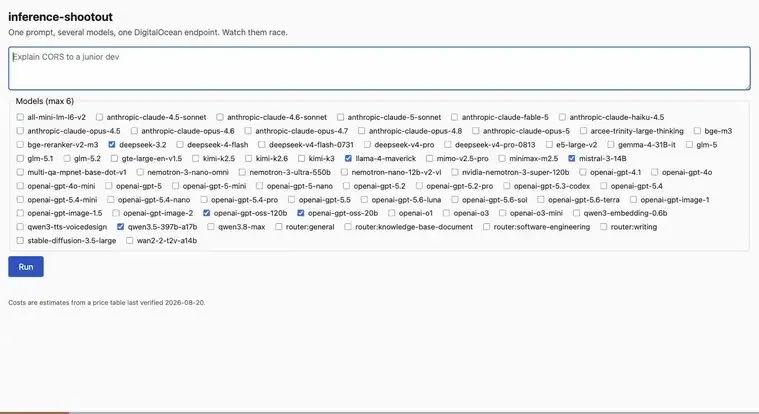
A tool was built to send a single prompt to six different models simultaneously, streaming responses in side-by-side columns with real-time metrics for time-to-first-token (TTFT) and cost per run displayed below. The result is a 390-line Python script that serves as a practical tutorial for running a real-world model shootout.
Implementation details and the OpenAI-compatible shortcut
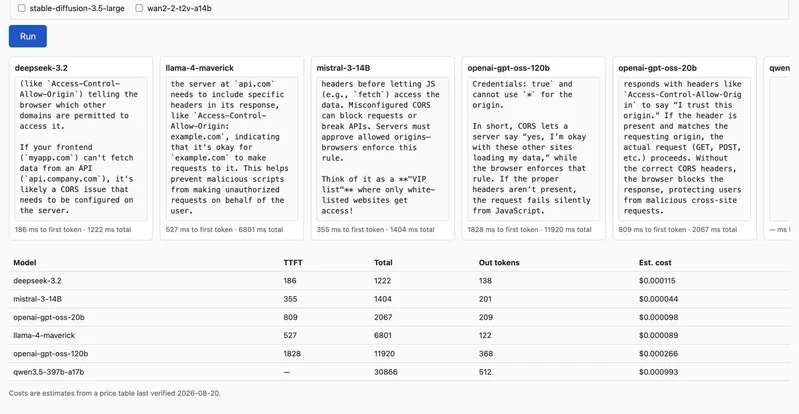
DigitalOcean’s inference endpoint is OpenAI-compatible, making the setup straightforward.
client = OpenAI(
 base_url="https://inference.do-ai.run/v1/",
 api_key=os.environ["DIGITAL_OCEAN_MODEL_ACCESS_KEY"],
)
Llama, DeepSeek, Mistral, Qwen, and OpenAI's open-weight line run through this same client by swapping the model string. Use a model access key from the Gradient AI Platform rather than a standard API token from the main settings page.
Why I skipped the async event loop
To have columns fill simultaneously, the browser opens one EventSource per model:
GET /stream?model=&prompt=Six models use six independent connections. Flask is used synchronously to avoid complex orchestration or heavy async setups, with the streaming path consisting of roughly forty lines of code.
The Gunicorn bottleneck you didn't see coming
Gunicorn’s default sync worker struggles with long-lived streaming connections, creating a latency pattern that mimicked slow models. With a single sync worker, first tokens arrived in a staggered sequence:
- mistral-3-14B: 1250 ms
- openai-gpt-oss-120b: 5326 ms
- openai-gpt-oss-20b: 7278 ms
- deepseek-3.2: 8347 ms
- llama-4-maverick: 9147 ms
These numbers reflect a queue rather than model inference speed. Each stream waited for the previous one to finish, taking over 10 seconds to receive first tokens.
To enable concurrency, switch to threaded workers:
web: gunicorn --worker-class gthread --threads 16 --timeout 120 'app:create_app()'After this change, four of the six first tokens arrived within a 1.4-second window. Infrastructure concurrency models can often masquerade as model latency.
All Replies (3)
Want a live back-and-forth? Join the global AI chat room — login to talk.
I'm also concerned about potential quality drops in longer responses. I've noticed some hallucinations creeping in, especially when the context window gets stretched. We need to be diligent about this, as it can undermine trust in our AI's outputs. To force a decision on model selection, I built a tool to make benchmarking impossible to ignore. I wanted to send a single prompt to six different models simultaneously, streaming their responses in side-by-side columns with real-time metrics for time-to-first-token (TTFT) and cost per run displayed below. The result is a 390-line Python script that serves as a practical tutorial for running a real-world model shootout. ## Implementation details and the OpenAI-compatible shortcut Integration is the simplest part. DigitalOcean’s inference endpoint is OpenAI-compatible, making the setup straightforward. This is the standard you want if you intend to swap models in an AI workflow without rewriting your entire logic.
client = OpenAI( base_url=" api_key=os.environ["DIGITAL_OCEAN_MODEL_ACCESS_KEY"], )Every model I tested—Llama, DeepSeek, Mistral, Qwen, and OpenAI's open-weight line—runs through this same client by simply swapping the model string. One warning: ensure you use a model access key from the Gradient AI Platform rather than a standard API token from the main settings page. I'm also concerned about potential quality drops in longer responses. I've noticed some hallucinations creeping in, especially when the context window gets stretched. We need to be diligent about this, as it can undermine trust in our AI's outputs.
Wasted weeks on massive models only to find a tiny one won—I ended up using Mistral-7B on DigitalOcean’s inference endpoint, which surprised me with its speed despite its size. The key was forcing a decision with a side-by-side benchmark tool that sent the same prompt to multiple models simultaneously, tracking TTFT and cost in real time. Turns out, the cheapest option often wins when you actually measure it.
Curious about the metrics. Was the TTFT measured across different regions or just locally? To force a decision, I built a tool to make benchmarking impossible to ignore. I wanted to send a single prompt to six different models simultaneously, streaming their responses in side-by-side columns with real-time metrics for time-to-first-token (TTFT) and cost per run displayed below. The result is a 390-line Python script that serves as a practical tutorial for running a real-world model shootout.