Why Benchmark Scores Fail to Guarantee Real‑World LLM Deployment Success
Benchmark suites and curated datasets shine during early prototyping, helping teams pick base models or test prompt engineering ideas. Once the goal shifts to production, however, those tidy scores no longer reflect the chaos of actual usage.
In real environments inputs are frequently ambiguous, contexts incomplete, and the data distribution diverges from the polished academic sets. Edge cases ignored by benchmarks become the culprits that disrupt workflows after launch.
A recent look at how teams manage this shift uses a high‑stakes case: cutting false positives in GitHub secret scanning. In security, an LLM that flags a random string as a credential creates noise that wastes developer time, while missing a genuine credential can lead to a breach. This challenge extends beyond raw accuracy; it is a layered product decision.
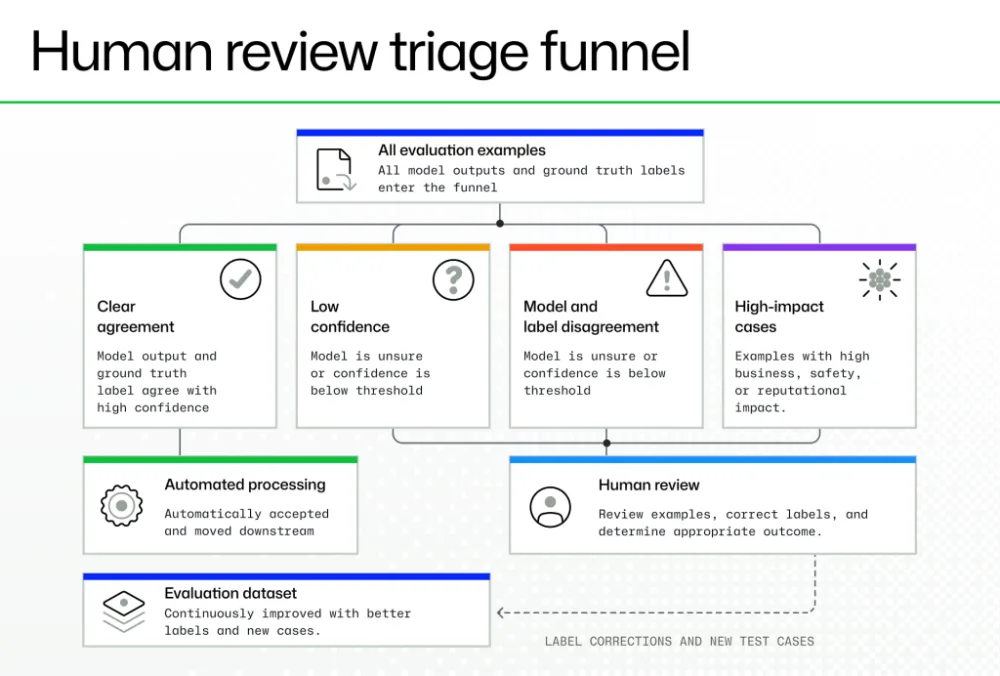
The most common pitfall observed in AI pipelines is the “tinker loop.” When performance drops, groups immediately rewrite prompts, add more few‑shot examples, or swap GPT‑4o for Claude 3.5 Sonnet, treating a product problem as a tuning issue.
Before editing any prompt line, define the precise decision the evaluation must support. Determine which mistakes are tolerable and which are fatal.
For a security‑oriented LLM agent, precision and recall cannot be treated as interchangeable. Optimizing for high precision while recall falls below an acceptable threshold means the primary objective—detecting real secrets—is compromised.
A three‑tier evaluation framework separates prototype promise from production reliability.
- Primary Outcome (User Benefit) – the core metric the project aims to improve. In secret scanning this is false‑positive reduction and precision; without gains here the effort is considered a failure.
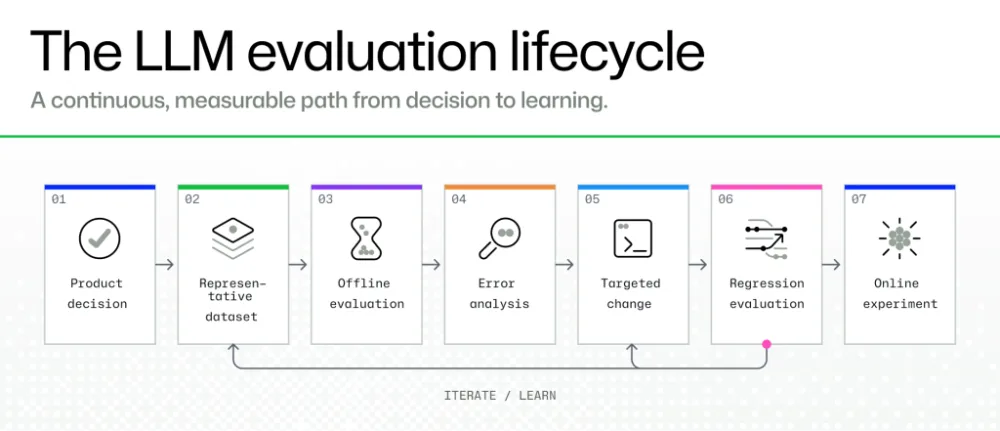
- Safety Constraints (Non‑negotiables) – guardrails that prevent “optimizing” into disaster. For security the recall threshold is the critical guardrail; any configuration that drops recall beneath the defined limit is automatically rejected.
- Operational Guardrails (Reality check) – practical limits that make an LLM usable. Track latency (must be fast enough for the workflow), cost ($0.50 per request is the benchmark figure), reliability (graceful handling of API timeouts), and compatibility (integration into the existing production pipeline).
When running experiments, avoid chasing the highest single score. Apply a logic‑based decision process.
Consider two prompt variants. Variant A shows a larger precision gain, but testing reveals it missed a critical secret that the earlier version caught. Despite the higher precision “score,” the safety constraint is breached, so the variant is not advanced.
A successful deployment hinges not on finding the “smartest” model but on locating the configuration that maximizes performance while respecting safety and operational limits. To build real‑world AI workflows, stop measuring only benchmark scores and start constructing a multi‑layered evaluation suite.
All Replies (3)
Want a live back-and-forth? Join the global AI chat room — login to talk.
This is stressful. Don't just rely on standard benchmarks, as they often hide the messy edge cases that break production workflows. Instead, stop optimizing the model and start defining clear decision criteria before you even tweak the prompts.
Benchmarks alone won’t reveal the messiness of real‑world inputs, so the first thing you should do is define clear decision criteria before you start tweaking prompts or the model—for example, set acceptable false‑positive and false‑negative thresholds for each task. Then run a small pilot with actual user queries to spot where the agent breaks and iterate from there.
Ridiculous! How much does a single word change in a prompt swing these benchmark scores? If you rely only on standard benchmarks to judge whether your LLM agent is ready for real-world deployment, you are heading for a major failure. Benchmarks and curated datasets are useful in the prototyping stage—they help you choose a base model or see if a prompt engineering idea might work in theory. But once you aim for production, the situation changes completely. In practice, inputs are messy. They are ambiguous, context is often cut off, and the data distribution in production rarely matches the clean, polished sets used in academic tests. The edge cases that benchmarks skip are exactly the ones that will break your workflow after you go live. I recently examined how teams manage this shift, using a high-stakes example: lowering false positives in GitHub secret scanning. In security, if an LLM tags a random string as a credential, it creates noise that wastes developer time. If it misses a real credential (a false negative), the breach can be catastrophic. This is not just an accuracy issue; it is a complex product decision. Stop optimizing the model and start defining the decision. The most common error I see in AI workflows is the “tinker loop.” When an LLM underperforms, the team immediately rewrites the prompt, adds more few-shot examples, or swaps out the model. Instead, define your decision criteria before making any model changes.