DSPy: Applying Object-Oriented Abstraction to Prompts
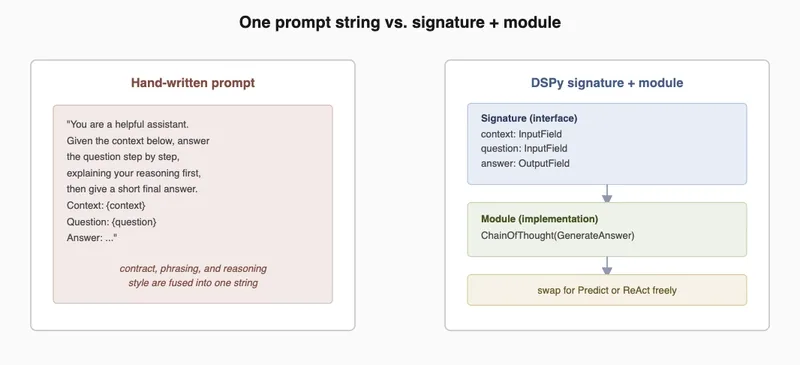
Hard-coding prompts is essentially the same as writing "spaghetti code" for LLMs. When you jam the instructions, the few-shot examples, and the output format into one giant string, you're creating a fragile system. If you switch from GPT-4 to Claude, or even move to a newer version of the same model, that carefully crafted wording often breaks. You get "silent failures"—no error messages, just a subtle dip in quality that forces you to spend hours manually tweaking adjectives and punctuation.
DSPy changes this by treating prompt engineering like software engineering, specifically by using a concept similar to Object-Oriented Programming (OOP). Instead of writing a prompt, you define a "Signature."
Separating the Contract from the Implementation
In a traditional backend, you have an interface that defines what a method does without specifying how it does it. DSPy does this for AI workflows. A Signature is just a contract: it defines the inputs and the outputs, but it contains zero instructional wording.
Here is how you define a basic contract for a Q&A task:
class GenerateAnswer(dspy.Signature):
    """Answer questions based on the given context."""
    context = dspy.InputField()
    question = dspy.InputField()
    answer = dspy.OutputField()
This is a clean abstraction. It tells the system: "I provide context and a question; I expect an answer." To actually execute this, you wrap the signature in a Module. If you want the model to reason through the problem, you use ChainOfThought. If you want a direct response, you use Predict.
class RAG(dspy.Module):
    def __init__(self):
        self.generate = dspy.ChainOfThought(GenerateAnswer)

    def forward(self, context, question):
        return self.generate(context=context, question=question)
Because the GenerateAnswer signature remains constant, you can swap the module (the implementation) without changing the rest of your code. This is a huge leap forward for any professional AI workflow.
Compiling Prompts via Optimization
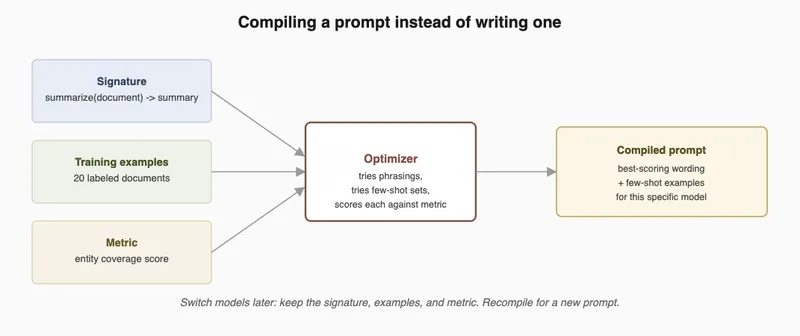
The most powerful part of this approach is that DSPy acts as a compiler. Instead of you guessing which phrasing works best, you provide a few labeled examples and a metric for success. The DSPy optimizer then iterates through different prompt variations and few-shot selections, scoring them against your metric and keeping the winner.
This solves the "model migration" headache. If you move from one LLM to another, you don't rewrite your prompts from scratch. You simply re-compile. The signature stays the same, but the optimizer generates a new, model-specific prompt that satisfies the original contract.
Mapping OOP to DSPy
If you come from a typed background like Java or TypeScript, the logic maps perfectly:
- Interface/Abstract Method: The Signature (defines the input/output).
- Concrete Class: The Module (e.g.,
ChainOfThought,ReAct). - Constructor Arguments: InputFields.
- Return Type: OutputField.
- Compiler: The Optimizer (e.g.,
BootstrapFewShot). - Polymorphism: Swapping different modules under the same signature.
All Replies (4)
Want a live back-and-forth? Join the global AI chat room — login to talk.
Iterating on signatures is so much faster now. Which optimizer are you using for your RAG pipeline?
Curious if this handles dynamic few-shot selection automatically or if I'm still stuck curating examples manually?
My old prompt was a total disaster. How long did it take you to migrate everything over to DSPy?
Git diffs for long prompts are a disaster. Which tool are you using to manage your versions?