Mid-Chain Governance: Fixing the AI Agent Blind Spot
Validating only the initial prompt and the final response is a recipe for data leaks when you're running multi-step LLM agents. In a professional environment, a "safe" user request like "Summarize the Q3 regional performance" can trigger a chain of events—document retrieval, SQL generation, and API calls—where the agent accidentally pulls sensitive PII or references restricted tables in an intermediate step. If you only check the start and end, you're blind to everything happening in the middle.
The Gap in Standard Guardrails
Most of the AI workflows we've deployed rely on entry-point filtering or final content moderation. The problem is that risks often emerge during the execution, not from the user's input. An agent might generate a policy-violating internal plan or a risky query that doesn't show up in the final polished answer but still exposes the system to risk.
Implementing Mid-Chain Governance
The logic here is to shift from "entry-only" to "interval-based" validation. Instead of blocking the actual tool execution (like a database connection), you validate the text the agent produces before it gets passed to the next step in the chain.
To keep this from killing performance, you can't check every single token. I've found that a selective re-verification approach works best:
1. Interval Checks: Validate outputs at specific milestones in the workflow.
2. Final Gate: Always run a mandatory check on the final response before it hits the user.
This hybrid approach significantly cuts down latency compared to checking every single step, while still catching the majority of mid-process hallucinations or data leaks.
Real-World Application
This is particularly critical for high-stakes deployment scenarios:
- Enterprise AI assistants handling internal company data.
- Autonomous software agents writing and executing code.
- Multi-agent orchestration where one agent's output is another's input.
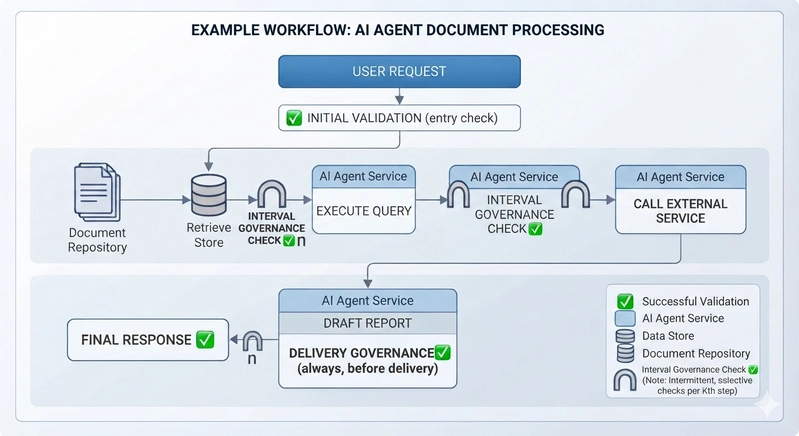
For anyone building a complex AI workflow, treating the "middle" of the chain as a trust-less zone is the only way to actually ensure data governance. Moving toward a mid-chain validation model prevents the "black box" effect where the agent does something risky internally that you only discover after a security audit.
Logging intermediate steps to a hidden file is a game changer. Which file format are you using for those logs?