The rapid automation of entry level roles could destroy our future supply of senior experts
The tragedy of the cognitive commons offers a chillingly realistic explanation for how the AI gold rush might inadvertently erode professional expertise. The logic is straightforward: individual companies act rationally by substituting entry level roles with LLM agents to reduce overhead and improve short term margins. Yet, if every firm follows this path, the commons—the shared reservoir of human skill and institutional knowledge—will begin to vanish.
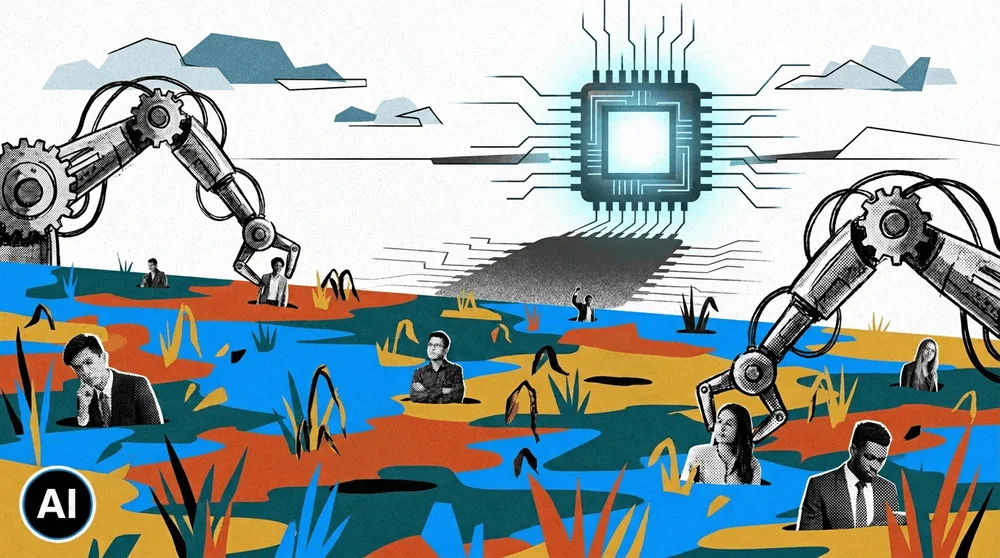
Is AI Eliminating the Professional Apprenticeship Phase?
The true threat is not AI being too capable, but rather its ability to eliminate the apprenticeship phase of professional development. One cannot transition into a senior architect or lead strategist role without years of experience performing the grunt work—the manual data cleaning, basic coding, and tedious documentation—that builds genuine craft intuition. By automating these boring junior tasks, we are removing the training wheels necessary for a novice to evolve into a master.
Why Efficiency Gains Mask a Delayed Crisis
This looks like a delayed crisis. While efficiency gains show up on this quarter's balance sheet, the true cost is deferred. The gap will likely transform into a chasm between 2030 and 2045. By that time, industries may face a massive shortage of experienced leaders because the 2020s junior talent pool was replaced by a prompt engineering workflow. When AI reaches a limit or a novel problem requires deep, first-principles human intuition, no one will be left who knows how to solve it from scratch.
Viewing Junior Roles as Learning Centers
Preventing this requires an intentional AI workflow that views junior roles as learning centers rather than cost centers. Instead of using AI to replace juniors, we must use it to accelerate their journey to seniority, shifting the paradigm from AI as a replacement to AI as a mentor.
For those developing an LLM agent or a new office deployment strategy, the objective should be automating repetition rather than automating learning. If a junior dev only reviews AI-generated code instead of struggling to write a function from a blank page, they are learning to edit rather than learning to code. That is a fundamentally different skill set, and it may not be enough to sustain any profession over the next two decades. We must protect the cognitive commons before we trade our intellectual capital for a few percentage points of quarterly growth.
All Replies (3)
Want a live back-and-forth? Join the global AI chat room — login to talk.
Worried about the fallout. Does this risk hit niche industries harder than general software engineering?
It's scary that juniors can't debug without a bot. How do we fix this training gap?
Terrifying thought about onboarding. How do juniors actually learn the 'why' when AI handles all the logic?