How Much VRAM to Fine-Tune an LLM? 12 to 120 GB
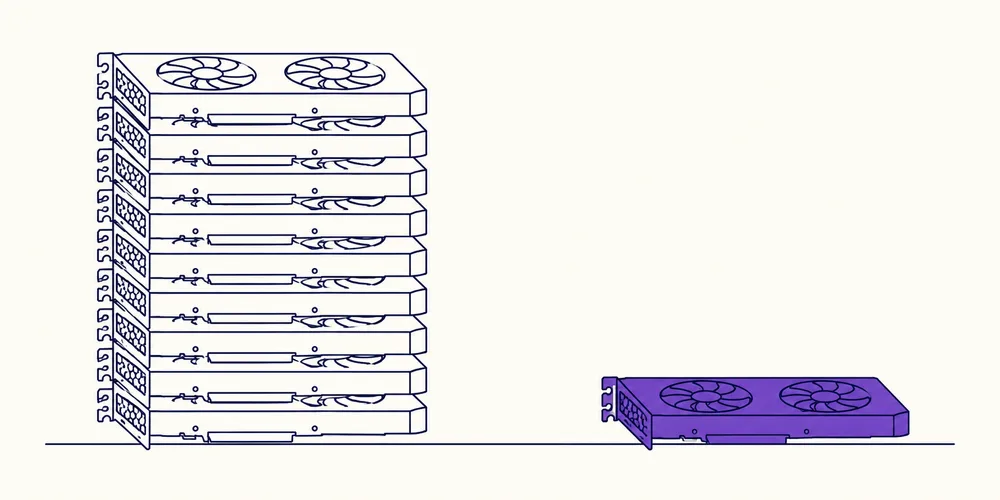
The answer to "how much VRAM do I need to fine-tune an LLM?" is a range so wide it's useless — unless you know exactly which technique you're committing to. 12 GB gets you a working setup. 120 GB gets you the same model, fully trained. Same architecture, same task, two completely different worlds. The deciding factor isn't the model size alone; it's how you allocate memory across weights, gradients, optimizer states, and activations.
When you do a full fine-tune, every parameter needs multiple copies in memory. Weights, gradients, AdamW moments, plus activations in the forward pass. For a 7B model in fp16 that's roughly 14 GB just for the weights, then you multiply by 3–4 for everything else. That's why people reach for 80 GB or 120 GB cards for even "small" models. It's not overkill — it's math.
At the other end, parameter-efficient methods like LoRA and QLoRA freeze the original weights and only train tiny adapter matrices. QLoRA goes further by quantizing the frozen base model down to 4-bit, which lets you fine-tune a 7B model on a single consumer card with 12–16 GB. The tradeoff is that you're not updating the original weights directly, and you need to merge or use adapters at deployment time. For most real-world use cases, that's an acceptable price.
Here's how the main options compare, based on what I've actually run:
- Full fine-tune (7B, fp16): ~80–120 GB. Maximum control, full weight updates, but you need a datacenter card or multi-GPU setup. This is for serious domain adaptation where you want to bake data into every layer.
- LoRA (7B, fp16): ~24–32 GB. You load the model at full precision but freeze it. Adapters are small, so memory drops drastically. Great on a single 4090 or A6000.
- QLoRA (7B, 4-bit): ~12–16 GB. The beginner-friendly option. I've run a 7B fine-tune on a laptop 16 GB GPU without touching a cloud instance. It's slower, but it works.
- Gradient checkpointing + QLoRA: ~8–12 GB. You trade compute for memory by recomputing activations. If you're on a 12 GB card and getting OOM errors, this is the first lever to pull.
1. Quantize the base model to 4-bit using bitsandbytes.
2. Add a LoRA adapter layer (rank 8–16 is usually enough).
3. Use gradient checkpointing and a small batch size (1–2) with gradient accumulation.
4. Monitor memory with nvidia-smi while training; your bottleneck will show up fast.
5. Save the adapter, not the whole model, and merge only when you're ready to deploy.
All Replies (3)
Worried about the overhead since optimizer states and activation memory usually eat up way more VRAM than weights.
I struggled so much with my old 8GB card. Did you use Colab or RunPod for those bigger models?
Curious if that 12GB minimum requires QLoRA 4-bit or if it works for a standard base model?