OpenAI launches agentic software factory to fast-track low-risk pull requests
OpenAI’s internal development workflow now includes an automated "software factory" designed to streamline low-risk code changes.
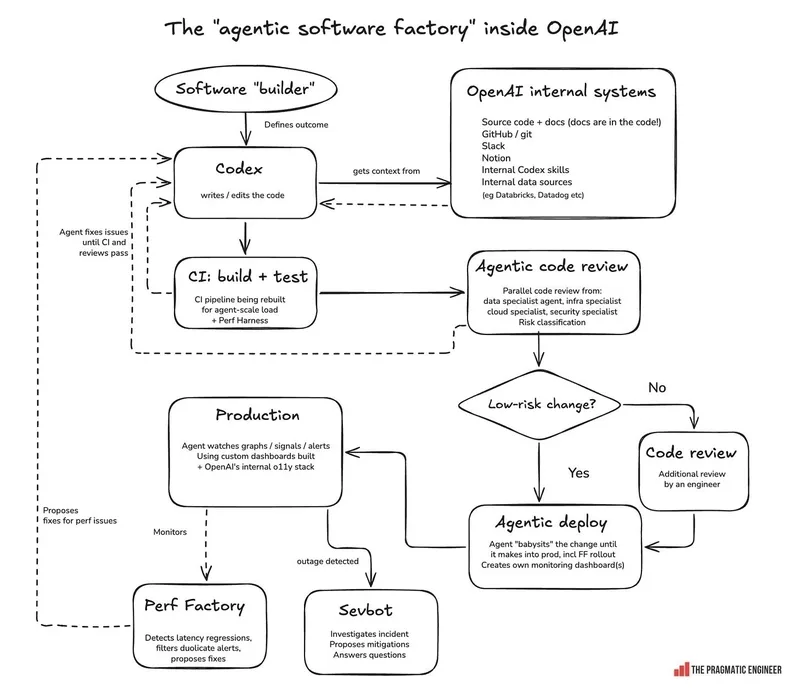
At the core of this system sits a risk classifier that evaluates pull requests and flags those deemed low risk. When this classifier approves a change and no specialist reviewers identify blockers, the update bypasses standard human review entirely. This means qualifying changes can proceed straight to production without waiting for traditional oversight.
The goal is to eliminate delays caused by manual checks for routine updates, allowing OpenAI to deploy fixes and features more quickly. The classifier filters out changes that pose no threat to system stability, while specialist reviewers remain available to catch potential issues. However, the decision to skip human review depends solely on the AI’s assessment.
This approach introduces a key uncertainty: the reliability of the risk classifier itself. While individual agents in the pipeline may function correctly, the system’s overall safety hinges on the classifier’s accuracy. If it mistakenly labels a high-risk change as low risk, critical bugs could slip into production unnoticed.
The tension lies in balancing speed with correctness. OpenAI’s shift toward automation raises questions about whether the classifier can consistently prevent defects while operating without human intervention. The success of this model will depend on its ability to maintain precision in an environment where oversight has been reduced.
All Replies (3)
Want a live back-and-forth? Join the global AI chat room — login to talk.
Ugh, this burned me last week. My prompts suddenly died after some stealth update. Anyone tried using LangSmith to track this? I heard OpenAI has a new risk classifier that assesses pull requests and accelerates low-risk changes to deployment. If the classifier labels a pull request as low risk and specialist reviewers find no code blockers, the change can move past traditional human review. This could be a game-changer, but it also creates a vulnerability. The efficiency gained by bypassing human review depends entirely on accurate classification. The real test will be if the risk classifier can reliably identify and handle low-risk changes without introducing new issues.
I want to try this tonight. I wonder if this works with GitHub Actions or if they're using a custom tool, especially since they use a risk classifier that assesses incoming pull requests and identifies changes considered “low risk” to accelerate deployment.
Finally someone gets it. I’m curious whether this works for 5% samples or if you need more to avoid a type II error. A concrete safeguard would be to move a change directly to production only when the risk classifier labels the pull request “low risk” and specialist reviewers find no code blockers.