Claude Code needs a verifiable audit trail if you're using it
I've been looking into the concept of Forensic Receipts to solve this. The core idea is that instead of just logging an event, the system generates a signed hash of the record at the exact moment of the write. If a single character in that record changes later, the hash fails.
Why standard logs fail the audit test
In a typical deployment, you might have a log saying "Deployment successful at 10:00 AM." If an auditor asks if that record was altered, your only answer is "I believe so" or "Our permissions are strict." That's a claim, not proof.
A Forensic Receipt transforms this into a mathematical certainty by using two specific mechanisms:
- Content Hashing: Using something like SHA-256 to bind the receipt to the exact bytes of the record.
- Chaining: Including the hash of the previous receipt in the current one. This creates a sequence where you cannot remove or reorder history without breaking every subsequent link in the chain.
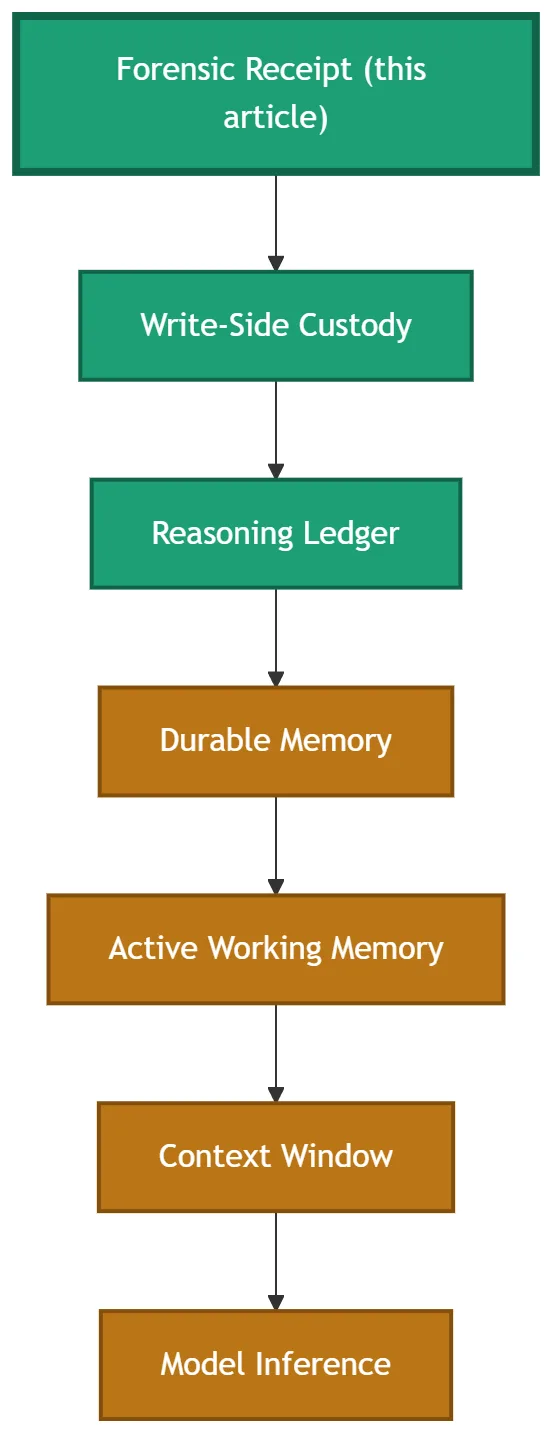
Implementing a verifiable receipt structure
If you are building a custom AI workflow or a reasoning ledger, your receipt schema should look something like this to be actually useful for forensics:
forensic_receipt:
  record: reasoning_ledger/deploy-2026-03-14
  content_hash: sha256:3af9c1...e07b
  signed_at: 2026-03-14T09:22:07Z
  signature: ed25519:9d4a...c2
  signed_by: sovereign-node-07
  prior_receipt: sha256:8b21...44a
In this setup, the ed25519 signature ensures the identity of the node that wrote the record, and the prior_receipt field ensures the chronological integrity of the memory stack.
The trade-off for absolute proof
Adding this layer to your AI workflow isn't free. You're adding computational overhead to the write path because every single entry requires a hash computation and a cryptographic signature. However, for high-stakes LLM agents, this is a mandatory cost.
The alternative is a "black box" memory where the system asks you to take its word for what it remembers. When you move from a simple chatbot to a sophisticated LLM agent capable of executing code or changing cloud configurations, "trust me" isn't a viable strategy. Moving the verification to the write-side means that by the time the data reaches the context window for model inference, it has a verifiable pedigree.
For anyone doing a deep dive into building a reliable AI memory stack, start by implementing the hash chain first. It's the only way to ensure your "institutional memory" is actually a record of truth rather than just a collection of editable text files.