Local small language models don’t require frustrating guesswork—layered optimization solves the problem.
When users begin by grabbing a GGUF file, the odds of immediate success vanish. Instead of treating deployment as a monolithic task, breaking it into distinct layers—like inference, context handling, and retrieval—turns modest models into practical assets for tasks such as local retrieval-augmented generation (RAG) or autonomous agents.
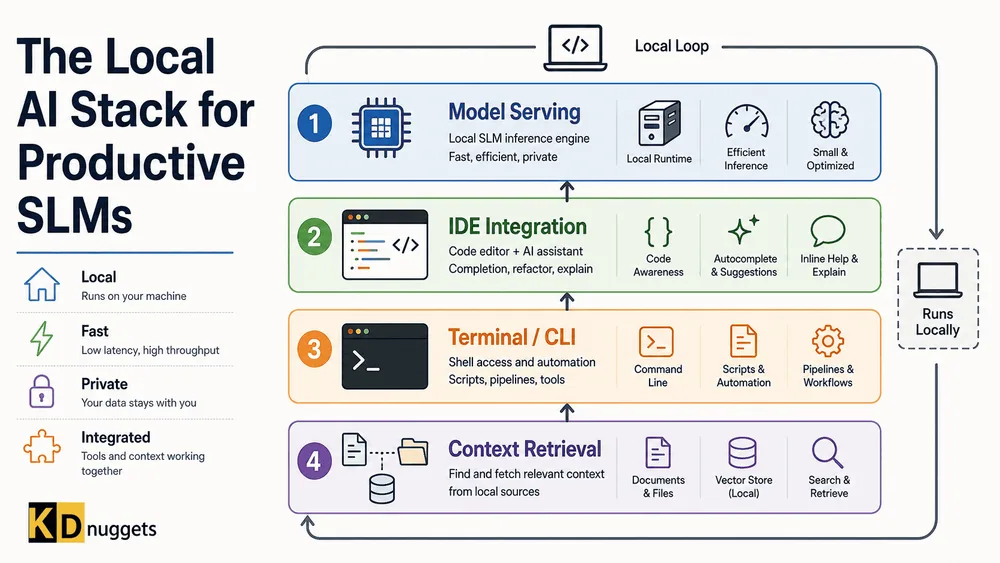
The first critical layer is inference. Heavy frameworks slow responses, but Llama.cpp stands as the benchmark for lightweight, high-performance execution. Those needing OpenAI-like compatibility can use tools like Ollama or LocalAI without sacrificing speed. Since small language models prioritize speed over complex reasoning, minimizing latency becomes essential.
Context management proves the most common stumbling block. Models like GPT-4o thrive on long-term reasoning, whereas SLMs—even 3B to 8B-parameter ones—struggle with sustained attention. Unfiltered prompts risk hallucinations or context loss. Instead, a vector database such as ChromaDB or Qdrant should pre-filter relevant snippets before they reach the model, ensuring prompts remain concise and focused.
Structured prompts elevate SLMs from generic tools to specialized assistants. A "Context Refiner" prompt acts as a pre-processor, stripping raw data into a structured format before reasoning begins. The template below enforces strict extraction rules:
### TASK
Extract only the facts needed to answer the query.

### CONSTRAINTS
1. Remove conversational filler and redundant details.
2. Preserve all numbers, dates, names, and technical identifiers.
3. Flag conflicting information clearly.
4. Format output as a bulleted list.
5. Exclude commentary or introductions.

### RAW CONTEXT
{{retrieved_chunks}}

### TARGET QUERY
{{user_query}}

### SYNTHESIZED DATA
This approach refines a model’s reliability. Tests with Llama-3-8B on a MacBook showed marked accuracy gains over direct input, proving the workflow’s effectiveness.
The workflow’s strength lies in its modularity—each layer addresses a distinct weakness, turning what was once a trial-and-error process into a repeatable, reliable system.
All Replies (3)
Want a live back-and-forth? Join the global AI chat room — login to talk.
Mind blown by how much llama.cpp speeds up RAG on a GPU. Which backend are you running? To extract real productivity from models in the 3B to 8B parameter range, you have to fine-tune three specific layers: the inference engine, the context management, and the retrieval mechanism. Most people approach local AI by downloading a GGUF file and hoping for the best, but that often leads to a frustrating experience. If you want to build something genuinely useful—like a local RAG system or an autonomous agent—you need to think of your setup as a layered stack rather than a single application. I've spent time experimenting with different ways to orchestrate Small Language Models (SLMs) on consumer hardware, and there's a specific architectural pattern that lets these tiny models punch far above their weight class. Skip the heavy, bloated frameworks when you're just running a single model. For a lightweight, high-performance deployment, llama.cpp is the solid foundation I recommend—it's the gold standard for good reason. If you need an API that mirrors OpenAI's structure so you can swap in different tools easily, spinning up a local server through Ollama or LocalAI is the way to go.
Curious if you're using Chroma or just keeping embeddings in memory for those smaller sets? For real productivity with 3B-8B parameter models, you have to fine-tune three specific layers: the inference engine, the context management, and the retrieval mechanism.
My RAM crashed hard when I first tried this—turns out the issue wasn't the model size but how I was feeding it context. For small setups, stick with Q4_K_M or Q5_K_M quantizations on 3B–8B models; they balance speed and quality without blowing up your memory. The real fix, though, is to treat your setup as a layered stack: instead of dumping everything into one prompt, fine-tune your context management by chunking data into smaller, relevant pieces before sending it to the model. That way, you're not loading 10,000 tokens into a tiny reasoning window, and your RAM stays stable.