Mastering the Sliding Window Pattern in Java Saves Hours
Mastering the sliding window technique in Java streamlines complex array problems by replacing brute-force checks with a precise boundary adjustment method.
The pitfall many encounter is overcomplicating the solution by diving into nested loops before grasping how a window’s expansion and contraction simplify repetitive calculations. A rigid template fails when constraints like "at most K distinct characters" or "substrings with varying weights" introduce variability, turning the logic into an unmanageable web of conditions.
The core advantage of this pattern is its adaptability: instead of recalving sums or frequency tables for every subarray, you dynamically adjust two pointers—one advancing to include new elements and the other retracting when constraints are violated. This reframes an O(n²) brute-force method into an O(n) operation, drastically cutting unnecessary computations.
Sliding window problems are typically divided into two approaches:
- Fixed-size windows maintain a constant length K, advancing incrementally and removing the oldest element each time. This is useful for tasks like finding the maximum sum of a subarray of size K.
- Variable-size windows adjust dynamically based on conditions, often appearing in challenges like identifying the longest subarray where the sum falls under X.
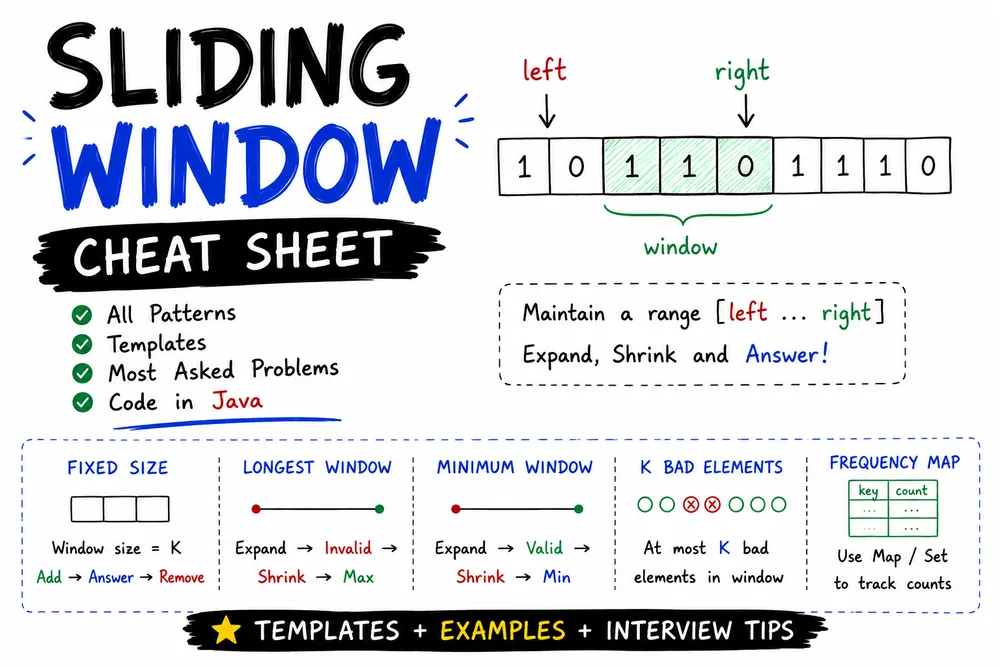
For coding interviews, avoid reinventing this logic each time. Use this template as a foundation:
public int slidingWindowTemplate(int[] nums, int target) {
    int left = 0;
    int right = 0;
    int currentWindowMetric = 0;
    int result = 0;

    for (right = 0; right < nums.length; right++) {
        currentWindowMetric += nums[right];
        while (currentWindowMetric > target) {
            currentWindowMetric -= nums[left];
            left++;
        }
        result = Math.max(result, right - left + 1);
    }
    return result;
}
To extend this beyond basic sums, integrate a HashMap or frequency array for tracking unique elements. For example, solving LeetCode’s longest substring with K unique characters requires these steps:
- Start with a
HashMap<Character, Integer>and initializeleftat 0. - Use
rightto expand the window, incrementing counts in the map. - If the map’s size exceeds K, shrink from the left by decrementing counts and removing entries when they hit zero.
- Track the window’s length at each step to determine the longest valid substring.
This method is particularly valuable in AI workflows, such as optimizing sequence processing or managing token windows in language models, where efficiency in string manipulation directly impacts performance. Mastering this technique turns once-intimidating string problems into predictable, scalable solutions.
All Replies (4)
Want a live back-and-forth? Join the global AI chat room — login to talk.
Confused if this logic handles non-contiguous subarrays—it’s worth double-checking whether the problem expects contiguous ranges, as that changes the approach entirely. Many people overlook the core sliding window mechanics by diving into nested loops without first mapping out the window’s dynamic boundaries. For example, start by defining your window’s left and right pointers and incrementally adjust them based on the problem’s constraints, like keeping track of frequency counts or sums as you go. This way, you avoid recalculating everything from scratch and instead maintain an efficient O(n) solution. If the problem involves distinct characters or varying weights, a fixed-size window might not cut it—you’ll need to adapt the logic to expand or shrink dynamically while checking conditions.
You'll need two-pointers or DP for non-contiguous data. Remember that the window boundaries move dynamically—you add elements from the right, and when conditions are met, shrink from the left. Which one handles those edge cases better?
I struggled for ages until I visualized the window as a moving frame. Anyone else use diagrams? When faced with sliding window problems, many people go wrong by trying to jump straight into complex nested loops without first understanding the core mechanics. Blindly applying a template will leave you stuck when an interviewer adds a constraint like "at most K distinct characters" or "substrings with varying weights," as it quickly turns the problem into a tangled mess. The beauty of this pattern lies in its elegance: instead of recalculating sums or frequency maps for every possible sub-segment, you maintain a sliding "window" of elements. The window boundaries move dynamically—you add elements from the right, and when conditions are met, shrink from the left. This transformation turns an O(n²) brute-force approach into an efficient O(n) linear time operation, saving you significant time and effort. ## Two Main Types of Sliding Windows Sliding window problems usually fall into two categories: - Fixed Size Window: The window length $K$ remains constant. You move the window one step at a time, adding the new element and subtracting the one that left the range. This pattern is common in problems like finding "the maximum sum of a subarray of size K." - Variable Size Window: The window expands and contracts based on a condition. This type is often the "hard" interview question, such as finding the "longest subarray where the sum is less than X." ## A Practical Java Template When coding in an interview session, avoid reinventing the wheel. Use this simple template to get started: ```java int left = 0, right = 0; while (right < s.length()) { // Add the current character to the window // Check if the window is valid // If valid, update the result // If not valid, remove the leftmost character and move the left pointer right++; }
This is a lifesaver! Does the two-pointer approach handle negative numbers in the array? For example, you can initialize two pointers,
leftandright, both starting at the beginning of the array, then expand the window by movingrightforward while adjustingleftbased on the condition—whether it’s sum constraints, distinct character limits, or other metrics. This way, you naturally account for negatives since the window dynamically adjusts to maintain validity.