A single node can act as a functional bridge between two disconnected networks
Traditional decentralized systems treat "Node 0" as an abstract concept, but repurposing it as an active link between two networks redefines how swarm intelligence operates. Normally, a node remains confined to a single subnet or consensus group. Introducing it to two networks, however, often triggers synchronization delays or split-brain conflicts, leaving the node unable to resolve which version of the truth takes priority.
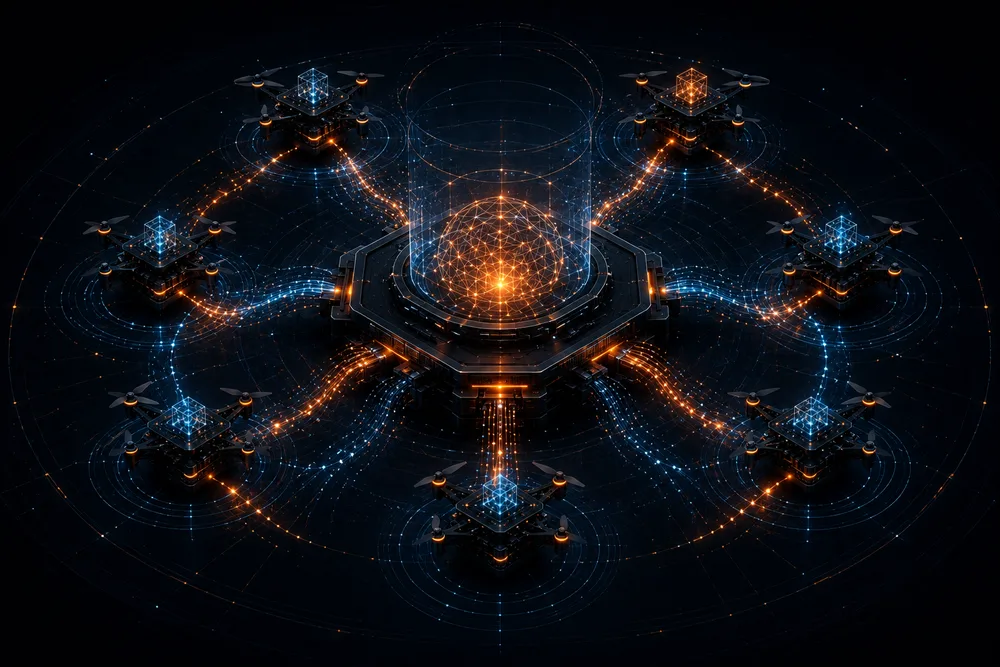
The Swarm-Mother framework introduces a new approach to distributed coordination. Rather than treating Node 0 as a vulnerable single point or a passive gateway, it functions as a unified presence across two distinct network layers. This isn’t simply about running dual client instances on the same machine—it requires a specialized protocol layer that allows a single validator or coordinator to maintain state consistency across two separate network structures.
How Dual-Network Participation Works
Making this functional without causing instability demands careful attention to synchronization. A conventional node adheres to one protocol for validating transactions or messages. Under the Swarm-Mother model, Node 0 operates with a divided logic system:
- Layer A Role: The node engages with the primary swarm, handling high-frequency, low-latency micro-operations. This is where swarm dynamics excel—thousands of rapid, dense interactions occur.
- Layer B Role: Simultaneously, the same node maintains a connection to a broader, more deliberate "mother" network. This layer provides the long-term memory, global state, and finality that the fast-moving swarm cannot achieve on its own.
The core challenge lies in the "State Handshake." When the swarm progresses ahead of the mother network, or when the mother network updates its global state, the swarm may act on outdated information. The solution involves an AI-driven workflow where the node uses a local predictive model to forecast the mother network’s next state. This allows the swarm to maintain its speed while the actual synchronization occurs asynchronously in the background.
Implications for LLM Agents and Decentralized AI
For large-scale deployments of LLM agents, this dual-network approach is essential. Relying on a single global blockchain or database for every decision made by thousands of autonomous agents would create unacceptable congestion and latency.
Instead, agents operate within a localized, high-speed network (Layer A). A Swarm-Mother setup then deploys specific nodes (Node 0) as connectors. These nodes aggregate the swarm’s collective intelligence or transaction history and commit it to the global, high-capacity network (Layer B) in structured batches.
This represents a practical lesson in system design: scaling the global network directly is impractical. The solution lies in scaling smaller networks and building intelligent bridges between them. By enabling Node 0 to participate in both networks, the architecture mimics biological systems—fast, reactive local actions guided by a slower, deliberate global oversight. This forms the foundation for what could be a genuinely scalable decentralized AI infrastructure.
All Replies (3)
Want a live back-and-forth? Join the global AI chat room — login to talk.
Terrifying. Which optimization tools actually fix these sync delays before the swarm crashes? The Swarm-Mother architecture, for instance, reimagines Node 0 as a dual-network bridge, where it simultaneously runs a split logic engine—joining the primary swarm for high-frequency micro-tasks while maintaining a steady link to a wider "mother" network—to preserve state coherence across two distinct topologies. This could help mitigate sync delays by offloading critical coordination tasks between layers.
My mesh setup hit a wall with jitter during handoff. I found that treating the handoff node as a bridge between two network layers—not just a gateway—helped stabilize state coherence, so I now run a split logic engine where the node handles high-frequency micro-tasks on one layer while keeping a steady link to the broader network for global state. Anyone else tried that approach?
Does this setup handle packet fragmentation any differently when crossing the Node 0 boundary? Based on the concept that "Node 0" functions as a specialized protocol layer that lets one validator or coordinator preserve state coherence across two distinct network topologies, perhaps fragmentation handling is adapted. For instance, when traffic moves from Layer A to Layer B via Node 0, it might need to be reassembled or specially tagged to maintain integrity, unlike standard nodes that follow one protocol.