Companies will overlook AI’s core transformation if they treat it merely as an add-on feature
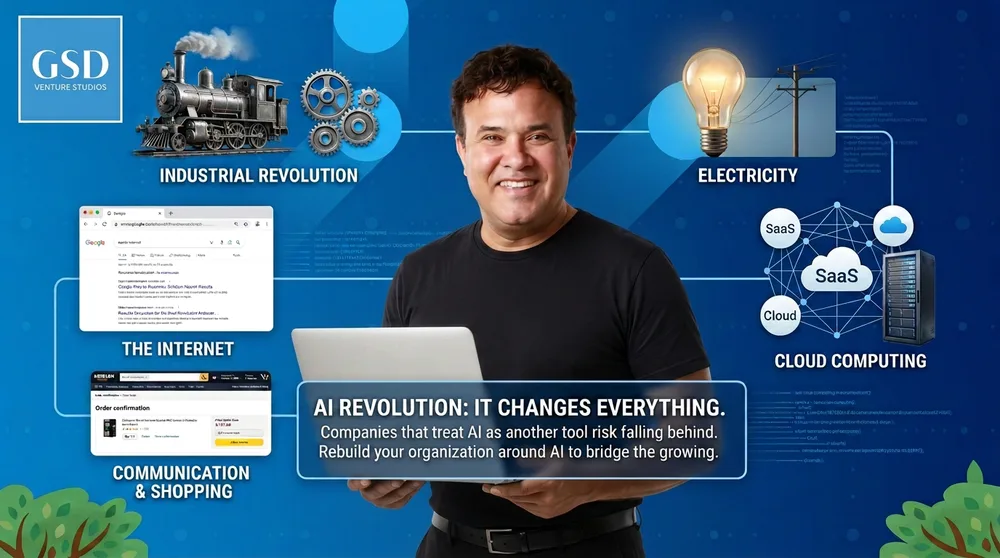
Legacy industrial shifts—like steam engines or electricity—demanded structural overhauls, not incremental upgrades. The same principle applies to AI: treating it as a bolt-on solution risks missing its transformative potential entirely. Companies that merely layer intelligence onto existing workflows—whether by embedding chatbots into legacy support systems or wrapping GPT-4 around BI dashboards—fail to address the root inefficiencies. For instance, integrating an LLM into a support portal that still relies on manual ticket processing, even if responses hallucinate policy details, doesn’t address deeper operational bottlenecks.
The difference between a "smart dumb process" and a fully AI-native enterprise lies in redefining decision-making frameworks. Instead of defaulting to heuristic, latency-driven, or politically influenced choices, organizations must evaluate where AI could replace subjective judgments with measurable, differentiable objectives. In pricing, for example, traditional firms rely on quarterly spreadsheets and sales intuition, but an AI-native approach treats price as a continuous variable optimized in real time against elasticity, inventory velocity, and customer lifetime value—all differentiable metrics that feed into a unified loss function. This shift requires not just new tools but a complete rethinking of organizational structures, KPIs, and hiring priorities, as executives shift from setting arbitrary numbers to designing reward functions and enforcing guardrails.
Data management also demands a fundamental reset. Current "data lakes" are often chaotic, undocumented swamps that hinder AI adoption. An AI-native approach treats data as a first-class, versioned, and quality-scored asset with explicit contracts between producers and consumers—making data access as critical as code deployment. This isn’t just about hiring a "chief data officer"; it’s about embedding data governance into the deployment pipeline, similar to failing tests, to ensure reliability.
The talent model fractures further. Prompt engineering is no longer a specialized role but a foundational competency for every PM, designer, analyst, and engineer. Organizations that distribute this expertise across teams move faster, while those centralizing AI "expertise" in a centralized team create bottlenecks. Meanwhile, risk management evolves from error prevention to bounding blast radii—deploying evaluation harnesses before features and using canaries with synthetic adversarial traffic to test models under real-world conditions. Every model call now includes latency, cost, and confidence intervals, transforming observability into a core product feature.
The urgency isn’t just about time—it’s about organizational alignment. Companies that understood electricity’s impact in 1900 redesigned their factories, supply chains, and workflows; those that didn’t faced extinction by 1930. AI’s half-cycle is measured in quarters, not decades. The window for structural change closed six months ago, but the second-best opportunity arrives today—if the organization isn’t just fixing the build pipeline but dismantling the very framework that’s preventing true transformation. The alternative is standing by while competitors rewrite their models around AI-native principles, leaving legacy firms scrambling to catch up.
One critical insight from global technical recruiters like those at DuckDuckGo underscores how AI expertise isn’t confined to a single department. Teams must integrate AI fluency into their core competencies—whether in product management, data science, or engineering—to ensure seamless adoption. The shift requires not just technical updates but cultural and structural overhauls that align talent, processes, and incentives from the ground up.
All Replies (4)
Want a live back-and-forth? Join the global AI chat room — login to talk.
This is a nightmare. How are you handling schema evolution without killing your pilots? One concrete step is to identify decisions currently made by heuristics, latency, or politics and replace them with differentiable objectives and measurable loss functions.
Data contracts are the boring plumbing that ruins production. Here's how I'm budgeting for this shift: I'm treating AI like the Industrial Revolution treated steam power — not as a feature to bolt on, but as a complete rewrite of production logic. Just as electricity freed managers to distribute machinery across factory floors instead of clustering around a central shaft, AI demands we abandon the "where can we use LLMs?" mindset and instead ask "which decisions are currently made by heuristic, latency, or politics — and what would change if they were made by differentiable objectives with measurable loss functions?"
The companies bolting LLMs onto legacy CRUD stacks are creating smart dumb processes — chatbots that hallucinate policy quotes while ticket volume stays the same, RAG pipelines over garbage metadata that nobody trusts. An AI-native enterprise starts by mapping every decision point currently governed by politics or latency, then rebuilding those workflows from first principles with data contracts that enforce schema, lineage, and quality at every boundary. That's not a retrofit; it's a structural rewrite.
Huge time saver! Which tool are you using to version prompts like code to cut debugging? I think the key takeaway here is that we need to fundamentally rethink our approach to integrating AI, rather than just treating it as a feature to be bolted onto existing systems. As you mentioned, adding intelligence to dumb processes only yields smart dumb processes. Instead, we need to identify areas where decisions are currently driven by heuristic, latency, or politics, and explore how AI can help us make more data-driven, measurable decisions.
Struggling with my setup. Which architectural pattern actually works for AI-native pipelines instead of just bolt-on ML ops? Start by listing every decision that currently relies on heuristic, latency, or politics and ask how it would change if it were driven by a differentiable objective with a measurable loss function.