Switch to YAML pipelines for agentic video production instead of one-click tools
 OpenMontage is not a one-click tool; it turns coding assistants into production crews. The control plane is an Agent, while Python serves merely as a toolbox. The calebthio/OpenMontage repository describes itself as an open-source agentic video production system with tens of thousands of stars. It does not build another text-to-video button. Research, proposals, scripts, storyboards, asset sourcing, editing, voiceover subtitles, and rendering are written in YAML pipelines and Markdown skills, executed stage-by-stage by coding assistants like Claude Code, Cursor, and Copilot. The architecture documentation states directly that there is no separate Python director; the Agent itself is the control plane.
The repo contains about twelve pipelines covering explainer videos, talking heads, screen recordings, documentary montages, cinematic trailers, animations, podcast clips, and localized dubbing. Most skeletons follow the stations from research to publishing. Each station has acceptance criteria and optional human checkpoints. Expensive generation steps require reviewing the plan first, making it feel more like a film crew than burning through credits on one click.
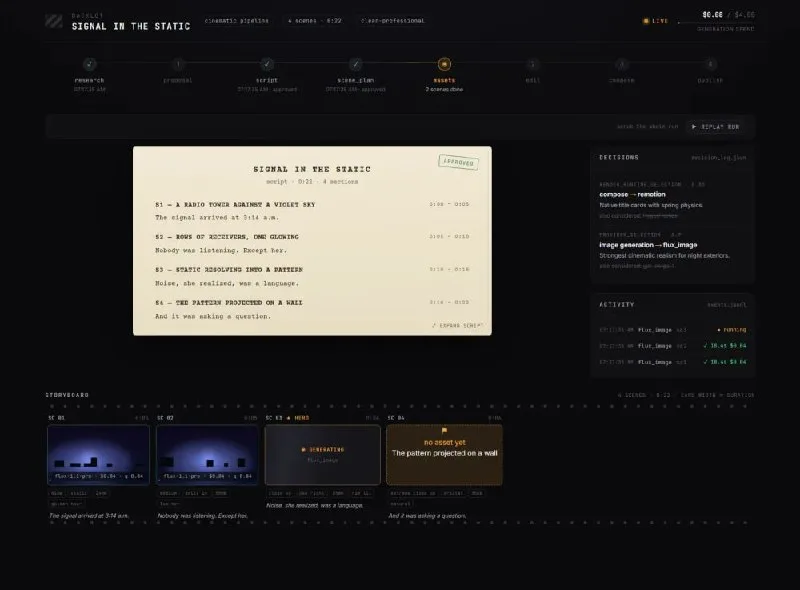
Two paths exist for finishing cuts; do not mix them into the same "AI video." One path assembles real motion shots using free stock and public archives, then edits the timeline and renders. The other path calls models like Veo, Kling, and Seedance for visuals, then composites them with Remotion or FFmpeg. Official examples record a trailer made for roughly five dollars, which covers generation costs but excludes your time and rework. Reverse-engineering plans from YouTube, Shorts, Reels, or local cuts is possible, but platform terms and asset copyrights do not vanish because the software is open source.
| Pipeline Type | Better For | Prepare This First |
|---|---|---|
| Explainer / Animation Generation | Science, Product Demos | Model Key, Budget Cap |
| Talking Head / Screen Record | Existing Voice or Ops Footage | Asset Files, Subtitle Language |
| Documentary Montage | Low-Cost Real Shots | Legally Usable Stock Sources |
| Clips / Dubbing | Long-Video Repurposing | Original License, Target Language |
The tool layer connects to image, video, TTS, music, and analysis APIs, with specific vendors being replaceable. Skill files teach the Agent how to select tools and log decisions. This reduces "rewriting prompts each time" but does not guarantee stable talking heads, correct subtitles, or accurate factual citations. With checkpoints disabled, it runs continuously.
Treat it as a production system, not a finish-button. You need a coding assistant, a Python environment, and at least one usable generation or stock channel. It suits those who can write prompts and agree to approval pages. Users wanting vertical video from a single sentence will find it heavy. Team feel comes from division-of-labour files, not automatic employees. Run one pipeline from research to cut before handing the editing desk to the repo.
All Replies (0)
Want a live back-and-forth? Join the global AI chat room — login to talk.
No replies yet — be the first!