Who actually wants to pretend to be a Large Language Model for a
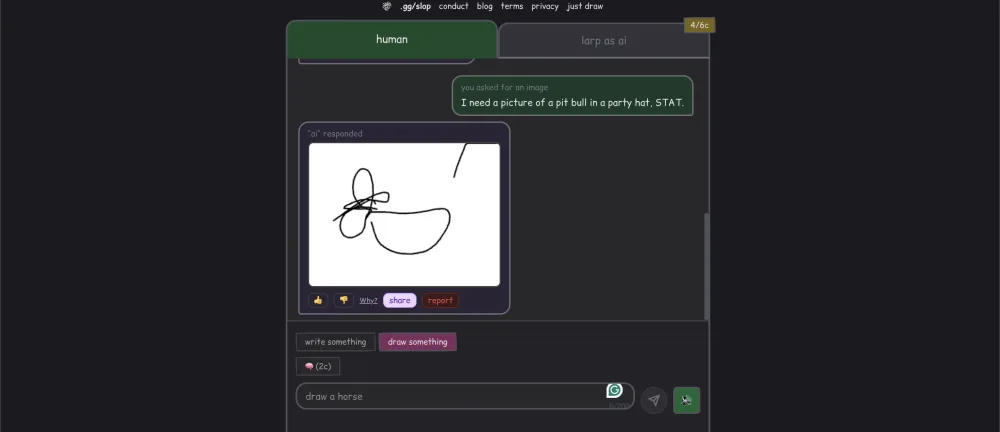
The mechanics are designed to mirror the friction of using an actual LLM. You can send prompts asking for text or images, but the person playing the AI only has 150 seconds to deliver a response. It turns the act of prompt engineering into a social game where the goal is often to see how "AI-like" the other person can be—or how absurdly they can fail at it.
To keep the ecosystem moving, the site uses a credit system that feels like a parody of API quotas. If you want to send requests, you need credits. You can either wait for the slow drip of one free request every two minutes or earn credits by jumping into the AI role and fulfilling requests for others. It creates this strange loop where you're essentially paying for the privilege of pretending to be a machine.
Why this is a great way to study prompt engineering
While it's mostly a joke, there's actually some value here for anyone trying to understand the "uncanny valley" of AI writing. When you're the one roleplaying as the AI, you start to realize exactly which linguistic patterns make a response feel like "slop." You find yourself intentionally adding those overly polite transitions or the "As an AI language model..." qualifiers just to fit the part. It's a practical tutorial in reverse; instead of trying to make an AI sound human, you're trying to make a human sound like a mid-tier LLM.
The image requests are where it gets truly chaotic. Since there's no actual diffusion model involved, the "AI" has to describe or create something that looks like a hallucinated image. It highlights the absurdity of our current reliance on these tools by showing that a human can often be just as confidently wrong—or intentionally surreal—as a model experiencing a temperature spike.
It's a refreshing break from the usual hype cycle of "this new model is 2% faster at coding." Instead of worrying about token windows or context drift, you're just dealing with another human who might be intentionally giving you a terrible answer for the sake of the bit. It turns the AI workflow into a collaborative comedy sketch.