Persistent AI worlds are finally possible with LLM agents
The biggest lie in gaming is the "pause" button. For decades, we've accepted that NPCs are just static scripts waiting for a player to trigger a dialogue tree, and the entire universe freezes the millisecond we hit Alt+F4. But if you integrate an LLM agent into the backend of a game world, you move from a scripted experience to a living simulation where characters have autonomy, memories, and goals that persist regardless of whether a human is watching.
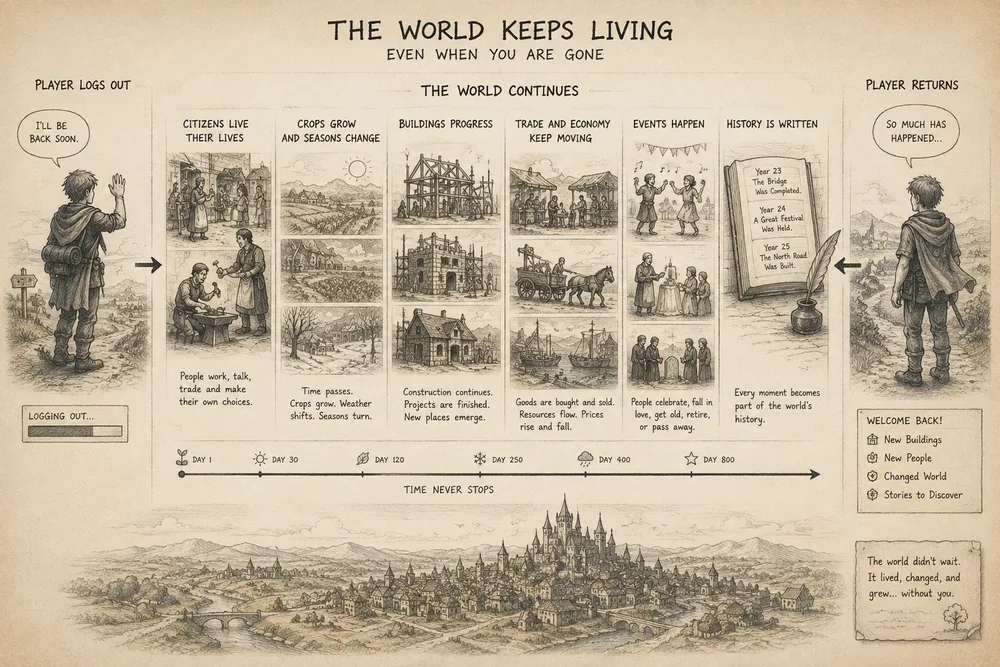
Imagine a town where the blacksmith isn't just standing there waiting to sell you a sword; he's actually managing his inventory, arguing with the local mayor about taxes, and forming grudges with other NPCs based on their interactions. If you log out for a week, you might return to find that the town's political landscape has shifted or a local war has started—not because a developer wrote a quest line, but because the agents' autonomous behaviors led to a logical conflict.
To actually build this kind of persistence, you need a specific AI workflow. You can't just plug in a chatbot; you need a memory architecture that allows agents to store "experiences" as embeddings in a vector database.
Implementing Persistent Agent Memory
If you're trying to build a prototype of this from scratch, here is the basic logic for how an agent "lives" while the player is gone:
1. The Event Loop: Instead of waiting for player input, the server runs a scheduled loop (e.g., every 10 minutes of game time) where agents "reflect" on their current state.
2. Memory Retrieval: The agent queries their long-term memory for relevant past interactions using a vector search.
3. Decision Making: The LLM processes the current environment and memories to decide on an action (e.g., "Go to the tavern to discuss the wheat shortage").
4. State Update: The action is executed in the game world, and the result is written back into the agent's memory as a new experience.
For those looking for a practical tutorial on the prompt side, the "System Prompt" for these agents needs to be incredibly strict about their persona and the current "world clock" to prevent them from hallucinating that the player is present.
agent_config:
  persona: "Grumpy Blacksmith"
  memory_retrieval: "top_k=5"
  autonomous_goal: "Accumulate 500 gold by trading ore"
  interaction_style: "Terse, suspicious of strangers"
  persistence_mode: true
The real challenge here isn't the LLM—it's the compute cost. Running hundreds of agents in a continuous loop is expensive. The next step for this tech is likely "dormancy," where agents only "wake up" and simulate their lives when they are within a certain proximity to another active entity or a player, effectively creating a "bubble" of simulation that feels persistent but saves on API tokens. This is where prompt engineering becomes critical to ensure the "compressed" time they spend in dormancy is summarized accurately when they return to active state.
All Replies (3)
Want a live back-and-forth? Join the global AI chat room — login to talk.
This sounds insane! Which LLM are you using to run your DnD world right now?