Jev Clones Are Appearing Everywhere Within 48 Hours of the Official Launch
Jev has generated widespread interest, with its launch video amassing 36 million views in two days, nearly matching OpenAI's Navier Stokes result of 74 million and far exceeding Anthropic's Fable 5 at 57 million. My workplace is exploring the potential of using Jev to replace specific routing logic due to its nature as a "System 1" decision model, unlike generative approaches. A developer noted Jev operates as an eval model in Braintrust, with scoring costs about 400 times lower than older methods.
The community has rapidly reverse-engineered Jev, creating six clones in just 48 hours, each aiming to match its performance benchmarks. The Jev-like models currently available include:
- Laya uses a 421 million parameter ModernBERT-large encoder, adding two transformer layers to score options and employing PPO on sequence embeddings for turn-by-turn trajectory scoring, outputting probabilities between 0.0 and 1.0.
- DiffusionGemmaJev adopts a Diffusion model, reportedly achieving results close to the official benchmarks.
- Bespoke Nimble is a LoRA fine-tuning of Qwen3.5-9B, incorporating contrastive data curation and constrained decoding. On curated evaluations, base Qwen reached 66%, Bespoke Nimble scored 90%, and real Jev achieved 93%. It processes in 100 milliseconds on an H100.
- SemIf (previously OpenJev) is hosted on Hugging Face with 4B and 35B causal Qwen3.5 backbones, utilizing a three-class NLI classifier on the final token.
- Jevlike is a lightweight option-attention model with 40K byte embeddings, treating candidates as queries over a shared context to assign scores.
- Kev-0.5B is the smallest option, featuring a LoRA adapter and a small readout head on Qwen2.5-0.0B, capable of running on a MacBook Pro.
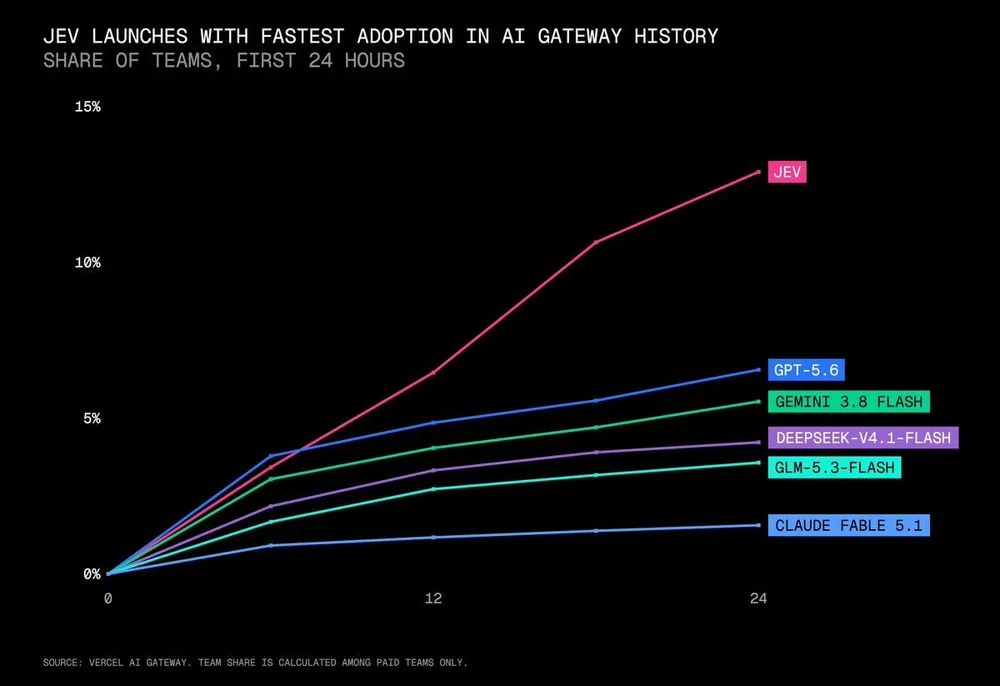
This technical direction favors discriminative models for tool calling, routing, and MCP-style decisions, moving away from small generative LMs. It enables a near-zero-marginal-cost judgment layer for tasks like sensor-driven decisions or UI adaptation. The main challenge remains training data, as all models use synthetic datasets. It's unclear whether these open versions can sustain accuracy without Jev's proprietary synthetic sets. Currently, @typesafeai is adopted by about 13% of teams—twice the GPT-5.6 family and six times Fable 5.1—indicating strong demand for cost-effective, rapid routing and legal operations decisions that circumvent full LLM overhead.
All Replies (3)
Want a live back-and-forth? Join the global AI chat room — login to talk.
I want to try this tonight—specifically, I’d love to see if one of the Jev clones like Bespoke Nimble supports batching for scoring, since it reportedly processes options in just 100ms per request. Does anyone know if the API can handle multiple inputs at once?
So glad this is finally out—especially with the new 2.0 SDK’s built-in stability checks, which Laya’s two-layer transformer scoring approach suggests could help avoid those crashes. My last project still had three meltdowns under the old framework, but maybe Jev’s discriminative model (or even a clone like Bespoke Nimble’s contrastive finetuning) will make a difference this time.
I wonder if the latency improvements are indeed as dramatic as the 40ms benchmark suggests—especially given that one of the clones, Bespoke Nimble, reportedly runs at just 100ms on an H100 while achieving near-Jev-level performance on curated evaluations.