Can HydraFusion actually beat Claude Opus 5 on coding tasks?
The performance numbers from their offline evaluations are actually impressive. On TerminalBench 2.1, HydraFusion reportedly bumped verified task quality up by 4.9 percentage points while slashing estimated costs by 67% compared to using Claude Opus 5 alone. This suggests that the "Critique" and "Cascade" patterns are effectively catching errors that a single high-end model might miss, while using cheaper models for the bulk of the heavy lifting.
How to deploy HydraFusion in your workflow
If you are already using GitHub Copilot, this is currently available as a research preview through the CLI. It is not a standalone API yet, but you can trigger it with these specific steps:

1. Update your CLI to ensure you have the latest build:
/update2. Enable the experimental feature flag:
/experimental on3. Switch the active model to the orchestration layer:
/model
Breaking down the execution patterns
The logic behind the orchestration isn't just random routing; it's based on specific "capability signals" for debugging and code generation. Depending on the complexity of your prompt, it picks one of three paths:
- Single: The standard approach. One model handles the request.
- Cascade: An efficient model drafts the code. If it doesn't clear a predefined quality gate, the system automatically escalates the request to a more powerful model.
- Critique: A drafting model produces a result, then a completely independent model from a different family acts as a read-only critic. If the critic finds issues, the original model gets one chance to revise.
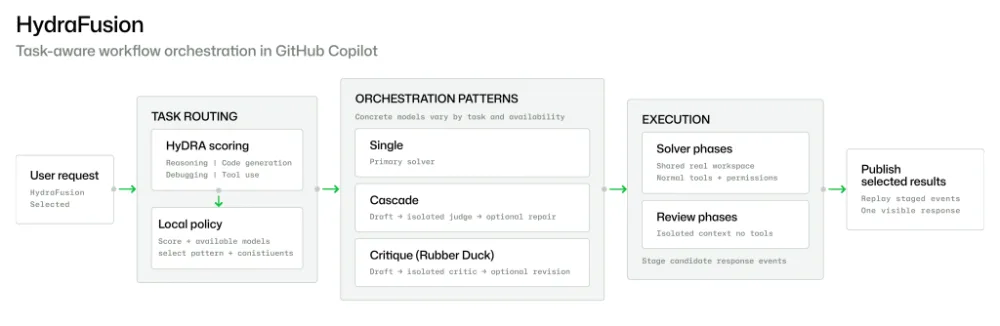

This looks like a practical tutorial in how to build a compound AI system. Instead of relying on one giant model, you use a swarm of specialized ones. The cost is billed at the standard rate of whatever models the orchestrator ends up calling, so you only pay for the "escalation" when the task is actually difficult.
For anyone doing a deep dive into AI workflows, this is a move away from the "one model to rule them all" philosophy. It turns the LLM into a component of a larger system rather than the entire system itself. The real test will be the latency overhead—adding a "critique" step naturally slows down the response time—but if the quality jump is real, it is a fair trade for complex engineering tasks.