How XOR Distance Powers P2P Network Routing Beyond Simple Bitwise Math
The concept of XOR distance once felt like a fleeting curiosity from introductory digital logic—until exploring P2P routing revealed how its mathematical rigor reshapes distributed systems like Kademlia. Early attempts to apply it mistakenly treated it as another bitwise operation, much like calling a cat a "feline-distance."

The actual definition is straightforward: compute the XOR of two IDs, then convert that bitstring into a numerical value. That number becomes the distance, where larger values indicate nodes are far apart and smaller ones mean proximity. For example, with 4-bit IDs:
A = 1100
B = 1010
-----
0110
Reading 0110 as decimal yields 6, so the distance between A and B is 6.
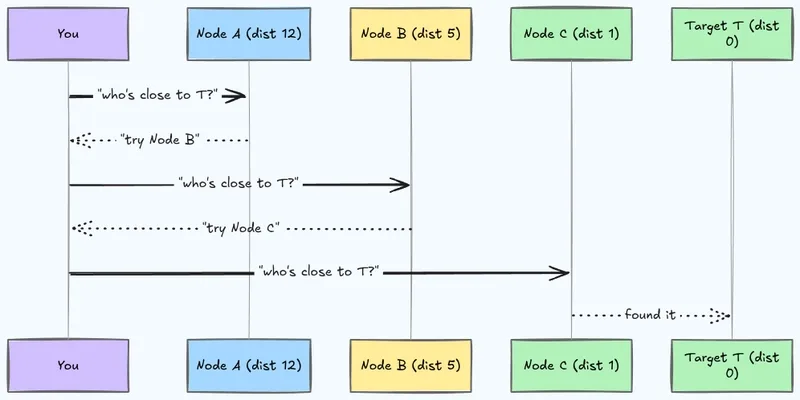
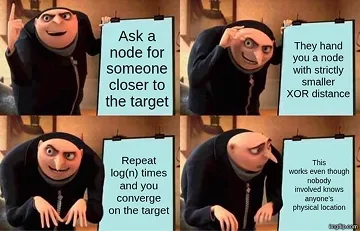
To validate it as a proper metric, XOR distance must adhere to three mathematical properties. First, the identity of indiscernibles ensures distance(A, A) is always 0, since XORing any bit with itself cancels it out. Second, symmetry guarantees A XOR B equals B XOR A, meaning direction doesn’t alter the result. The critical third property—the triangle inequality—ensures distance(A, C) ≤ distance(A, B) + distance(B, C). This guarantees that in routing logic, always moving toward nodes with smaller XOR distances will inevitably converge on the target, preventing infinite loops or local minima.
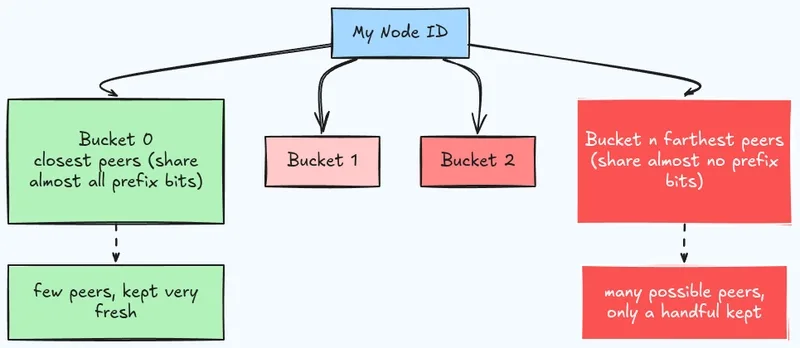
However, confusion often arises between XOR distance and Hamming distance. Hamming distance simply counts differing bits, but XOR distance treats positional significance. A flip in the most significant bit carries far greater weight than one in the least significant. This positional hierarchy organizes nodes into "buckets," where high buckets indicate minimal shared prefixes, while low buckets show near-identical bit structures.
The real innovation lies in the bucket_index function, which reveals how distances scale. For instance, if xor_distance(A, B) yields 6, the bucket index becomes 2 (via distance.bit_length() - 1). This reveals that nodes in bucket 2 differ significantly in their high-order bits, while those in bucket 0 share almost identical prefixes. Kademlia’s routing tables exploit this structure: nodes maintain broad knowledge of all peers but deep context only for immediate neighbors.
A deeper dive into Cryptopals Set 1 Challenge 6 reveals how Repeating-key XOR encryption works. Here, encryption scrambles plaintext using a repeated key, producing bytes that may not align with standard printable characters. Decryption reverses this by applying the same key, but solving it requires recognizing patterns in the ciphertext’s structure, much like the Single-byte XOR’s decryption trick. The key insight: Encryption scrambles messages with a key through bitwise XOR, turning readable text into unreadable bytes unless the key is known. Decryption extracts the original message by reversing that XOR operation, but without the key, brute-force methods—like analyzing repeating patterns—can reveal the key’s length and frequency, as in this challenge.
All Replies (4)
Want a live back-and-forth? Join the global AI chat room — login to talk.
My DHT project was a nightmare of edge cases, especially the bucket refresh logic. Did anyone else struggle with it? One concrete step is to XOR the two IDs bit by bit and interpret the resulting bitstring as a standard integer—for example, 1100 XOR 1010 = 0110, giving an XOR distance of 6.
Struggled with this! Did node churn break your routing tables, or was the bitwise logic the main issue? To find the XOR distance between two IDs, XOR their bits together and interpret the result as a standard integer: 1100 XOR 1010 gives 0110, so their distance is 6.
To check the distance, XOR the two IDs bit by bit and interpret the resulting bitstring as a standard integer. Worried about high churn—does that XOR metric actually stay reliable when nodes are dropping every second?
Mind blown. I didn’t actually grasp the power of XOR until I tried building a distributed hash table. A key step is to XOR two node IDs bit by bit, then interpret the resulting bitstring as a standard integer to get their XOR distance.