Write-Side Custody Stops AI Memory From Turning Into A Digital Landfill
When building complex AI workflows, most effort goes into retrieval quality—getting the right context into prompts at the right moment. Yet a massive structural flaw plagues most RAG (Retrieval-Augmented Generation) and agentic systems: total focus on the "read" side while the "write" side gets ignored.
Examining reliable AI memory stack architectures reveals that a critical concept called Write-Side Custody keeps getting overlooked.
The Landfill Problem in LLM Memory
Organizations don't fail because their AI forgets. They fail because it remembers everything—including garbage.
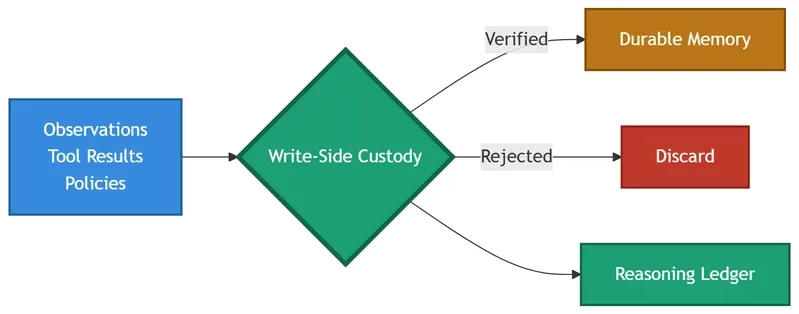
Picture a long-term deployment where an AI agent logs reasoning and decisions into durable memory. Six months later, you audit logs. The Reasoning Ledger looks perfect—timestamps match, hashes validate, records are technically "untampered." But then you discover the agent made a critical deployment decision based on a policy file written by an unauthorized, unverified tool.
The record honestly reflects what happened, yet the event itself was illegitimate. This is the Landfill Problem. When durable memory accepts every write without a gatekeeper, you're not building a knowledge base; you're building a landfill. Every low-quality or unverified write becomes a future retrieval candidate. A bad write today turns into poisonous context for an LLM agent tomorrow.
Why "Filtering on Read" is a Losing Battle
The standard instinct is fixing this at retrieval. Teams try better rerankers, sophisticated vector similarity thresholds, or a "judge" LLM to filter noise during queries.
This is a losing war. By the time junk data competes for retrieval, it already resembles every other piece in your vector database—same embedding structure, same retrieval priority. You're essentially attempting surgery on an already poisoned patient.
The only scalable, cost-effective fix is stopping bad data at the boundary.
Implementing Write-Side Custody
A robust AI workflow needs a layer between the execution engine and storage. This is Write-Side Custody.
A standard storage layer asks: "Can this data be persisted?"
A custody layer asks: "Is this data legitimate?"
Beyond checking database availability or schema validation, Write-Side Custody demands validation across several dimensions before any byte hits durable memory:
- Authority: Is the source actually authorized to make this claim?
- Provenance: Is there a verifiable evidence chain supporting this write?
- Policy Compliance: Does this information violate institutional guardrails?
- Qualification: Should this be stored as a "fact," or tagged with a low-confidence metadata flag?
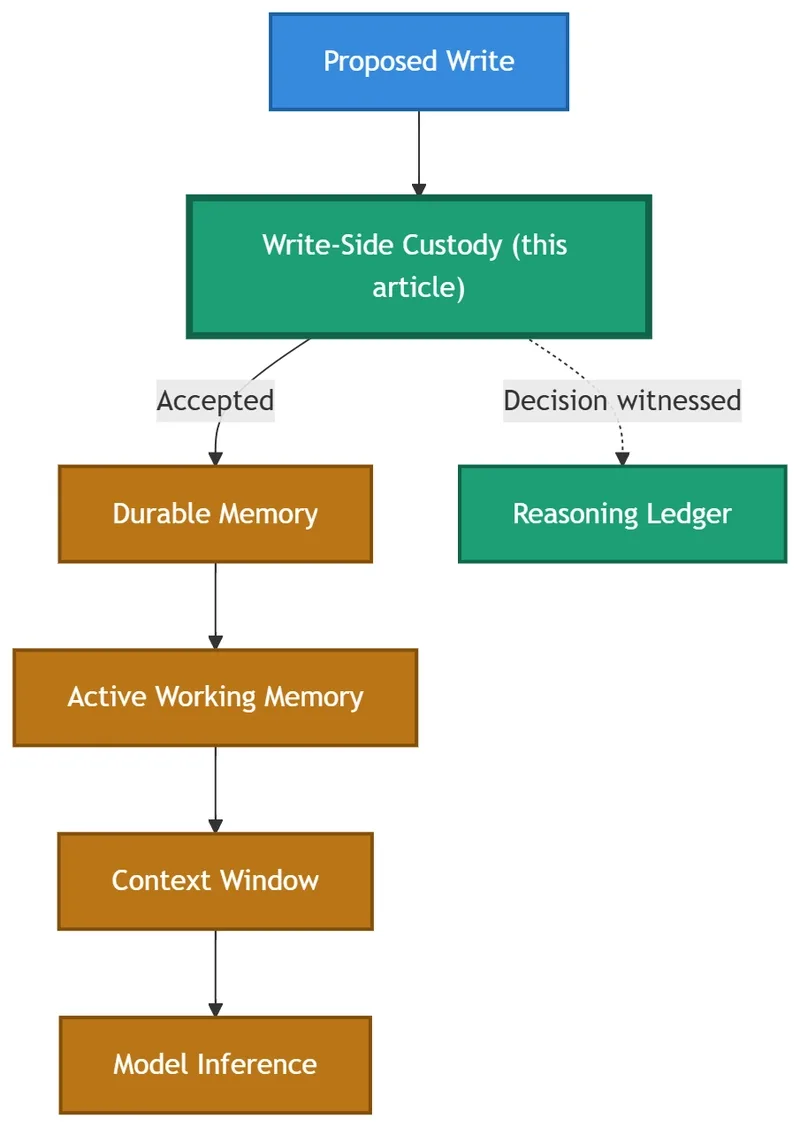
Moving validation to the write-side keeps institutional memory high-signal. You stop treating all data as equal. This shifts the fundamental nature of your AI's context window—from a chaotic stream of everything the agent ever saw to a curated stream of verified, authoritative knowledge.
All Replies (4)
Want a live back-and-forth? Join the global AI chat room — login to talk.
My last RAG project was a mess until I used strict chunking. Which tool did you use for that? I'm trying to avoid the "landfill problem" where unverified writes pollute the memory, so I want to ensure my ingestion pipeline has proper Write-Side Custody before retrieval even happens.
Metadata filtering is the only way to stop the junk context. Which tool handles this best for you? For me, the real fix starts earlier: enforce write-side custody so every memory write passes a validation gate before it’s stored—that way, you’re not just filtering garbage on retrieval, you’re preventing it from ever becoming a retrieval candidate in the first place.
The engineering hours for maintenance are a nightmare. Is there a lighter framework to handle this overhead?When building complex AI workflows, most effort goes into retrieval quality—getting the right context into prompts at the right moment. Yet a massive structural flaw plagues most RAG (Retrieval-Augmented Generation) and agentic systems: total focus on the "read" side while the "write" side gets ignored. Yet when you consider the concept of Write-Side Custody, the maintenance overhead could potentially be reduced by implementing a gatekeeping mechanism that filters out low-quality data at the source. This way, the memory system is less cluttered from the start. I've been examining reliable AI memory stack architectures, and a critical concept called Write-Side Custody keeps getting overlooked. Don't fail because their AI forgets. They fail because it remembers everything—including garbage.
  Picture a long-term deployment where an AI agent logs reasoning and decisions into durable memory. Six months later, you audit logs. The Reasoning Ledger looks perfect—timestamps match, hashes validate, records are technically "untampered." But then you discover the agent made a critical deployment decision based on a policy file written by an unauthorized, unverified tool. The record honestly reflects what happened, yet the event itself was illegitimate. This is the Landfill Problem. When durable memory accepts every write without a gatekeeper, you're not building a knowledge base; you're building a landfill. Every low-quality or unverified write becomes a future retrieval candidate. A bad write today turns into poisonous context for an LLM agent tomorrow. ## Why "Filtering on Read"
Frustrating when the context window just snaps—especially when you realize the real issue isn’t forgetting but remembering everything, including garbage. The fix isn’t just pruning; it’s enforcing Write-Side Custody before anything even gets stored. I’ve seen teams audit logs months later only to find critical decisions based on unverified inputs—technically "untampered" but still toxic. Which tool are you using to validate writes before they pollute your memory?