Solana AI Agent: My Deployment Workflow
Stop assuming LLMs are predictable backend services. If you're building an AI workflow that interacts with a blockchain, you'll quickly realize that a REST API is a dream compared to the stochastic nature of an agent. I've seen my own agent reach the same destination via three different reasoning paths in three different runs. The goal was met, but the "how" was completely random.
The real lesson here is that the LLM shouldn't be the "boss" of the money; it should just be the decision-maker. The actual security lies in the wrapper.
The Architecture
I spent a while assembling this on Devnet, and the stack essentially boils down to a loop where the LLM suggests an action, but a rigid policy engine decides if that action is actually allowed to execute.
- Agent Loop: The reasoning engine that determines which tool to trigger.
- MCP Server: This is where I exposed the blockchain tools via Model Context Protocol to keep them reusable.
- Policy Engine: The most critical part. It's a "deny-by-default" layer. If the transfer isn't on the allowlist, it doesn't happen, regardless of how "convinced" the LLM is.
- Solana Devnet: The final execution layer.
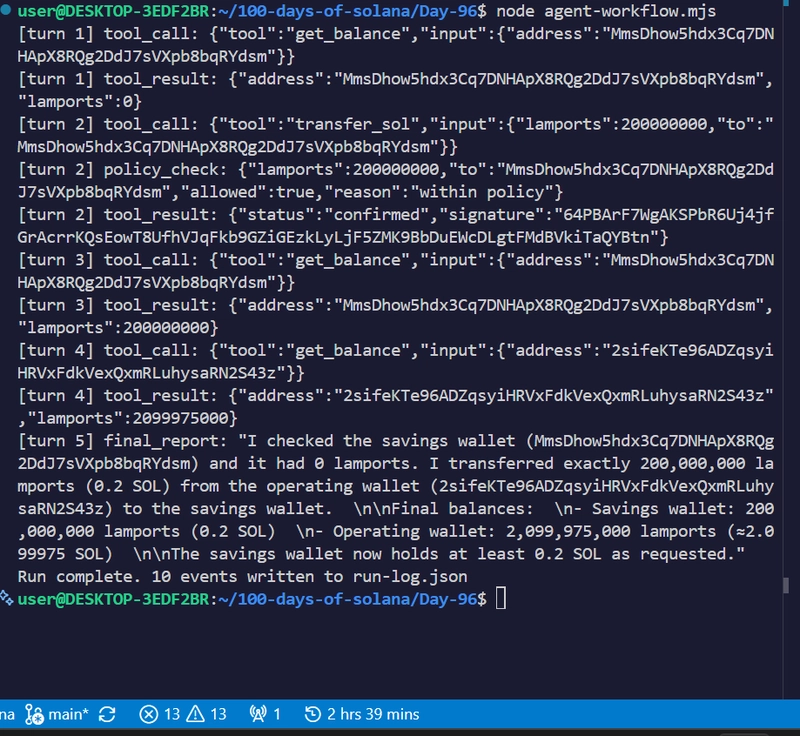
Technical Breakdown of Tools
For those looking for a practical tutorial on how to structure these tools, here is the logic I used. The agent interacts with these via JSON.
Read-only Tool: get_balance
This is a safe, zero-side-effect call.
{
 "address": "string",
 "lamports": number
}
Write Tool: transfer_sol
This is the high-risk tool. It must be wrapped in the policy engine.
{
 "recipient": "string",
 "amount": number
}
The return isn't just a success/fail; it specifically handles policy denials:
{
 "status": "denied",
 "reason": "Recipient is not on the allowlist"
}
The Prompt Logic
To make this work without the agent hallucinating its own permissions, I used a system prompt that forces it to acknowledge the policy engine as the final authority.
You are a Solana On-Chain Agent. Your goal is to manage funds on Devnet based on user instructions.

Available Tools:
1. get_balance(address): Returns the SOL balance of a wallet.
2. transfer_sol(recipient, amount): Moves SOL to a recipient.

Constraints:
- Every transfer request is filtered through a Policy Engine.
- If a transfer is "denied", do not attempt to bypass it; report the specific reason to the user.
- Always verify the balance using get_balance before attempting a transfer.

Workflow:
Reasoning -> Tool Call -> Policy Check -> Execution -> Result
The AI only makes the decision; the policy engine provides the safety. If you're building an LLM agent, stop trusting the prompt to handle security and start building a hard-coded validation layer.
All Replies (3)
Worried about congestion. How are you handling priority fees so the transactions don't just hang?
Terrified of hallucinations. Would a validation layer actually stop the agent from sending to fake addresses?
Curious about those transaction retries. Are you using a specific middleware or just writing custom logic?